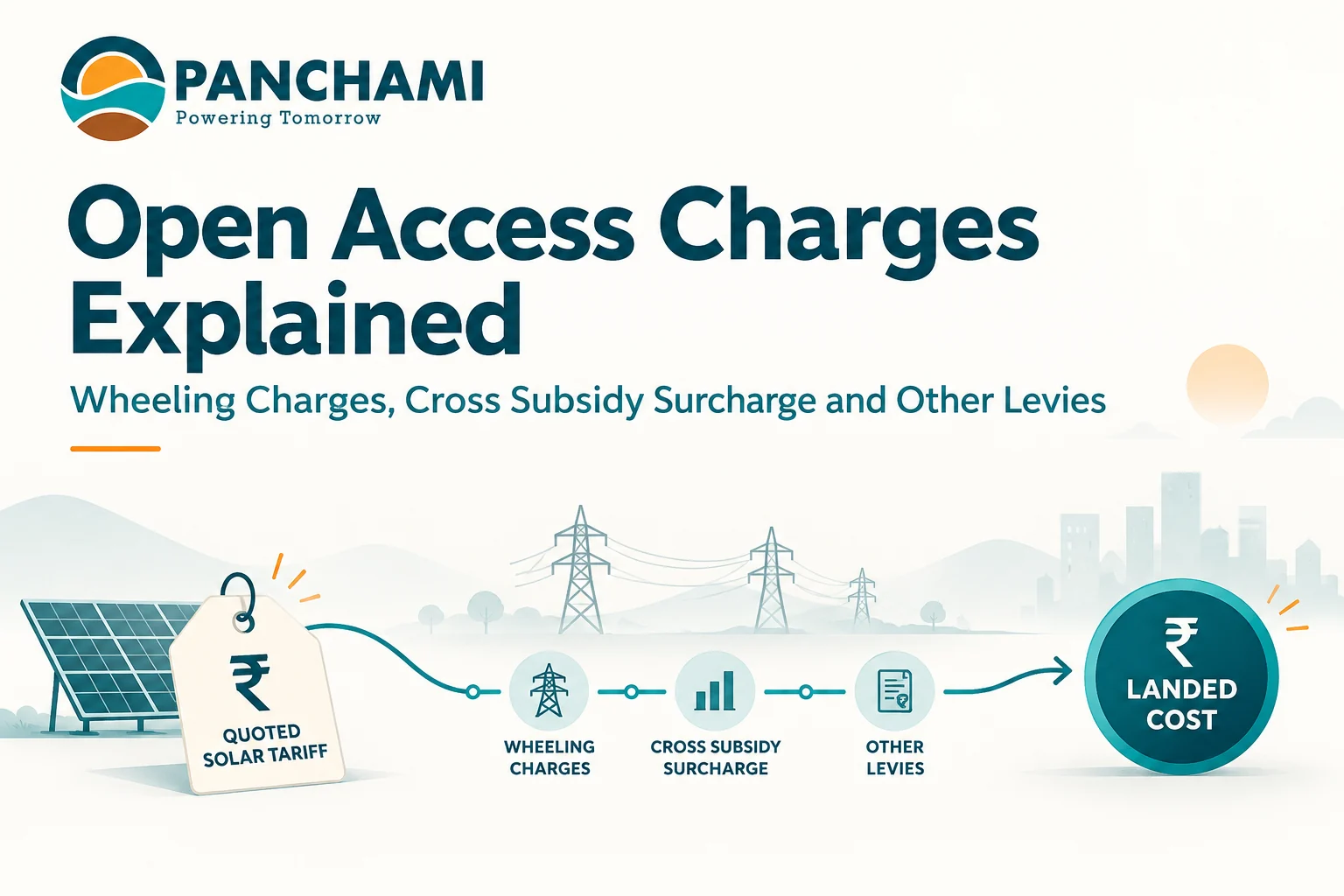
A solar developer offers your factory power at ₹3.50 per unit. Your ESCOM charges ₹7. It looks like you will halve your power bill. Then the first open access bill arrives, and the saving is far smaller than you expected.
The gap almost always comes from open access charges: wheeling charges, cross subsidy surcharge, transmission charges, losses and a few smaller fees. This guide explains the meaning of each one, how they are calculated, which ones apply to your model, and how to check them before you sign.
- Wheeling charges are the fee for moving electricity over a distribution network you do not own.
- Cross subsidy surcharge compensates the DISCOM for revenue it loses when a business buys power elsewhere.
- Captive and group captive users do not pay cross subsidy surcharge. Third-party buyers usually do.
- Always compare the landed cost per unit, not the solar tariff alone.
Wheeling Charges Meaning
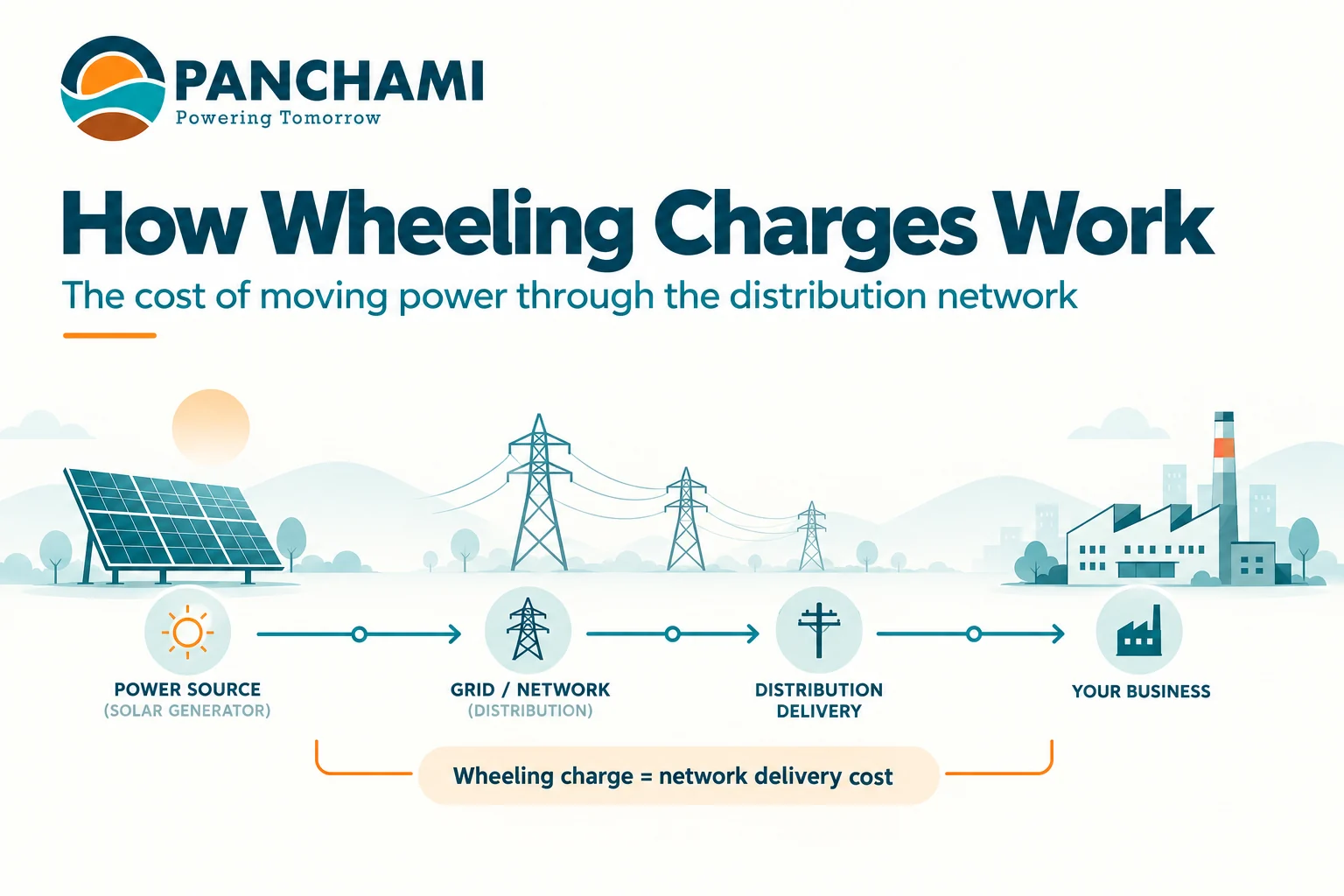
Wheeling charges are the fee a consumer or generator pays to a distribution company for carrying electricity over its local network of wires, substations and transformers. "Wheeling" simply means moving power over someone else's system. The state regulator sets the rate, usually in rupees or paise per unit.
Think of it as a courier fee. The solar tariff is the price of the product. The wheeling charge is what you pay to have it delivered to your door over roads that belong to someone else.
Wheeling charges are different from transmission charges. Transmission charges pay for the high-voltage lines that carry power across long distances. Wheeling charges pay for the lower-voltage distribution network that brings it to your premises. Many open access users pay both.
Why Wheeling Charges Appear on Some Household Electricity Bills
If you live in Maharashtra, you may see a separate "wheeling charge" line on your MSEDCL bill even though you have never used open access. That is because Maharashtra shows the cost of using the distribution network as its own per-unit line. Most other states fold this cost into the energy charge, so it does not appear separately. In both cases, the total you pay for network use is part of your tariff.
For businesses using open access, wheeling charges work differently. You pay them specifically for the units your supplier sends through the network to you.
How Wheeling Charges Are Calculated
Wheeling charges are usually billed per unit of energy carried over the distribution network. Three factors decide how much you pay.
- The approved rate. The state regulator fixes it in its tariff order. In Karnataka, KERC's Open Access Regulations, 2025 say wheeling charges are set through tariff orders issued from time to time.
- The units wheeled. Charges apply to the energy carried over the network, after accounting for losses along the way.
- Your voltage level. Consumers connected at higher voltages use less of the local network, so charges and losses depend on where your connection sits.
| Step | Units |
|---|---|
| Units injected by the solar plant | 100 |
| Transmission charges apply on | 100 |
| Transmission losses deducted (say 3%) | 97 remain |
| Wheeling charges apply on | 97 |
| Distribution losses deducted (say 5%) | About 92 reach your meter |
The loss deductions matter as much as the charge itself. Every unit lost is a unit you paid the solar tariff for but cannot use.
Solar Wheeling Charges: What Is Different for Renewable Power
Solar wheeling charges are simply wheeling charges applied to solar power moved through open access. For years, states used concessions on these charges to attract solar investment.
Karnataka is a good example. KERC had exempted solar plants commissioned between 1 April 2013 and 31 March 2018, and selling power within the state through open access, from wheeling charges, banking charges and cross subsidy surcharge for 10 years from commissioning. Those exemptions run out by 2028 at the latest, and newer projects pay charges set in current tariff orders.
For projects that use the inter-state network, another concession is ending. Solar and wind projects commissioned after 30 June 2025 now pay inter-state transmission charges in stages, starting at 25% of the charges for projects commissioned by 30 June 2026 and reaching full charges for projects commissioned after 1 July 2028. Most Karnataka businesses buying from plants within the state are not affected by this, but it matters if your supplier's plant is in another state.
Pro tip: If a proposal mentions a charge waiver, ask for the order number and the end date in writing. Concessions that end mid-contract can wipe out years of expected savings.
Cross Subsidy Surcharge Explained
In India, industrial and commercial consumers pay tariffs above the actual cost of supplying them, so that farmers and households can pay less. That extra money is the cross subsidy. When a business leaves its DISCOM for open access, the DISCOM loses that contribution.
The cross subsidy surcharge (CSS) makes up part of that loss. It is paid per unit by open access consumers to the DISCOM, under Section 42(2) of the Electricity Act, 2003.
How CSS Is Calculated
KERC's 2025 regulations follow the national tariff policy formula:
CSS = T - [C / (1 - L/100) + D + R]
- T is the tariff your consumer category pays.
- C is the DISCOM's average power purchase cost.
- L is the total losses at your voltage level, in percent.
- D is the transmission, distribution and wheeling charges at your voltage level.
- R is the cost of carrying regulatory assets.
In plain words, CSS is roughly the difference between what your category pays and what it actually costs to supply you. The higher your tariff sits above cost, the higher your CSS. The tariff policy also says CSS should be brought down to no more than 20% of the tariff of the consumer's category.
Who Does Not Pay CSS
The Electricity Act, 2003 exempts power carried through open access from a person's own captive plant to where they use it. That is why captive and group captive structures are so common in open access solar.
CSS in Karnataka Is Set to Change
KERC notified the Roadmap for Reducing Cross-Subsidy and Cross-Subsidy Surcharge Regulations, 2026 in March 2026. Businesses signing long contracts should therefore model future CSS changes rather than assuming today's surcharge remains constant for the entire term.
Other Open Access Charges You Should Know
Wheeling charges and CSS get the most attention, but they are not the only costs. Under KERC's Open Access Regulations, 2025, consumers may also face the charges below.
| Charge | What it pays for | Who usually pays |
|---|---|---|
| Transmission charges | Use of high-voltage transmission lines | Most open access users |
| Additional surcharge | DISCOM's fixed costs for power it had contracted to supply you | Third-party buyers, where applicable |
| Standby charges | Backup supply from the DISCOM when your supplier's plant is down | Users who need backup |
| Banking charges | Storing surplus renewable units to use later, usually paid in units | Solar users with surplus midday power |
| Losses | Energy lost in transmission and distribution, deducted in units | All open access users |
| Scheduling and load despatch fees | Planning and managing power flows on the grid | All open access users |
| Deviation settlement charges | Differences between scheduled and actual power | Users whose actual flows differ from schedule |
| Meter reading and transaction charges | Metering and monthly administration | All open access users |
Banking terms deserve special attention for solar. In June 2026, KERC released draft regulations proposing monthly renewable energy banking until 31 March 2030 with an 8% banking charge. A higher banking charge means fewer of your midday solar units count against your evening consumption.
Which Charges Apply to Your Open Access Model
Your ownership structure decides which charges apply, and that has a bigger effect on savings than almost anything else.
| Charge | Captive | Group Captive | Third Party |
|---|---|---|---|
| Transmission charges | Yes | Yes | Yes |
| Wheeling charges | Yes | Yes | Yes |
| Losses | Yes | Yes | Yes |
| Banking charges | If banking is used | If banking is used | If banking is used |
| Cross subsidy surcharge | No, if captive rules are met | No, if captive rules are met | Yes |
| Additional surcharge | No, if captive rules are met | No, if captive rules are met | Usually yes, where applicable |
A captive power plant avoids the two surcharges because you own it and use its power yourself. A group captive power plant gives the same relief to several smaller businesses that share ownership, as long as they meet the ownership and consumption rules every year.
Worked Example: How Charges Change Your Landed Cost
The example below uses round numbers to show how the same solar tariff can produce very different results. These figures are for illustration only and are not current Karnataka rates.
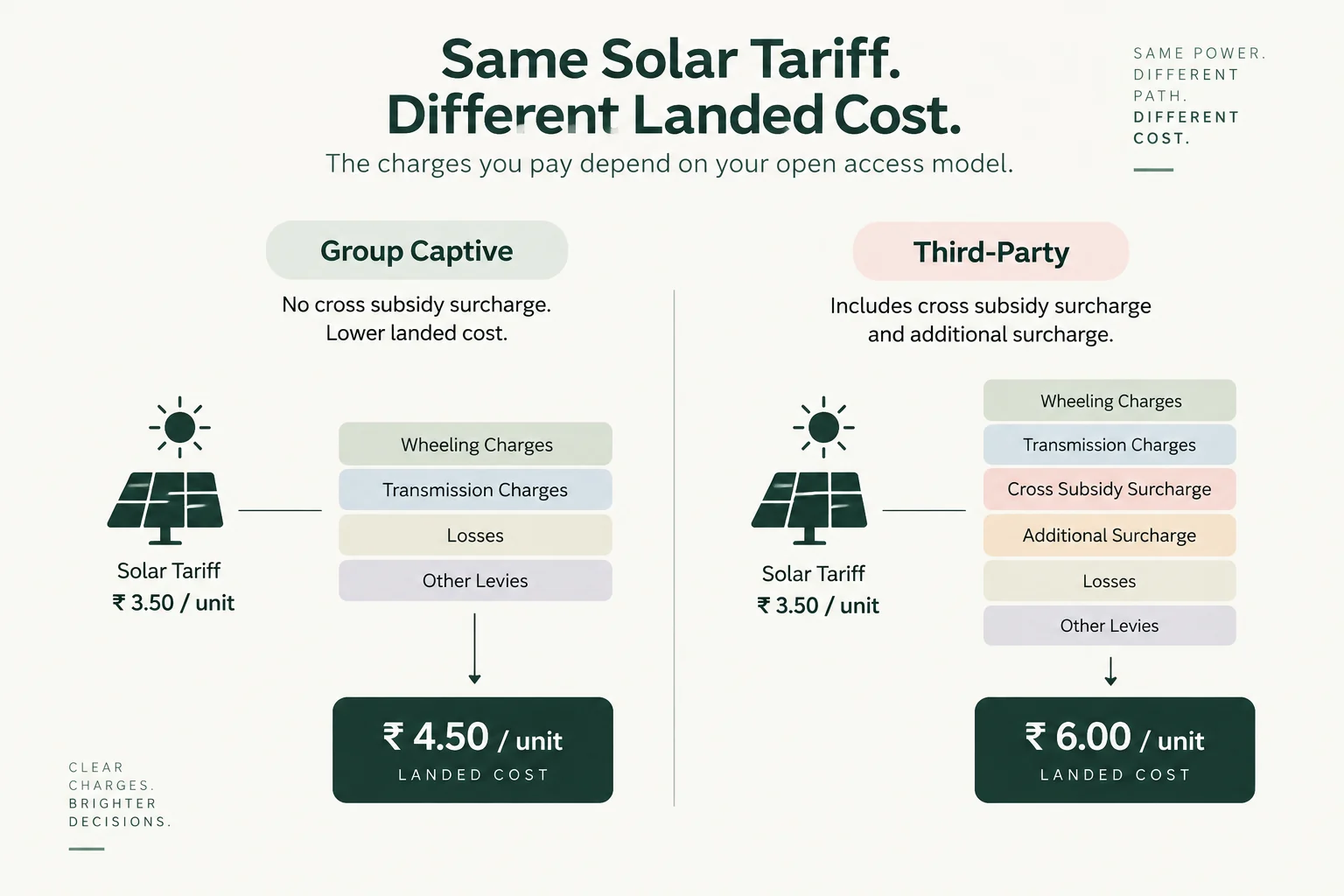
| Cost per unit | Group Captive | Third Party |
|---|---|---|
| Solar tariff | ₹3.50 | ₹3.50 |
| Transmission and wheeling charges | ₹0.60 | ₹0.60 |
| Cost of losses | ₹0.25 | ₹0.25 |
| Banking charges and grid fees | ₹0.15 | ₹0.15 |
| Cross subsidy surcharge | ₹0.00 | ₹1.20 |
| Additional surcharge | ₹0.00 | ₹0.30 |
| Landed cost | ₹4.50 | ₹6.00 |
| ESCOM tariff | ₹7.00 | ₹7.00 |
| Saving per unit | ₹2.50 | ₹1.00 |
For a business using 2,00,000 solar units a month, that difference is ₹5,00,000 a month under group captive against ₹2,00,000 under third party. Same sunshine, same tariff, very different outcome.
How to Check Charges Before You Sign
Before committing to any of your open access solar projects, run through this list:
- Get the current tariff order. Ask for the KERC tariff order and charge schedule that applies this year, not an old summary.
- Confirm your voltage level. Charges and losses differ between HT and EHT connections.
- Confirm surcharge applicability. Ask in writing whether CSS and additional surcharge apply to your model.
- Check banking terms. Find out the banking period, the banking charge and what happens to unused units.
- Ask for landed cost per unit. Request it for year one and for later years, with assumptions stated.
- Protect yourself from rule changes. Include a change-in-law clause that explains who bears new or higher charges.
Frequently Asked Questions
What is the meaning of wheeling charges?
Wheeling charges are the fee paid to a distribution company for carrying electricity over its local network of wires and substations. They are set by the state electricity regulator, usually per unit. For open access consumers, they are part of the cost of delivering power from a supplier's plant to their premises.
Why do wheeling charges appear in my electricity bill?
Some DISCOMs, such as MSEDCL in Maharashtra, show the cost of using the distribution network as a separate per-unit line called the wheeling charge. Most other states include this cost within the energy charge. It is part of your regular tariff even if you do not use open access.
What are solar wheeling charges?
Solar wheeling charges are the wheeling charges applied when solar power is carried over the distribution network through open access. Some states offered concessions for older solar projects, but most new projects now pay the rates set in current tariff orders, along with losses and banking charges.
What is cross subsidy surcharge in open access?
Cross subsidy surcharge is a per-unit charge that open access consumers pay to their DISCOM. It compensates the DISCOM for the extra revenue it earned from high-tariff industrial and commercial consumers, which it uses to keep tariffs lower for households and farmers.
Do captive and group captive users pay cross subsidy surcharge?
No. Under the Electricity Act, 2003, cross subsidy surcharge does not apply to power carried through open access from a person's own captive plant. Group captive users get the same exemption if they meet the ownership and consumption rules. They still pay wheeling and transmission charges.
How is landed cost calculated for open access solar?
Landed cost is the solar tariff plus transmission charges, wheeling charges, the cost of losses, banking charges, grid fees and any surcharges that apply to your model. Comparing landed cost per unit with your DISCOM tariff shows your real saving.
Who sets wheeling charges in Karnataka?
The Karnataka Electricity Regulatory Commission sets wheeling charges through its tariff orders. Its Open Access Regulations, 2025 state that wheeling charges, cross subsidy surcharge, additional surcharge and banking charges are decided by the Commission from time to time.
Conclusion
Wheeling charges, cross subsidy surcharge and the other open access charges are the difference between a solar tariff that looks good and a saving that actually shows up on your bill. The charges you pay depend on your state, your voltage level and, above all, your ownership model.
Before you sign, ask for the landed cost per unit, the tariff order behind it, and a clear answer on which surcharges apply.
Your next step: Share your last 12 months of electricity bills with Panchami Global. We will map every charge that applies to your connection under KERC's current orders and compare landed cost across captive, group captive and third-party options.
Check your actual landed cost
Share your electricity bills with Panchami Global to compare captive, group captive and third-party open access costs under the current Karnataka framework.