If electricity is one of your largest monthly costs, someone has probably told you to "go solar." For a factory, warehouse or hotel, that advice often runs into a wall. The roof is too small, too shaded, or not strong enough to carry the panels you would need. Open access solar removes that limit. It lets your business buy solar power from a plant built somewhere else and receive it through the existing grid, often at a lower cost per unit than your ESCOM tariff.
This guide explains what open access solar is, how the power reaches your meter, which businesses qualify, which charges decide your real savings, and how the rules work in Karnataka in 2026.
- Open access solar means buying solar power from an offsite plant and receiving it through the grid.
- Most commercial and industrial consumers with 100 kW or more of contract demand can apply.
- Your real saving depends on the grid charges you pay on top of the solar tariff.
- Karnataka holds the largest share of India's installed open access solar capacity.
What Is Open Access Solar?
Open access solar is an arrangement where a business buys electricity from a solar power plant located away from its premises, and the power is delivered through the state transmission and distribution network. The business pays for the solar energy and pays grid charges for using the network, instead of buying all its power from the local DISCOM.
In Karnataka, DISCOMs are called ESCOMs, so you will see both terms used for the same thing.
The legal right behind this comes from the Electricity Act, 2003, which allowed eligible consumers to use the grid to buy power from a supplier of their choice. If you want the background on how that right works for every power source, not only solar, read our guide on open access in the power sector.
Open access solar is really two pieces working together:
- A solar plant, usually built on land in an area with good sunshine and a nearby substation. It can be owned by a developer, by you, or by a group of consumers.
- A permission from the regulator and your ESCOM to move that power over the grid and credit it to your meter.
How Open Access Solar Works
Every open access solar power plant follows the same path from sunlight to your electricity bill.
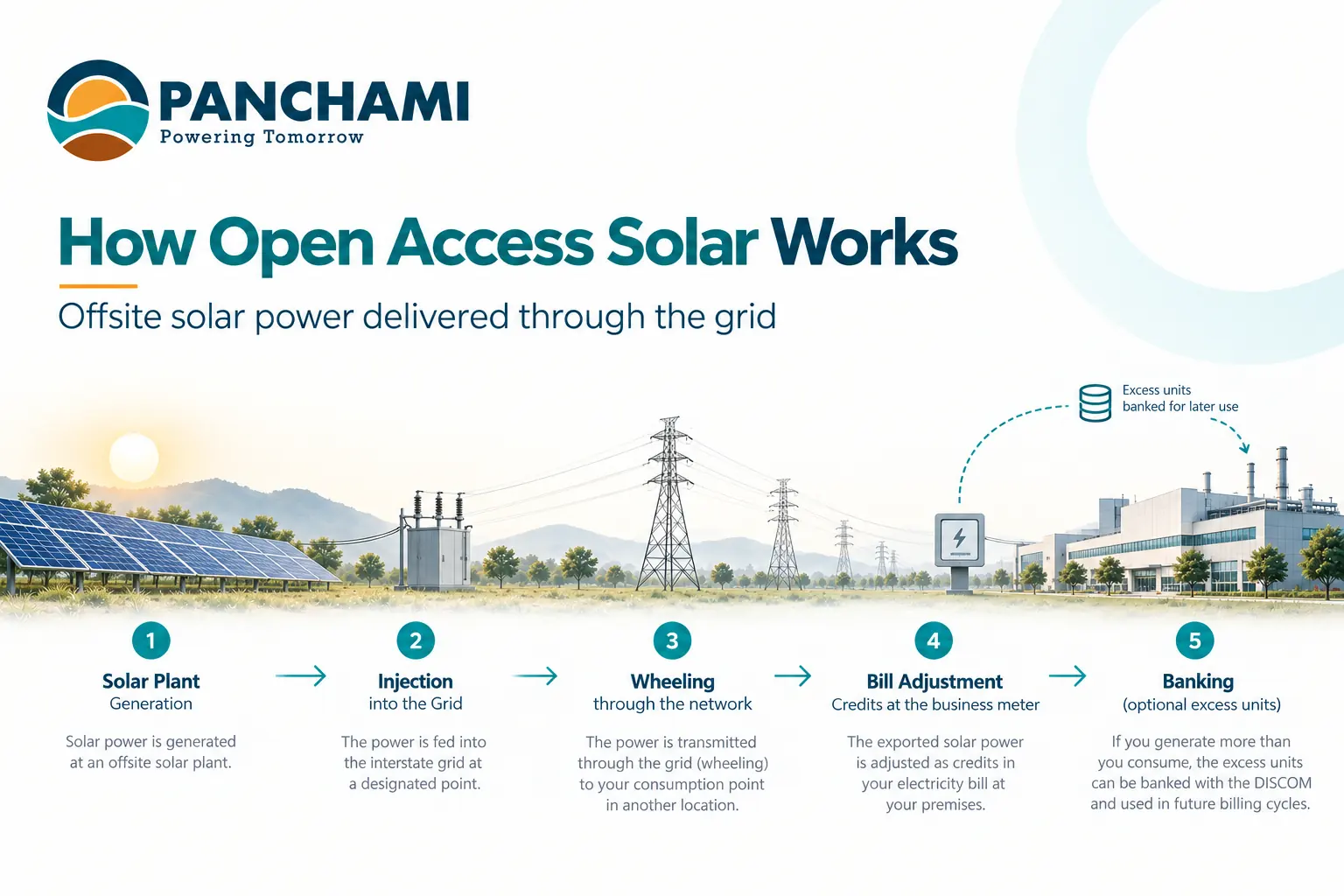
- Generation. A solar plant, from a few hundred kilowatts to many megawatts in size, produces electricity on land away from your site.
- Injection into the grid. The plant feeds power into the nearest substation. A special meter records the energy it injects in 15-minute blocks.
- Wheeling. The power travels over the transmission and distribution network. You pay for this through transmission and wheeling charges, and a small share of the energy is deducted as losses.
- Adjustment on your bill. Your ESCOM sets off the solar units against the units you consumed in the same time slots. You pay the ESCOM only for the balance you still draw from the grid.
- Banking. Solar plants produce most of their power around midday. If your site uses less at that hour, the extra units can be banked with the utility and used later, in return for a banking charge set by the regulator.
Physically, the electricity you use still comes from the common grid. What changes is the accounting. Every solar unit your plant injects is credited to your account.
Types of Open Access Solar Models
There are three main ways to structure open access solar projects. The right one depends on how much capital you want to commit and how much control you want over the plant.
Captive Open Access
You own the plant, directly or through a company you control, and use its power yourself. Captive users get the most relief on grid surcharges. Under Rule 3 of the Electricity Rules, 2005, a plant counts as captive when its users hold at least 26% of the ownership and consume at least 51% of the electricity it generates each year.
This model suits businesses with capital to invest and steady, high consumption. Our guide to the captive solar power plant model explains the ownership rules, costs and compliance in detail.
Group Captive Open Access
A developer builds a larger plant through a special purpose vehicle (SPV). Several businesses each buy a small equity stake in that company and together meet the captive ownership and consumption tests. This gives mid-sized companies captive benefits without funding an entire plant.
The catch is discipline. If members fall short of the consumption rules in a year, they can lose captive status and face surcharges. Read how a group captive solar power plant is structured and what each member has to track.
Third-Party Open Access
You own nothing. A developer builds and runs the plant and sells you power at an agreed tariff for a long period. You invest nothing upfront, but you pay cross subsidy surcharge and additional surcharge where they apply, which narrows the saving.
The contract carries most of the risk in this model. Before you sign, understand how a power purchase agreement for solar works, including tenure, tariff escalation, minimum offtake and exit clauses. Panchami's legal advisory services can support agreement review.
| Factor | Captive | Group Captive | Third Party |
|---|---|---|---|
| Who owns the plant | You (26% to 100%) | Several consumers hold equity in an SPV | Developer owns 100% |
| Upfront investment | High | Low to moderate | None |
| Cross subsidy surcharge | Not applicable if captive tests are met | Not applicable if captive tests are met | Payable |
| Additional surcharge | Not applicable if captive tests are met | Not applicable if captive tests are met | Payable |
| Best fit | Large users with capital to invest | Mid-sized commercial and industrial users | Businesses that want zero capex |
| Main risk | Capital locked in one asset | Losing captive status | Higher landed cost due to surcharges |
Open Access Solar vs Rooftop Solar
Rooftop solar and open access solar are not rivals. They solve different problems, and many businesses use both.
| Factor | Rooftop Solar | Open Access Solar |
|---|---|---|
| Where the plant sits | On your roof or premises | Offsite, connected through the grid |
| What limits the size | Roof area and sanctioned load | Your demand, regulations and banking rules |
| Grid charges | Usually none | Transmission, wheeling and other charges |
| Share of an energy-heavy site's power | Usually small | Can cover a much larger share |
| Approvals | Net metering or gross metering with your ESCOM | Open access approval, plus wheeling and banking arrangements |
A common setup is rooftop solar for part of the daytime load, with open access solar covering most of the rest.
Who Is Eligible for Open Access Solar in India?
For years, eligibility was the biggest barrier. Open access under the Electricity Act, 2003 was generally limited to consumers with 1 MW or more of demand, which kept most small and mid-sized businesses out.
That changed in June 2022. The Ministry of Power's Green Energy Open Access Rules 2022 cut the threshold for green power from 1 MW to 100 kW. The rules also required applications to be decided within 15 days, failing which they are treated as approved, as announced in the Ministry of Power's official press release. Consumers can reach 100 kW through one connection or several connections in the same area, and captive consumers have no minimum limit.
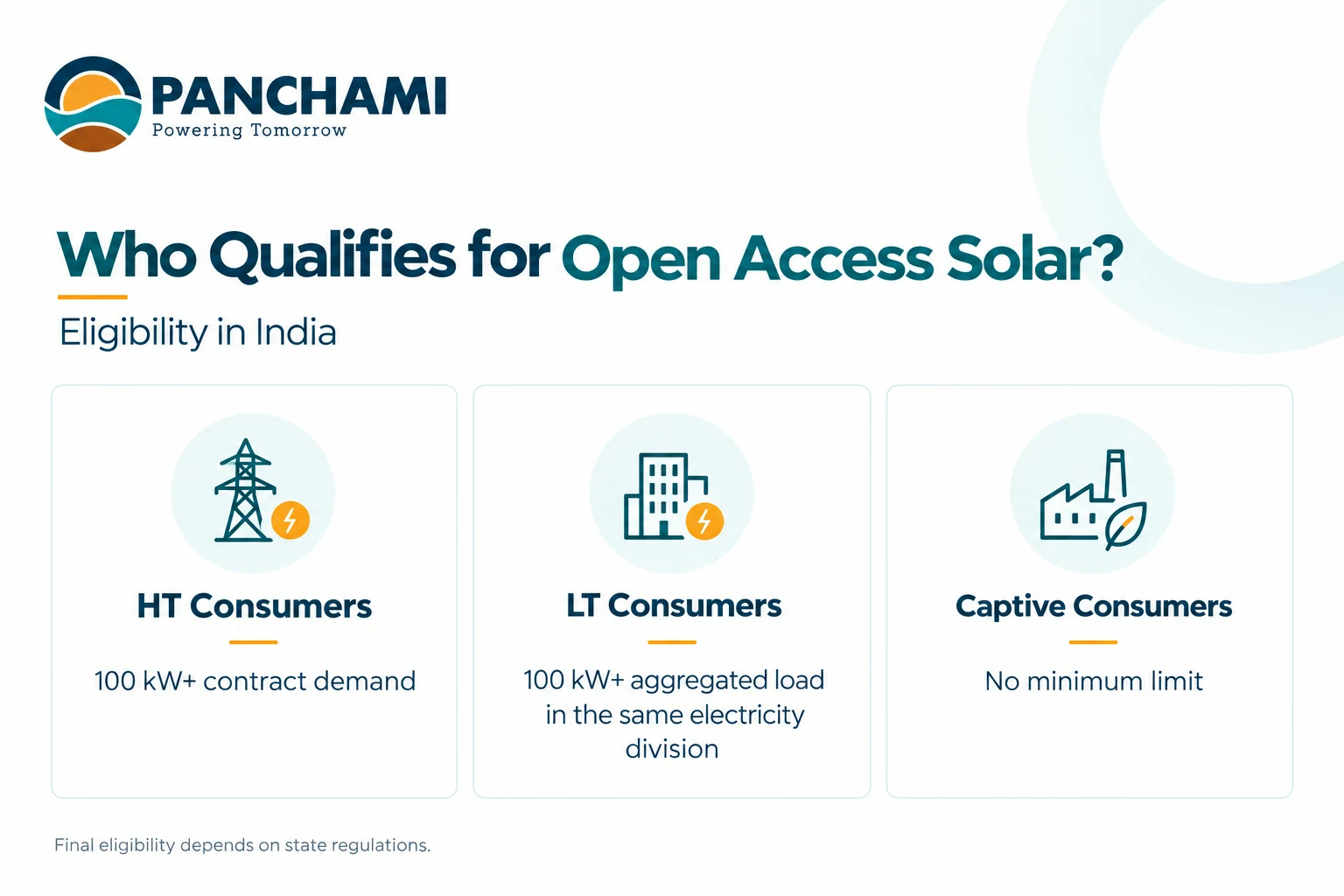
You are likely to be eligible if:
- You have an HT connection with a contract demand of 100 kW or more, or
- Your LT connections in the same electricity division add up to 100 kW or more, or
- You are setting up or joining a captive solar plant.
States have not applied these rules evenly. A December 2024 analysis by IEEFA found that almost every state had adopted green open access, but some, including Tamil Nadu, Karnataka and Uttar Pradesh, did not follow the central 100 kW threshold at the time. The rules of your own state regulator are what finally apply to you.
Open Access Solar in Karnataka: The 2026 Picture
Karnataka is India's biggest market for open access solar. According to Mercom India's Q2 2026 report, India's cumulative installed solar open access capacity reached 36 GW by June 2026, and Karnataka held the largest share at 21%. Karnataka also led new installations in calendar year 2025, with 24.5% of that year's additions.
The rules in the state have changed a great deal since 2022. Here is where things stand:
- Central rules struck down in Karnataka. The Karnataka High Court struck down the central Green Energy Open Access Rules 2022 and KERC's own 2022 green open access regulations, and directed KERC to frame fresh regulations.
- New KERC regulations in 2025. KERC then notified the Terms and Conditions for Open Access Regulations, 2025. These set eligibility at 100 kW of contract demand for HT consumers, and 100 kW of sanctioned load for LT consumers through one or more connections in the same electricity division. Captive projects are also eligible.
- 15-day decisions. Applications go through the State Nodal Agency portal and must be decided within 15 working days, or they are deemed approved.
- Monthly banking and smart meters. Monthly banking is allowed. Open access users must install special energy meters or smart meters that record usage in 15-minute blocks.
- More changes ahead. In June 2026, KERC released draft regulations for open access and general network access. The draft proposes monthly renewable energy banking until 31 March 2030, with an 8% banking charge.
Whether your supply comes from BESCOM, CESC, MESCOM, HESCOM or GESCOM, the same KERC regulations apply. You can read the orders and regulations on the KERC website.
Because these rules are still moving, ask for a current charge sheet for your ESCOM and project type before comparing offers. That number decides whether a proposal holds up.
Open Access Charges That Decide Your Savings
The solar tariff on a proposal is not what you finally pay. Your real cost, called the landed cost, is the solar tariff plus every grid charge and loss that applies to your model.
Under KERC's 2025 regulations, open access consumers in Karnataka may pay:
- Transmission charges
- Wheeling charges
- Cross subsidy surcharge, where applicable
- Additional surcharge, where applicable
- Banking charges, paid in units, where applicable
- Standby charges, where applicable
- Losses, paid in units
- Other fees, such as scheduling, meter reading and load despatch charges
For most businesses, the largest recurring items are wheeling charges and, for third-party buyers, cross subsidy surcharge. Captive and group captive users who meet the ownership and consumption tests avoid the surcharges, which is why those models usually land at a lower cost.
Illustrative example (these numbers only show how the calculation works; they are not a quote):
| Item | Value |
|---|---|
| Current ESCOM tariff | ₹7.00 per unit |
| Landed open access solar cost (tariff plus charges and losses) | ₹4.50 per unit |
| Saving per unit | ₹2.50 |
| Solar units supplied per month | 2,00,000 |
| Monthly saving | ₹5,00,000 |
| Annual saving | ₹60,00,000 |
Your actual figures depend on your tariff category, model, ESCOM, plant location and the charges in force when you sign. Be careful with any proposal that shows only the solar tariff and leaves out the landed cost.
Benefits and Challenges of Open Access Solar Projects
Benefits
- Lower power cost. For energy-heavy users, the gap between the ESCOM tariff and the landed cost of solar is where the savings come from.
- Long-term price certainty. A captive plant or long-term agreement fixes a large part of your power cost for years. Mercom India noted in 2026 that even as savings narrow, many consumers still value this predictability.
- No dependence on roof space. The plant sits elsewhere, so roof size and shading stop being limits.
- Proof of green energy use. Buyers, lenders and export customers increasingly ask suppliers about renewable energy use. Open access solar gives you metered units you can report. Businesses that cannot switch yet sometimes buy a renewable energy certificate instead, which proves green energy use without a physical power supply.
Challenges and How to Handle Them
| Challenge | How to handle it |
|---|---|
| Rules and charges keep changing | Include a change-in-law clause and model your savings with higher charges |
| Solar hours do not match your usage | Size the plant to daytime load and check banking terms before signing |
| Grid connectivity and transmission delays | Prefer developers with land near substations that have spare capacity |
| Losing captive status | Track ownership and consumption against the 26% and 51% tests every year |
| Long lock-in periods | Read termination, exit and assignment clauses closely |
How to Start an Open Access Solar Project
Here is the sequence most businesses follow.
- Collect 12 months of electricity bills, plus time-of-day load data if your meter records it.
- Check eligibility against the 100 kW threshold for your connection type and division.
- Choose a model (captive, group captive or third party) based on your capital and appetite for risk.
- Compare landed cost, not just the tariff, across at least two or three structures.
- Sign the agreements. This means a power purchase or shareholder agreement with the developer, plus the wheeling and banking arrangements with your ESCOM.
- Apply through the State Nodal Agency, install the required meters, and start receiving credits once the plant is commissioned.
The timeline from signing to first power depends mostly on land, grid connectivity and approvals, so ask every developer for a realistic schedule in writing.
Frequently Asked Questions
What is open access solar in simple words?
Open access solar means your business buys solar electricity from a plant located elsewhere, and the power reaches you through the public grid. You pay for the solar energy and pay grid charges for delivery, instead of buying all your electricity from the DISCOM. It suits sites whose roofs cannot hold a large solar system.
Who can apply for open access solar in India?
Under the Green Energy Open Access Rules 2022, consumers with 100 kW or more of contract demand or sanctioned load can apply, including by combining connections in the same area. Captive consumers have no minimum limit. States apply these rules through their own regulations, so the final eligibility depends on your state regulator.
Is open access solar available in Karnataka?
Yes. Karnataka has the largest installed open access solar capacity in India. Under KERC's Open Access Regulations, 2025, HT consumers with 100 kW of contract demand and LT consumers with 100 kW of aggregated load in one electricity division can apply through the State Nodal Agency.
How much can a business save with open access solar?
Savings depend on the gap between your DISCOM tariff and the landed cost of solar after every charge and loss. Captive and group captive users usually save more because they avoid surcharges that third-party buyers pay. Always compare landed cost per unit rather than the headline solar tariff.
What is the difference between captive and third-party open access?
In captive open access, you or a group of consumers own at least 26% of the plant and use at least 51% of its power, which removes cross subsidy surcharge and additional surcharge. In third-party open access, a developer owns the plant and sells you power, and those surcharges apply.
Do I need to invest money upfront for open access solar?
Not always. Third-party open access needs no upfront investment. Group captive needs a small equity investment in the company that owns the plant. Captive needs the most capital but usually gives the lowest long-term cost per unit.
What is banking in open access solar?
Banking lets your business store extra solar units with the utility when the plant produces more than you use, and draw those units later. Regulators allow banking within fixed periods, such as a month, and deduct a share of the banked energy as a banking charge.
How long does open access approval take?
Both the central Green Energy Open Access Rules and KERC's 2025 regulations set a 15-day window to decide an application, after which it is deemed approved. Building the plant and securing grid connectivity takes longer than the approval itself.
Conclusion
Open access solar lets businesses use solar power at a scale their roofs could never support. The idea is simple. The savings sit in the details: the model you choose, the charges that apply to it, and how closely the plant's output matches your load. In Karnataka, where the rules have changed more than once since 2022, those details matter even more.
Your next step: Share your last 12 months of electricity bills with Panchami Global. We will check your eligibility, compare captive, group captive and third-party options, and show you the landed cost per unit before you commit to anything.
Check your Open Access Solar eligibility
Share your latest electricity bills with Panchami Global to compare captive, group captive and third-party options and estimate your landed cost per unit.