For most businesses in India, buying electricity has meant one thing: pay whatever your DISCOM charges. Open access electricity changes that. It gives eligible consumers the legal right to buy power from a supplier of their choice and use the public grid to receive it, much like a truck uses a toll road it does not own.
This right has existed since the Electricity Act, 2003, yet many factory owners and finance heads still find it confusing. This guide explains what open access in the power sector means, which parts of the law create it, the charges attached to it, and who can use it today.
- Open access is the right to use transmission and distribution networks to buy power from someone other than your DISCOM.
- It comes from the Electricity Act, 2003, mainly Sections 2(47), 9 and 42.
- Users pay network charges and, in many cases, surcharges to the DISCOM.
- It is the route through which businesses buy offsite solar power.
What Is Open Access in the Power Sector?
Open access in the power sector is the right of an eligible consumer, generator or licensee to use the transmission and distribution network without discrimination, so power can move from a seller of their choice to their premises. The network owner cannot refuse fair use, but it can collect charges fixed by the regulator.
The Electricity Act, 2003 defines open access in Section 2(47) as the non-discriminatory use of transmission lines, distribution systems and related facilities by any licensee, consumer or generator, following the rules set by the regulator.
Think of the grid as a national highway. Before open access, only the state utility's trucks could use it, so you had to buy from that utility. Open access lets other trucks use the same highway. You still pay the toll, but you choose who loads the truck.
Open Access Under the Electricity Act 2003
Before 2003, electricity in most states was run by State Electricity Boards that generated, transmitted and sold power. Consumers had no real choice of supplier. The Electricity Act, 2003 replaced older laws and set out to bring competition into generation and supply. Open access was one of its main tools.
These are the sections that matter most for businesses:
| Section | What it does |
|---|---|
| Section 2(47) | Defines open access as non-discriminatory use of transmission and distribution networks. |
| Section 9 | Allows anyone to build a captive power plant and gives captive users the right to open access to carry that power to where they use it. |
| Sections 38, 39 and 40 | Require transmission utilities and licensees to give non-discriminatory open access to their networks. |
| Section 42(2) | Directs state regulators to introduce open access in distribution in phases, with a cross subsidy surcharge where applicable. |
| Section 42(4) | Allows an additional surcharge to cover the DISCOM's fixed costs linked to its duty to supply. |
| Section 49 | Lets consumers allowed open access agree terms, including price, directly with any supplier. |
The Act did not switch open access on overnight. It asked each State Electricity Regulatory Commission (SERC) to introduce it in phases. A later amendment required states to provide open access by January 2009 to consumers needing more than 1 MW of power, according to the Forum of Regulators' position paper on open access.
That 1 MW line became the practical cut-off for years. It is also why open access was long seen as something only large industries could use.
How Open Access Electricity Works in Practice
Every open access electricity transaction involves a few parties, even if you only deal with one of them directly.
- The seller. A generator, a power trader, a power exchange, or your own captive plant.
- The transmission utility. It carries power over high-voltage lines. In Karnataka, this is KPTCL.
- The distribution company. Your DISCOM or ESCOM, which delivers the power over local lines and bills the charges.
- The load despatch centre. It schedules how much power flows and when, so the grid stays balanced.
- The regulator. The SERC for transactions within a state, and the Central Electricity Regulatory Commission (CERC) for transactions across states.
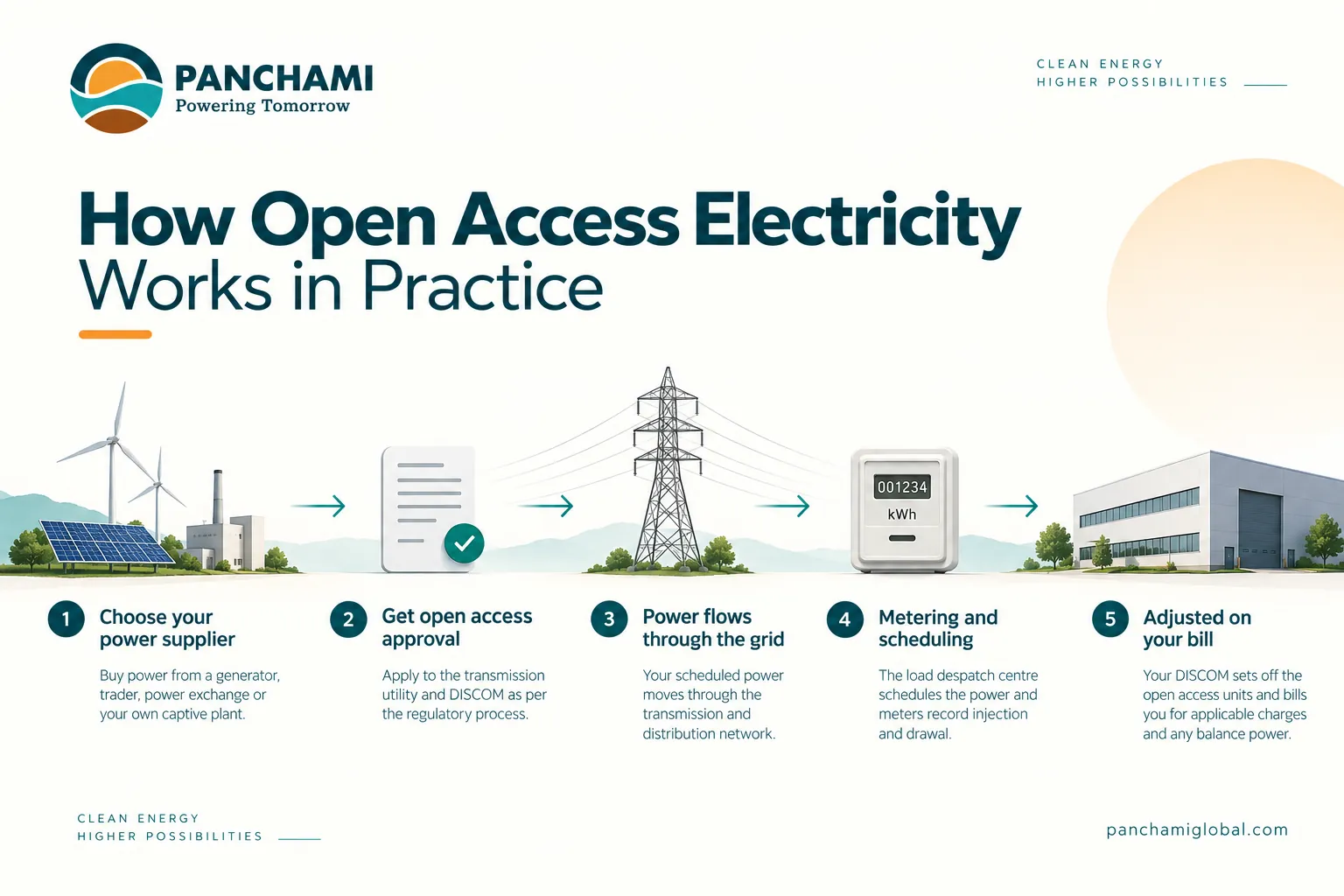
A typical transaction runs in five steps:
- You sign a supply agreement with the seller.
- You apply for open access approval through the state nodal agency.
- The load despatch centre schedules the power, usually in 15-minute blocks.
- Special meters record what the seller injects and what you draw.
- Your DISCOM bills you for network charges, surcharges and any power you still take from it.
Types of Open Access
Open access electricity is grouped in three ways: by the network used, by how long you use it, and by where the power comes from.
By Network: Inter-State and Intra-State
- Intra-state open access uses the network inside one state. The SERC sets the rules, which in Karnataka means KERC.
- Inter-state open access uses the inter-state transmission system. CERC sets the rules. Its General Network Access (GNA) Regulations, 2022 replaced the older long-term access and medium-term open access framework for inter-state transmission.
By Duration: Long, Medium and Short Term
States classify open access by how long a consumer reserves the network. Karnataka, for example, treats open access for five years or more as long-term, with separate medium-term and short-term categories for shorter periods. Long-term users usually get more certainty about network capacity. Short-term users get flexibility but face more scheduling risk.
By Source of Power
| Source | How it works | Typical user |
|---|---|---|
| Captive | You own the plant, fully or partly, and use its power. | Large industries with steady demand. |
| Third-party bilateral | You buy from an independent generator under a long-term contract. | Businesses wanting a fixed price without owning a plant. |
| Power exchange | You buy power in markets run by exchanges, often a day ahead. | Consumers comfortable with changing prices. |
Open Access Charges and Surcharges
Open access electricity is not free power. You pay to use networks you do not own, and you may pay the DISCOM for revenue it loses when you leave.
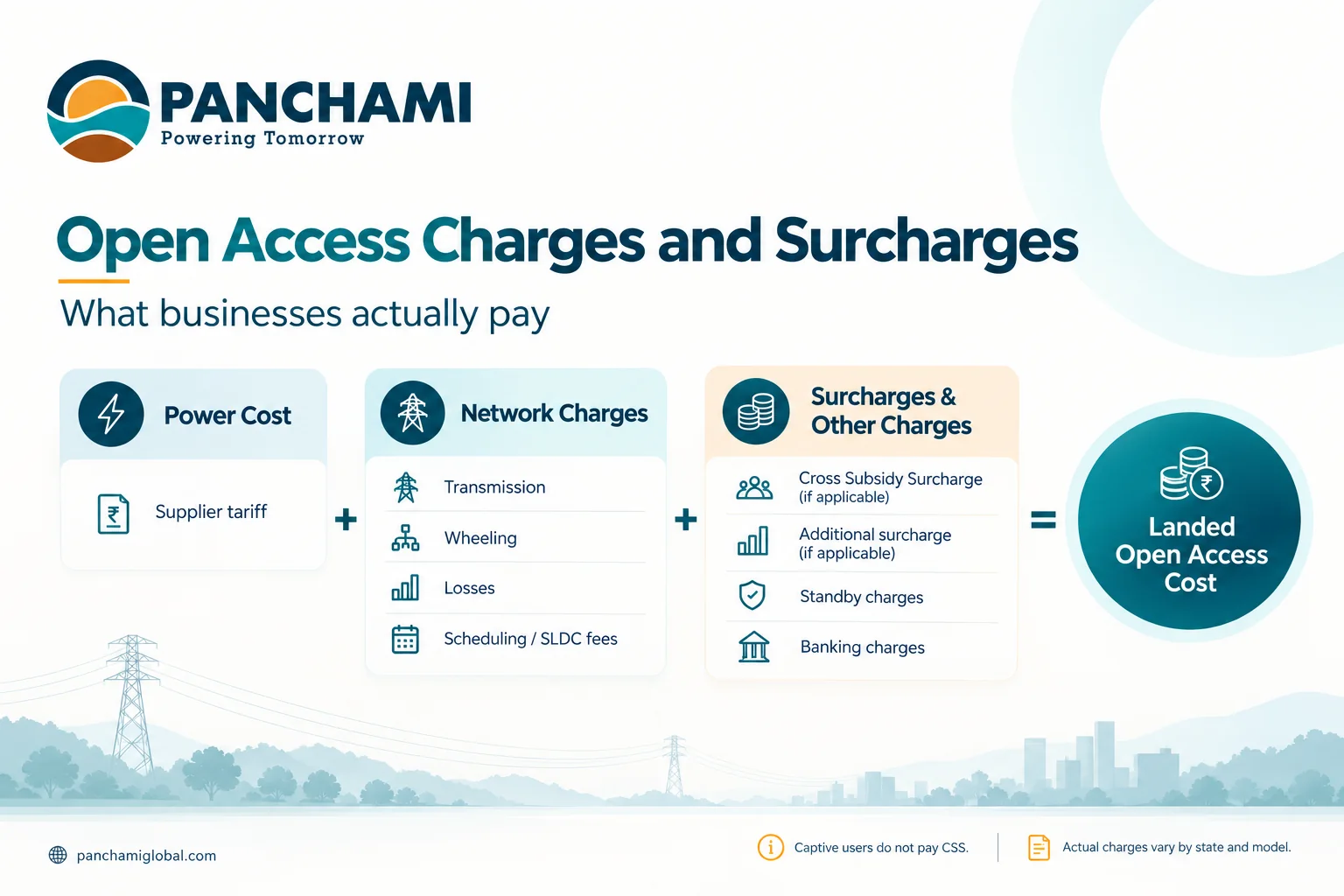
Network charges apply to almost everyone:
- Transmission charges for high-voltage lines
- Wheeling charges for the local distribution network
- Losses, deducted as a share of units
- Scheduling and load despatch fees
Surcharges apply to many, but not all, users:
- Cross subsidy surcharge (CSS). In India, industrial and commercial tariffs are set above the cost of supply so that homes and farms can pay less. When a business moves to open access, the DISCOM loses that extra revenue. The cross subsidy surcharge makes up part of the gap. Section 42(2) says this surcharge does not apply when a person uses open access to carry power from their own captive plant.
- Additional surcharge. This covers fixed costs the DISCOM still carries for power it had contracted to supply you, even though you now buy elsewhere.
Other charges depend on your setup:
- Standby charges, if you need DISCOM power when your supplier's plant is down
- Banking charges, if you store surplus renewable units with the utility to use later
The national tariff policy says cross subsidy surcharge should reduce over time, but levels still vary widely between states. That gap between states is why the same open access deal can save a lot in one state and very little in another.
Who Can Use Open Access Electricity in India?
Eligibility for open access electricity depends on the type of power you buy and the state you are in.
Conventional power. For regular open access, each state sets its own threshold, and the historic benchmark has been around 1 MW. Your SERC's current regulations decide the exact limit.
Green power. In June 2022, the Ministry of Power notified the green energy open access rules, which lowered the threshold for renewable power from 1 MW to 100 kW. The rules also set a 15-day timeline for approvals and gave captive consumers no minimum load.
Your state's rules. States adopt central rules through their own regulations, and some have gone their own way. In Karnataka, the High Court struck down the 2022 green open access rules. KERC then issued its Terms and Conditions for Open Access Regulations, 2025, which allow HT consumers with 100 kW of contract demand, and LT consumers with 100 kW of load across connections in the same division, to apply. Captive projects are also eligible.
A quick self-check before you speak to any supplier:
- What is your contract demand or sanctioned load?
- Is your connection HT or LT?
- Do you want green power, conventional power, or both?
- Would you prefer to own a plant, contract with a developer, or buy from an exchange?
Why Open Access Matters for Solar
Most businesses do not have enough roof space to meet their demand with solar. Open access solves this by letting a solar plant sit on land elsewhere while its units are credited to your meter.
Solar is now one of the fastest-growing uses of open access electricity in India. According to Mercom India, India's cumulative installed solar open access capacity reached 36 GW by June 2026, with Karnataka holding the largest share at 21%.
If you are considering this route, our complete guide to open access solar explains the models, eligibility, Karnataka's rules and how to estimate your real savings.
Benefits and Limits of Open Access for Businesses
| Benefits | Limits |
|---|---|
| Choice of supplier instead of a single DISCOM | Charges and surcharges can reduce savings |
| Potential for a lower cost per unit | Rules and charges change with state regulations |
| Long-term price certainty through contracts | Scheduling, metering and paperwork add work |
| Access to renewable power at scale | Grid connectivity can delay projects |
Frequently Asked Questions
What is open access in the power sector?
Open access in the power sector is the right of eligible consumers, generators and licensees to use transmission and distribution networks without discrimination. It lets a business buy electricity from a supplier other than its DISCOM, while paying regulated charges for using the grid to deliver that power.
Which section of the Electricity Act 2003 defines open access?
Section 2(47) of the Electricity Act, 2003 defines open access. Section 42 deals with open access in distribution, including the cross subsidy surcharge and additional surcharge. Section 9 gives captive plant owners the right to open access to carry their power to where they use it.
What is the minimum load required for open access electricity in India?
For conventional power, each state sets its own threshold, historically around 1 MW. For green power, the central rules of 2022 reduced the threshold to 100 kW, and captive consumers have no minimum. Your state regulator's current regulations decide the exact limit that applies to you.
What is the difference between inter-state and intra-state open access?
Intra-state open access uses the network within one state and is regulated by that state's electricity regulatory commission. Inter-state open access uses the inter-state transmission system and is regulated by the Central Electricity Regulatory Commission, now under its General Network Access Regulations, 2022.
Do captive users pay cross subsidy surcharge?
No. Under Section 42(2) of the Electricity Act, 2003, the cross subsidy surcharge does not apply when a person uses open access to carry electricity from their own captive generating plant to where they use it. Other network charges, such as wheeling and transmission charges, still apply.
Is open access electricity cheaper than buying from the DISCOM?
It can be, but not always. Open access electricity is cheaper only when the supplier's price plus transmission charges, wheeling charges, losses and surcharges stays below your DISCOM tariff. Businesses on high industrial or commercial tariffs usually gain the most, while captive users save more because they avoid the cross subsidy surcharge.
Can a business in Karnataka use open access electricity?
Yes. Under KERC's Open Access Regulations, 2025, HT consumers with at least 100 kW of contract demand and LT consumers with at least 100 kW of aggregated load in the same electricity division can apply through the state nodal agency. Captive projects are also eligible.
Conclusion
Open access electricity turns your business from a captive customer of one DISCOM into a buyer with choices. The Electricity Act, 2003 created that right, state regulators decide how it works in practice, and the charges attached to it decide whether it saves you money.
For most businesses today, the most practical use of open access is buying solar power from an offsite plant at a stable, long-term price.
Your next step: Send your last 12 months of electricity bills to Panchami Global. We will check whether you qualify for open access in Karnataka and which route suits your load and budget.
Check whether Open Access Electricity fits your business
Share your electricity bills with Panchami Global to review eligibility, compare supply routes and understand the landed cost before you commit.