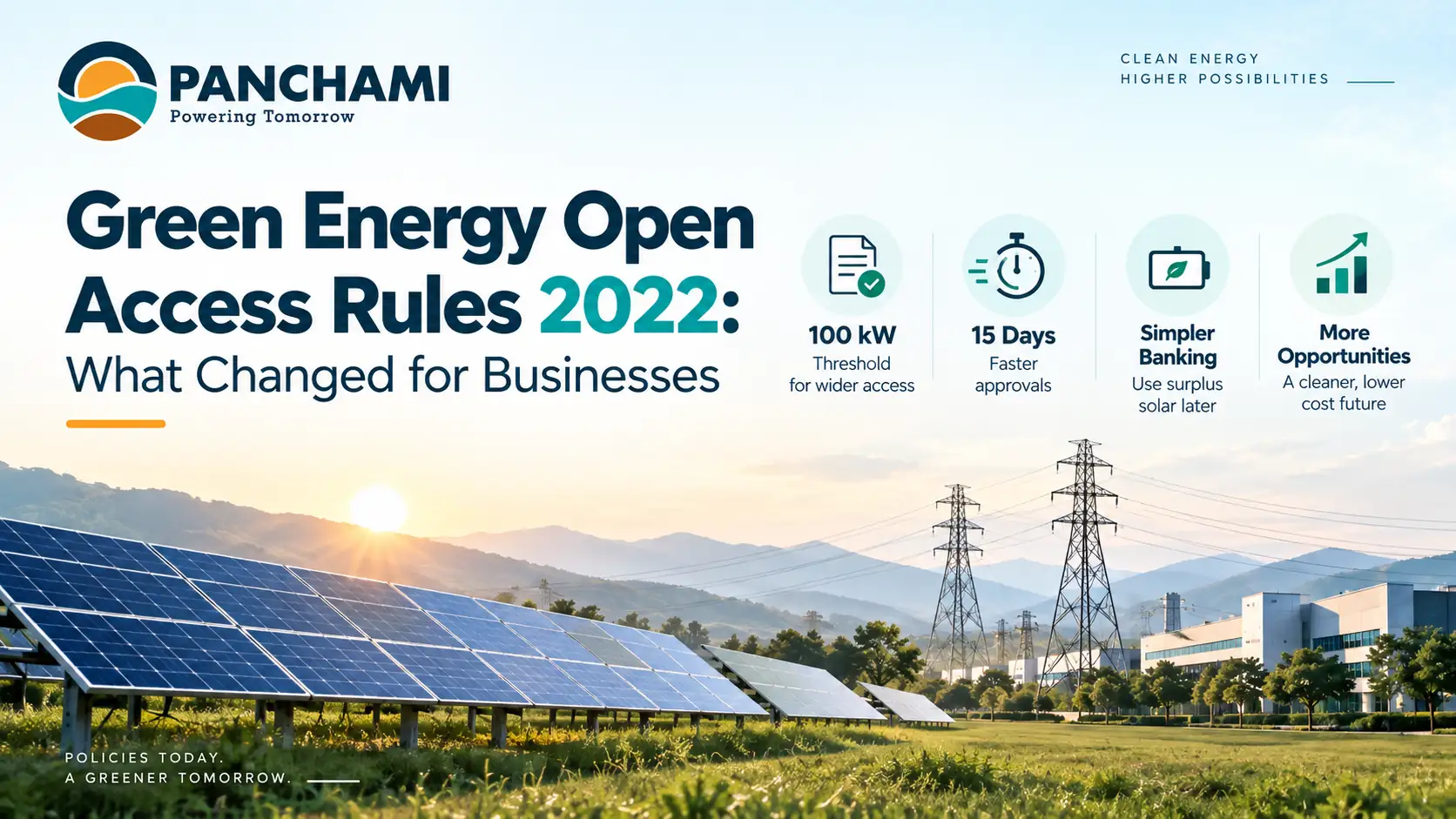
Until 2022, buying green power through the grid was mostly an option for large industries. You needed around 1 MW of demand, approvals could drag on for months, and every state charged differently. The Green Energy Open Access Rules 2022 set out to change all three.
This guide explains what the green energy open access rules changed, how the 2023 amendments refined them, how states applied them, and why businesses in Karnataka now follow KERC's own regulations instead.
- The Ministry of Power notified the rules on 6 June 2022.
- They cut the open access threshold for green power from 1 MW to 100 kW, with no limit for captive users.
- Applications had to be decided in 15 days, or they would count as approved.
- The Karnataka High Court struck the rules down in January 2025, and KERC issued new open access regulations the same year.
What Are the Green Energy Open Access Rules 2022?
The Green Energy Open Access Rules 2022 are central rules notified by India's Ministry of Power on 6 June 2022 to make it easier for consumers to buy renewable power through open access. Their full name is the Electricity (Promoting Renewable Energy Through Green Energy Open Access) Rules, 2022.
The rules covered who can buy green power through the grid, how quickly applications must be approved, which charges can be levied, how banking works, and how DISCOMs must supply green power to consumers who ask for it.
They built on a right that already existed. Open access itself comes from the Electricity Act, 2003, and our guide to open access electricity under the Electricity Act 2003 explains that legal base. If you want to see how these rules play out for a solar project in practice, start with what is open access solar.
Why the Rules Were Needed
Before 2022, three problems kept most businesses away from green open access.
- High entry threshold. Open access was generally available to consumers needing more than 1 MW, which excluded most MSMEs.
- Slow, uncertain approvals. Applications could sit with DISCOMs for long periods, and there was no common process across states.
- Unpredictable charges and banking. Each state set its own surcharges and banking terms. According to a Trilegal analysis of the rules, some states allowed annual banking, some monthly, and some had withdrawn banking altogether.
For a business planning a 25-year solar investment, that uncertainty made the numbers hard to trust.
Key Changes Under the Green Energy Open Access Rules
Here is what the rules changed, grouped by the questions businesses usually ask.
| Area | Before the rules | Under the Green Energy Open Access Rules 2022 |
|---|---|---|
| Eligibility | Around 1 MW of demand | 100 kW of contract demand or sanctioned load |
| Captive consumers | Threshold depended on state rules | No minimum limit |
| Approval time | No fixed national timeline | 15 days, or deemed approved |
| Application process | State by state | Single window national portal |
| Cross subsidy surcharge | Could rise year to year | Increase capped at 50% over 12 years |
| Additional surcharge | Often applied | Not applicable if the consumer pays fixed charges |
| Standby charges | Varied | Capped at 10% of the energy charges for the consumer category |
| Banking | Varied, sometimes withdrawn | At least monthly, for at least 30% of monthly DISCOM consumption |
| Green power from DISCOM | Rarely offered | Consumers can demand it at a regulator-set green tariff |
Eligibility: From 1 MW to 100 kW
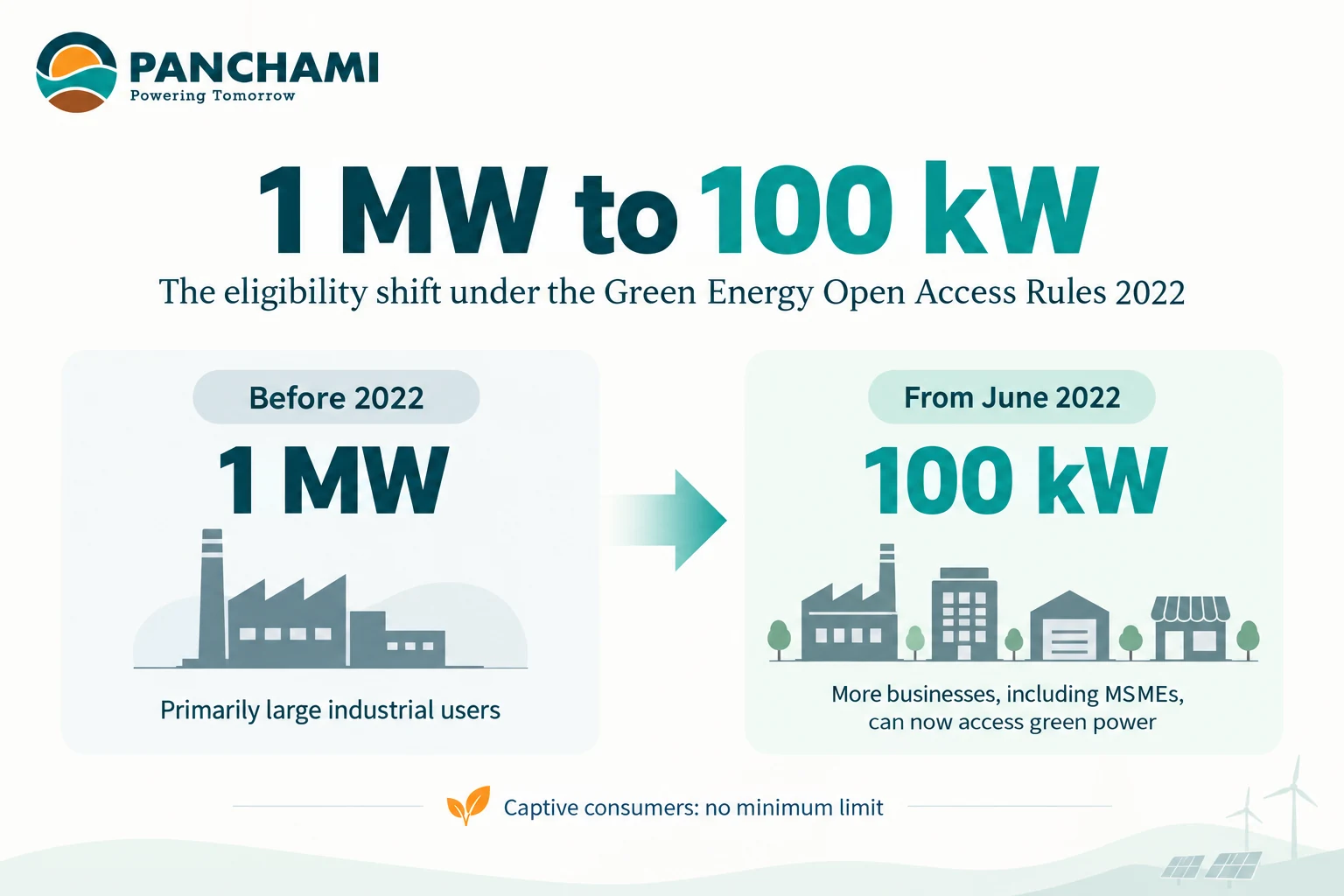
The biggest change was access. The Ministry of Power's press release confirmed that the open access limit for green energy fell from 1 MW to 100 kW, so small consumers could also buy renewable power through open access. Captive consumers were given no minimum limit at all.
Faster Approvals Through One Portal
Applications had to be decided within 15 days, failing which they would be deemed approved. The Ministry named Grid Controller of India Limited as the Central Nodal Agency, and it runs the Green Open Access Registry (GOAR) portal as the single window to register and apply.
Clear Limits on Charges
The rules listed the charges a green open access consumer can be asked to pay: transmission charges, wheeling charges, cross subsidy surcharge and standby charges, along with banking charges and regulated fees such as load despatch and scheduling charges.
Two limits mattered most for savings:
- Cross subsidy surcharge could not rise by more than 50% of the level fixed in the year open access was granted, for 12 years from when the plant starts operating.
- Additional surcharge would not apply to a green open access consumer who is already paying fixed charges to the DISCOM.
Both surcharges were removed entirely for power from waste-to-energy plants and for green energy used to make green hydrogen or green ammonia.
Banking of Surplus Green Energy
Solar plants produce most of their power at midday, so banking matters. The rules required banking to be allowed at least monthly. The permitted banked quantity had to be at least 30% of the consumer's total monthly electricity consumption from the DISCOM, with charges set by the state regulator.
Green Power Directly From Your DISCOM
Consumers who do not want to sign with a developer can ask their DISCOM for green power. The tariff is set by the regulator and is made up of the average pooled cost of renewable power, any cross subsidy charges, and a service charge. The request must be made for a minimum period of one year.
Uniform RPO and Green Certificates
The rules applied a uniform renewable purchase obligation to all obligated entities in a DISCOM's area, and allowed green hydrogen and green ammonia purchases to count towards it. DISCOMs were also required to issue yearly green certificates, on request, to consumers for green energy they consume beyond their obligation.
The 2023 Amendments
The first version left gaps, and the Ministry of Power issued two amendments in 2023. These allowed consumers to aggregate demand across multiple connections and cleared up confusion over banking charges and settlement periods.
The most useful change for businesses came in the Second Amendment. A consumer can now meet the 100 kW threshold through a single connection or through several connections in the same electricity division of a DISCOM. A business with three LT connections of 40 kW each, in the same division, can therefore qualify.
The official amendments can be reviewed on the GOAR rules page, which lists both 2023 amendments and the original rules.
How the Rules Shaped Open Access Solar Policy in the States
Electricity is regulated jointly by the Centre and the states, so the central rules only worked once each state regulator adopted them into its own regulations. That is where open access solar policy started to diverge.
IEEFA's December 2024 review found that 28 of 29 states and Union Territories had adopted green open access, either through final or draft regulations. It also found real differences:
- Some states, including Tamil Nadu, Karnataka and Uttar Pradesh, did not follow the central 100 kW threshold at the time.
- Approvals in Maharashtra and Uttar Pradesh took about twice as long as the central timeline.
- States added their own costs, such as Karnataka's facilitation fee and Rajasthan's Renewable Energy Development Fund.
Even with these gaps, the market grew fast. IEEFA reported that India's commercial and industrial open access market grew at a compound annual rate of 46% between FY2022 and FY2024, reaching 18.7 GW of cumulative capacity.
What Happened in Karnataka
In January 2025, the Karnataka High Court struck down the Green Energy Open Access Rules 2022 along with KERC's 2022 green open access regulations. The court held that open access falls within the powers of state electricity regulatory commissions under the Electricity Act, 2003, and that the Centre could not frame rules that override them. It allowed KERC to write fresh regulations.
KERC then notified the Terms and Conditions for Open Access Regulations, 2025. Many of the central rules' ideas survived, but they now come from KERC's own framework.
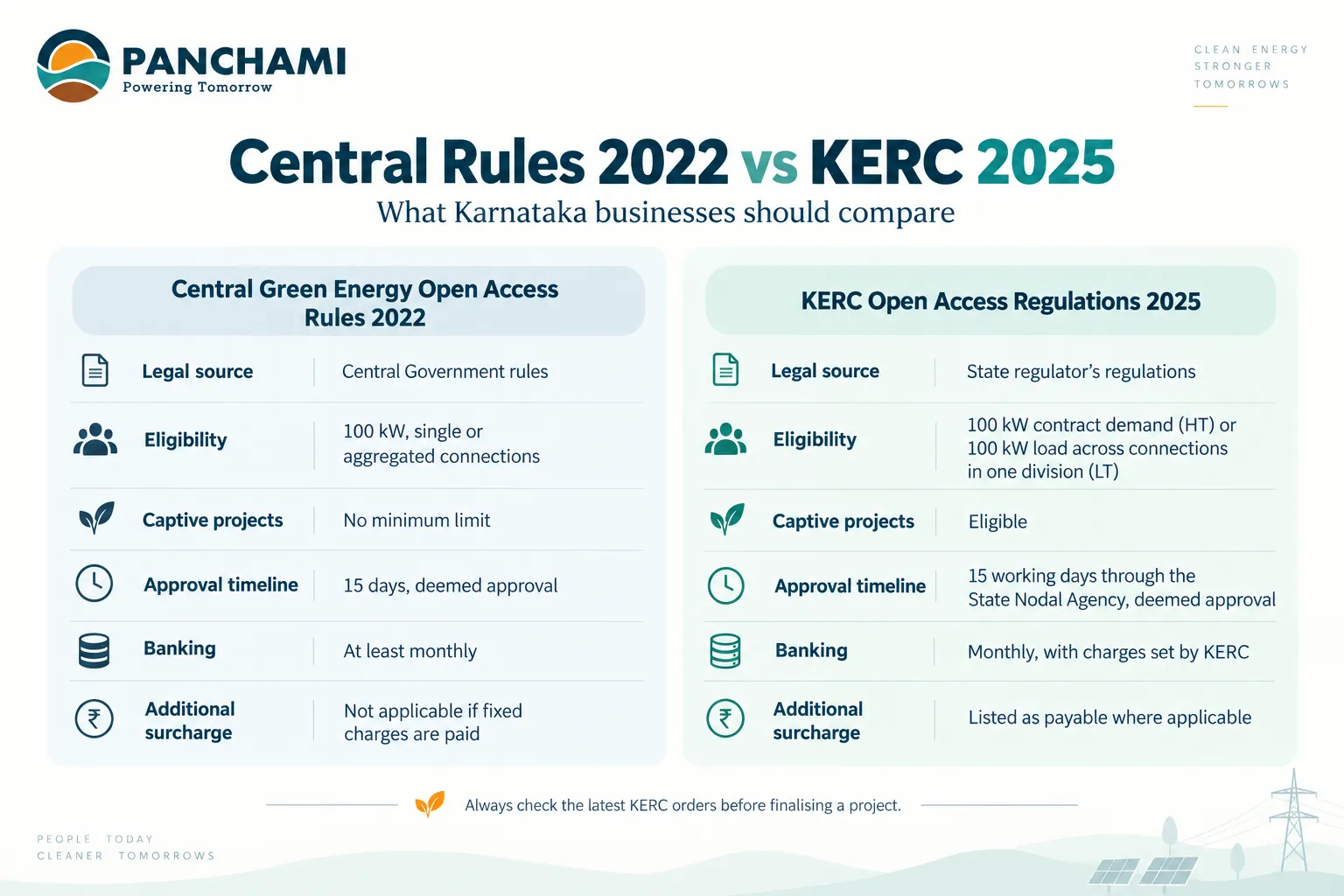
| Point | Central Green Energy Open Access Rules 2022 | KERC Open Access Regulations 2025 |
|---|---|---|
| Legal source | Central Government rules | State regulator's regulations |
| Eligibility | 100 kW, single or aggregated connections | 100 kW contract demand (HT) or 100 kW load across connections in one division (LT) |
| Captive projects | No minimum limit | Eligible |
| Approval timeline | 15 days, deemed approval | 15 working days through the State Nodal Agency, deemed approval |
| Banking | At least monthly | Monthly, with charges set by KERC |
| Additional surcharge | Not applicable if fixed charges are paid | Listed as payable where applicable |
The rules are still moving. In June 2026, KERC released draft regulations for open access and general network access, which propose monthly renewable energy banking until 31 March 2030 with an 8% banking charge. As of 16 September 2026, the material I could verify still identifies these as draft regulations, proposed to come into force from 1 October 2026.
What this means for you: If your business is in Karnataka, plan your open access project around KERC's 2025 regulations and verify whether the 2026 draft has been finally notified before signing. If you operate in other states, check how your state regulator has adopted or changed the central rules.
Where to Find the Green Energy Open Access Rules 2022 PDF
Always read the official text rather than a summary. You can find it here:
- Ministry of Power / PIB. The central rules and policy explanation are available through the Ministry of Power's official releases.
- GOAR portal. The Green Open Access Registry rules page hosts the rules and amendments.
- Your state regulator. For Karnataka, regulations and orders are published on the KERC website.
When reading the green energy open access rules 2022 PDF, look first at the eligibility rule, the charges rule and the banking rule. These three decide whether a project works financially.
What the Rules Mean for Your Business
Use this checklist before talking to any solar developer:
- Confirm your load. Is your contract demand or combined load in one division at least 100 kW?
- Confirm your state's version. Which regulations does your state regulator currently apply?
- List the charges. Ask for every charge that applies to your connection type, including additional surcharge.
- Check banking terms. Find out the banking period, the banking charge and how unused units are treated.
- Pick your model. Captive users avoid cross subsidy surcharge, which changes the savings significantly.
Frequently Asked Questions
What are the Green Energy Open Access Rules 2022?
They are central rules notified by the Ministry of Power on 6 June 2022 to promote renewable energy through open access. They lowered the eligibility threshold for green power to 100 kW, set a 15-day approval timeline, limited charges, allowed monthly banking and let consumers demand green power from DISCOMs.
What is the minimum load for green energy open access?
Under the central rules, the minimum is 100 kW of contract demand or sanctioned load, met through one connection or several in the same electricity division. Captive consumers have no minimum. In Karnataka, KERC's 2025 regulations also use a 100 kW threshold for HT and LT consumers.
Are the Green Energy Open Access Rules 2022 valid in Karnataka?
No. In January 2025, the Karnataka High Court struck down the central rules and KERC's 2022 green open access regulations. Businesses in Karnataka now follow KERC's Terms and Conditions for Open Access Regulations, 2025, subject to checking any later final KERC regulations.
What charges apply under green energy open access?
The central rules allowed transmission charges, wheeling charges, cross subsidy surcharge and standby charges, plus banking charges and regulated fees. Cross subsidy surcharge increases were capped, and additional surcharge did not apply if the consumer paid fixed charges. State regulations decide the actual rates.
How does banking work under the green energy open access rules?
Banking lets a consumer store surplus renewable energy with the DISCOM and use it later. The rules required banking at least monthly, covering at least 30% of the consumer's monthly DISCOM consumption, with banking charges set by the state regulator.
Where can I download the Green Energy Open Access Rules 2022 PDF?
The official text and amendments are available on the Ministry of Power website and on the Green Open Access Registry portal at greenopenaccess.in. For state-specific rules, download your state regulator's open access regulations, such as KERC's regulations for Karnataka.
What did the 2023 amendments change?
The Ministry of Power issued two amendments in 2023. They allowed the 100 kW threshold to be met by combining multiple connections in the same electricity division and clarified how banking charges and settlement periods work.
Conclusion
The Green Energy Open Access Rules 2022 opened green power to far more businesses by lowering the threshold, speeding up approvals and bringing order to charges and banking. States then shaped those ideas into their own regulations, and Karnataka now follows KERC's 2025 framework after the High Court's ruling.
For your business, the practical question is not which rule was notified in Delhi, but which regulation your ESCOM applies today and what it means for your landed cost.
Your next step: Share your last 12 months of electricity bills with Panchami Global. We will check your eligibility under KERC's current regulations and show you which open access solar model gives you the best landed cost.
Check your Green Open Access eligibility
Share your electricity bills with Panchami Global to review your eligibility under the current Karnataka framework and compare suitable open access solar models.