An export customer sends a supplier questionnaire: "What share of your electricity comes from renewable sources?" A lender asks the same thing during a loan review. For many companies, there is also a legal target to meet. The renewable energy certificate, or REC, is one of the tools Indian businesses use to answer all three.
This guide explains what a renewable energy certificate is, how RECs are issued and traded in India, what renewable purchase obligation (RPO) and the newer renewable consumption obligation (RCO) require, what RECs cost in 2026, and when buying solar power directly makes more sense than buying certificates.
- One renewable energy certificate represents 1 MWh of electricity generated from renewable sources.
- RECs let a business claim renewable energy use without receiving the physical green power.
- RPO and RCO require certain entities to source a rising share of their electricity from renewables, reaching 43.33% by 2029-30.
- RECs help you comply, but they do not cut your power bill. Open access solar can do both.
What Is a Renewable Energy Certificate?
A renewable energy certificate is a market instrument that represents the environmental value of 1 MWh of electricity generated from a renewable source and fed into the grid. It separates the "green" attribute of power from the electricity itself, so the attribute can be sold to a buyer who needs to show renewable energy use.
Think of it like an organic certification. A farm grows organic produce, but the produce travels through a common market where it mixes with everything else. The certificate is what proves that a certain quantity was grown organically, and whoever holds that certificate can claim it.
Once electricity enters the grid, no one can trace which units came from a solar plant. The REC solves that problem by turning each MWh of renewable generation into a certificate that can be tracked, sold and retired.
How Renewable Energy Certificates Work in India
Renewable energy certificates in India are governed by the Central Electricity Regulatory Commission's REC Regulations, 2022, notified on 9 May 2022, which replaced the older 2010 framework.
- One certificate, one MWh. Each REC represents 1 MWh of renewable electricity injected into the grid, or deemed injected in the case of captive self-consumption.
- Who can receive RECs. Renewable energy generators, captive plants based on renewable sources, distribution companies and open access consumers can all be eligible, subject to the conditions in the regulations.
- Central agency. The National Load Despatch Centre, run by Grid Controller of India, manages registration and issuance.
- Trading. RECs are sold on power exchanges or through licensed electricity traders, with prices set by the market.
- Validity. Certificates remain valid until they are sold and redeemed, rather than expiring after a fixed period.
The 2026 Amendment
CERC updated the framework through the REC (First Amendment) Regulations, 2026, which came into force on 24 March 2026. The amendment expanded eligibility to certain captive power producers, set final certificate multipliers by technology, and required distribution companies and open access consumers to apply for RECs within three months of their state commission certifying excess renewable purchases. The amendment also formally recognised virtual power purchase agreements.
| Technology | Certificate multiplier |
|---|---|
| Solar and wind | 1 |
| Hybrid renewable energy | 1.5 |
| Small hydro | 2.5 |
| Biomass, biofuel, pumped hydro, cogeneration, municipal solid waste, large hydro, battery storage charged from renewables | 3 |
| Offshore wind | 4 |
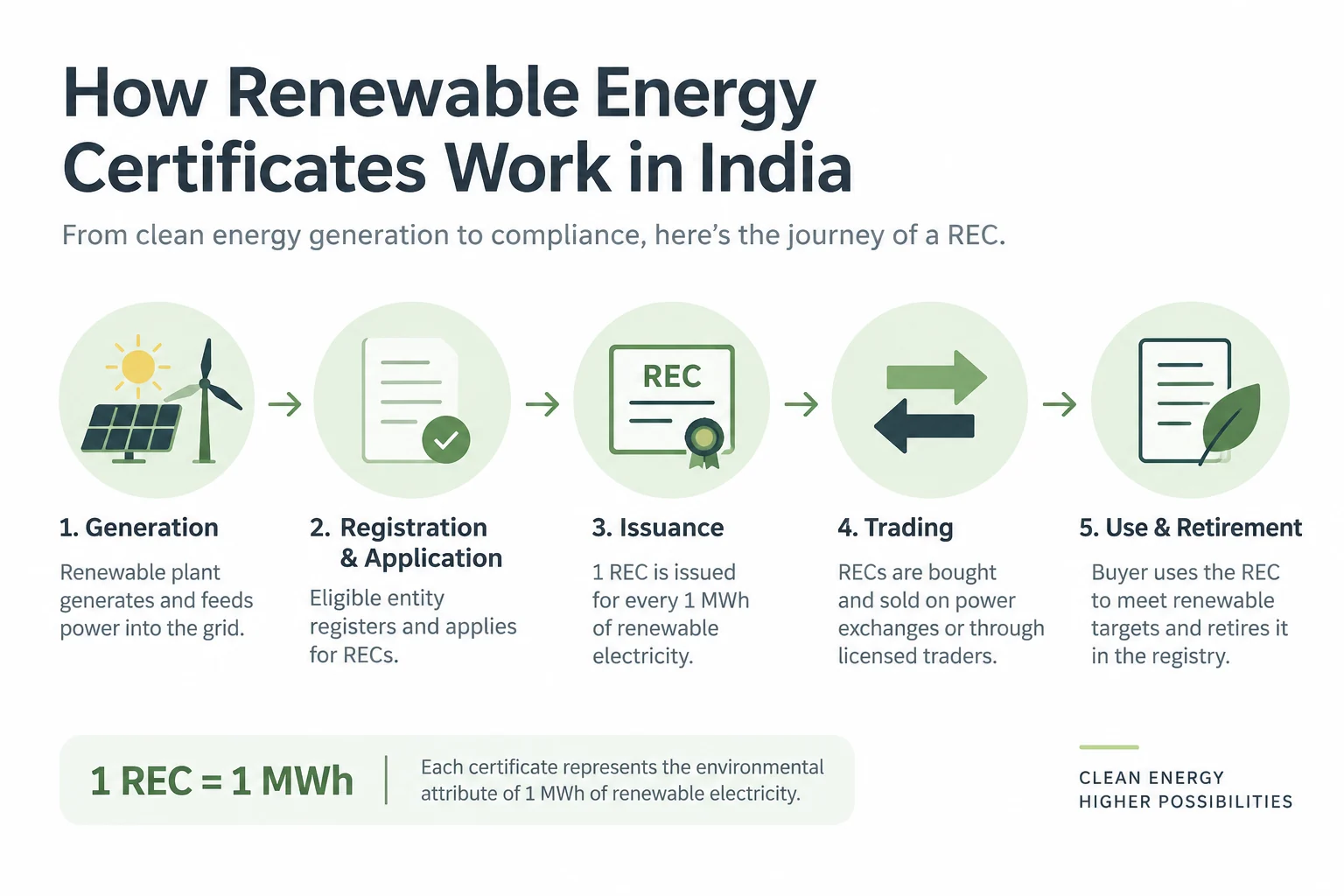
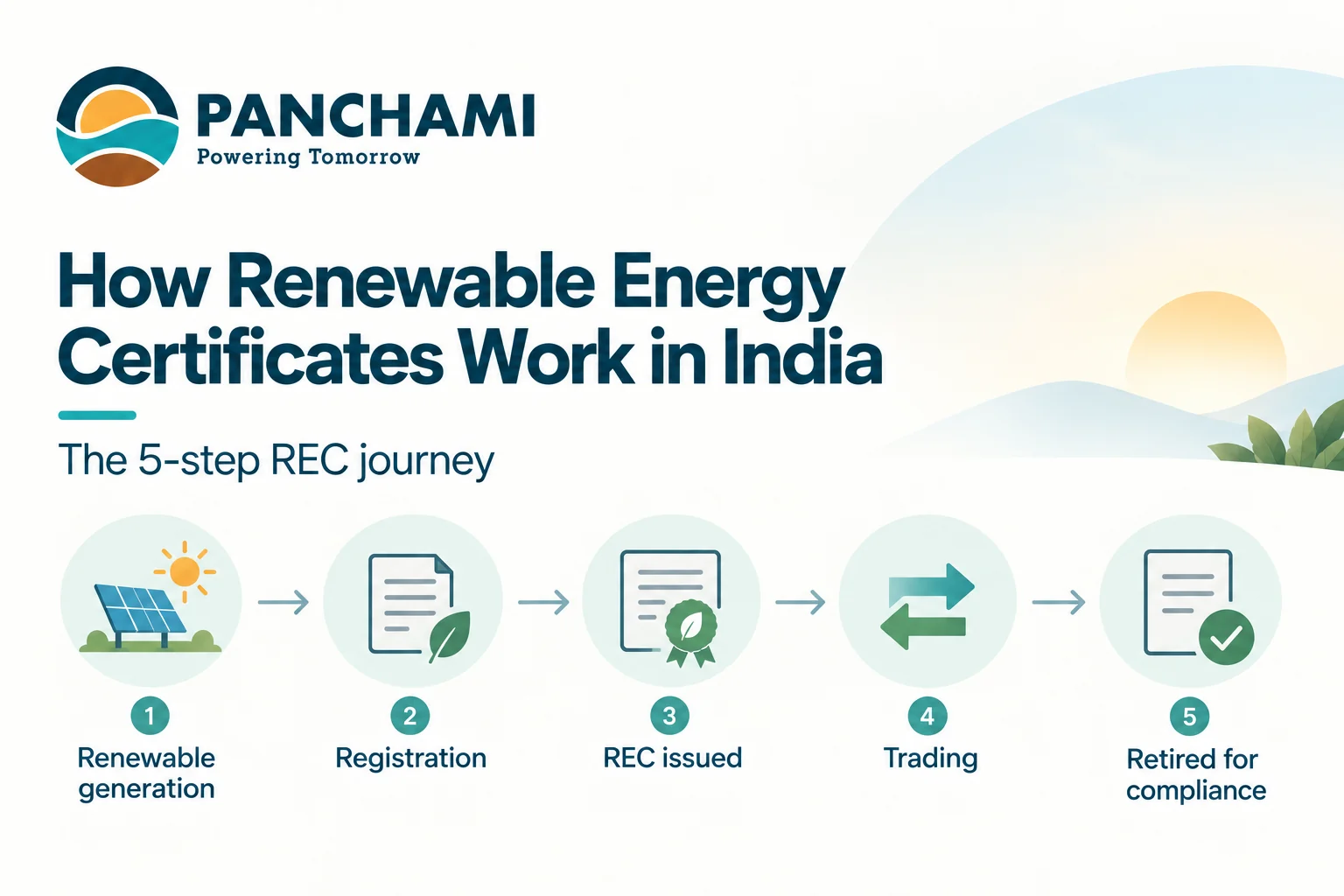
The REC Journey in Five Steps
- A renewable plant generates and injects power into the grid.
- The eligible entity registers and applies for certificates.
- The central agency issues RECs, 1 per MWh multiplied by the technology multiplier.
- RECs are sold on a power exchange or through a trader.
- The buyer uses the RECs for compliance, and they are extinguished so they cannot be reused.
Renewable Energy Certificate Prices in India
REC prices are discovered on power exchanges, so they move with supply and demand.
The Indian Energy Exchange reported its highest-ever yearly REC trade in FY 2025-26, with 187.20 lakh certificates traded, and REC sessions in March 2026 cleared at ₹340 per certificate. By July 2026, sessions cleared at ₹380 and ₹376 per REC, with a sharp fall in sell bids tightening supply.
Since one REC equals 1 MWh, or 1,000 units, a price of ₹380 per REC works out to about 38 paise per unit of electricity. That is the approximate extra cost of making a unit of grid power "green on paper" through certificates at mid-2026 prices.
What Is Renewable Purchase Obligation?
Renewable purchase obligation (RPO) is a requirement for certain entities to buy a minimum share of their electricity from renewable sources. Under India's electricity framework, it has applied to distribution companies, open access consumers and captive power users, with state regulators, including KERC in Karnataka, setting the obligations for entities in their states.
Renewable purchase obligation in India has followed a national trajectory set by the Ministry of Power, which aimed to raise the total obligation from 24.61% in 2022-23 to 43.33% by 2029-30.
The open access solar policy framework was also important in this area because it applied a uniform RPO to obligated entities in a distribution company's area and allowed green hydrogen and green ammonia purchases to count towards it.
From RPO to RCO: The Renewable Consumption Obligation
India has since moved from an obligation to purchase renewable power to an obligation to consume it. The Ministry of Power first notified the Renewable Consumption Obligation (RCO) under the Energy Conservation Act, 2001 in October 2023, and later issued an amended notification on 27 September 2025 that superseded it.
RCO applies to designated consumers that are distribution companies, and to designated consumers that use captive power plants or open access, to the extent of the electricity they consume from those sources.
| Year | Total RCO |
|---|---|
| 2024-25 | 29.91% |
| 2025-26 | 33.01% |
| 2026-27 | 35.95% |
| 2027-28 | 38.81% |
| 2028-29 | 41.36% |
| 2029-30 | 43.33% |
| Factor | RPO | RCO |
|---|---|---|
| Legal basis | Electricity Act framework and state regulations | Energy Conservation Act, 2001 |
| Focus | Purchase of renewable power | Consumption of renewable power |
| Who it covers | DISCOMs, open access consumers, captive users | Designated consumers that are DISCOMs, or use captive plants or open access |
| Monitoring | State regulators | Bureau of Energy Efficiency |
| Consequence of shortfall | As set by state regulations | Penalties under the Energy Conservation Act |
RPO Compliance: Ways to Meet Your Target
1. Consume Renewable Power Directly
This is the most valuable route, because it can lower your power cost while meeting the target. Options include rooftop solar, captive or group captive solar, and third-party supply through open access. Our guide to open access solar for businesses explains how offsite solar reaches your meter and which models suit which companies.
Most third-party supply is signed under a long-term contract. If you are new to these contracts, read what is a power purchase agreement before comparing offers.
2. Buy Renewable Energy Certificates
You can buy RECs on power exchanges to cover any shortfall. This is flexible and quick, but it adds cost without reducing your electricity bill.
3. Sign a Virtual PPA
A virtual PPA lets a large consumer contract with a renewable generator financially, without physical delivery, and receive the linked RECs for compliance.
4. Pay the Buyout Price
Under RCO, designated consumers can also pay a buyout price specified by CERC. This is generally the least attractive option, since it builds no asset and brings no savings.
| Route | Cuts power bill? | Counts for compliance? | Speed |
|---|---|---|---|
| Rooftop or captive solar | Yes | Yes | Months |
| Open access solar | Usually yes | Yes | Months |
| Buying RECs | No | Yes | Days |
| Virtual PPA | No direct saving | Yes, through linked RECs | Weeks to months |
| Buyout price | No | Yes | Immediate |
RECs vs Open Access Solar: Which Is Better?
The answer depends on whether you only need compliance or also want savings.
An illustrative example: Suppose a designated consumer has 10 million units a year of obligated consumption, and faces the 2026-27 RCO of 35.95%.
- The obligation equals 3,595 MWh of renewable energy.
- Meeting it fully through RECs at ₹380 per certificate would cost about ₹13.7 lakh a year.
- Meeting it through open access solar with a landed cost below the ESCOM tariff could meet the same target while saving money on each unit consumed.
In other words, RECs are a cost of compliance, while direct renewable power can be a source of savings. Many businesses use both: open access solar for most of the obligation, and RECs to cover short-term gaps or years when consumption rises faster than planned.
When RECs make sense
- You need to close a small gap quickly before a reporting deadline.
- Your load is too small or too uncertain for a long-term solar contract.
- You are waiting for a solar project to be commissioned.
When open access solar makes more sense
- Your obligation will keep rising every year until 2029-30.
- You use enough power for landed-cost savings to matter.
- Customers or investors want proof of physical renewable power, not only certificates.
Frequently Asked Questions
What is a renewable energy certificate?
A renewable energy certificate is a tradable instrument representing the environmental attribute of 1 MWh of electricity generated from a renewable source and fed into the grid.
How does the renewable energy certificate system work in India?
Eligible entities register with the central agency and receive RECs for eligible generation or excess renewable purchase. RECs are sold on power exchanges or through traders and are extinguished once used for compliance.
What is the price of a renewable energy certificate in India?
REC prices are set by the market on power exchanges. In March 2026, REC sessions on the Indian Energy Exchange cleared at ₹340 per certificate, and in July 2026 they cleared at ₹380 and ₹376.
What is renewable purchase obligation?
Renewable purchase obligation is a requirement for entities such as distribution companies, open access consumers and captive users to buy a minimum share of their electricity from renewable sources.
What is the difference between RPO and RCO?
RPO focuses on purchasing renewable electricity and is set under the electricity framework by state regulators. RCO focuses on actual consumption by designated consumers and is monitored by the Bureau of Energy Efficiency.
How can a company achieve RPO compliance?
A company can meet its obligation by consuming renewable power through rooftop, captive, group captive or open access solar, by buying renewable energy certificates, through virtual PPAs, or under RCO by paying the buyout price.
Can open access solar help meet RCO?
Yes. Renewable electricity consumed through open access counts towards a designated consumer's obligation and can also lower electricity costs.
Conclusion
Renewable energy certificates give Indian businesses a flexible way to prove renewable energy use and meet their obligations, and the 2026 amendment has made the system clearer. But RECs only ever add cost. With RCO targets rising every year until 2029-30, the businesses that plan early for direct renewable power will meet their targets and cut their power bills, while others keep paying for certificates.
Your next step: Share your last 12 months of electricity bills with Panchami Global. We will estimate how much of your renewable obligation open access solar can cover, what it would save compared with buying RECs, and which model fits your business.