When a business buys solar power from a developer, the tariff gets the attention. The document behind it gets far less. Yet a power purchase agreement for solar can bind your business for 10 to 25 years, and its clauses decide whether the promised savings actually reach your bill.
This guide explains what a power purchase agreement is, how a solar PPA works in India, the main types, the clauses you must read line by line, and the 2025 and 2026 policy changes that are affecting PPA prices right now.
- A power purchase agreement (PPA) is a long-term contract to buy electricity from a generator at agreed terms.
- In a solar PPA, the developer usually builds and owns the plant, and you pay only for the power.
- The tariff is only one part. Minimum offtake, charges, change in law and exit clauses matter as much.
- New cell sourcing rules and the phase-out of transmission waivers are pushing solar PPA tariffs up.
What Is a Power Purchase Agreement?
A power purchase agreement is a long-term contract between an electricity generator and a buyer, under which the buyer agrees to purchase power at a set price and on set terms for a fixed period. It is often shortened to PPA. In solar, the generator is usually a developer that builds, owns and runs the plant.
Think of a PPA as a long-term supply contract for a raw material. A bakery might agree with a mill to buy a fixed quantity of flour every month for five years at an agreed price. The bakery gets price certainty, and the mill gets a guaranteed buyer that helps it finance a bigger factory. A solar PPA works the same way, with electricity instead of flour.
The guaranteed buyer is what makes the project possible. Lenders fund solar plants because a PPA shows that someone will pay for the power for many years.
How a Power Purchase Agreement for Solar Works
Most business PPAs in India fall into two broad setups: the plant sits on your premises, or the plant sits elsewhere and the power travels through the grid. For an offsite plant, the PPA sits on top of the open access process. If you want the full picture of how open access solar works, including approvals and banking, our pillar guide covers it.
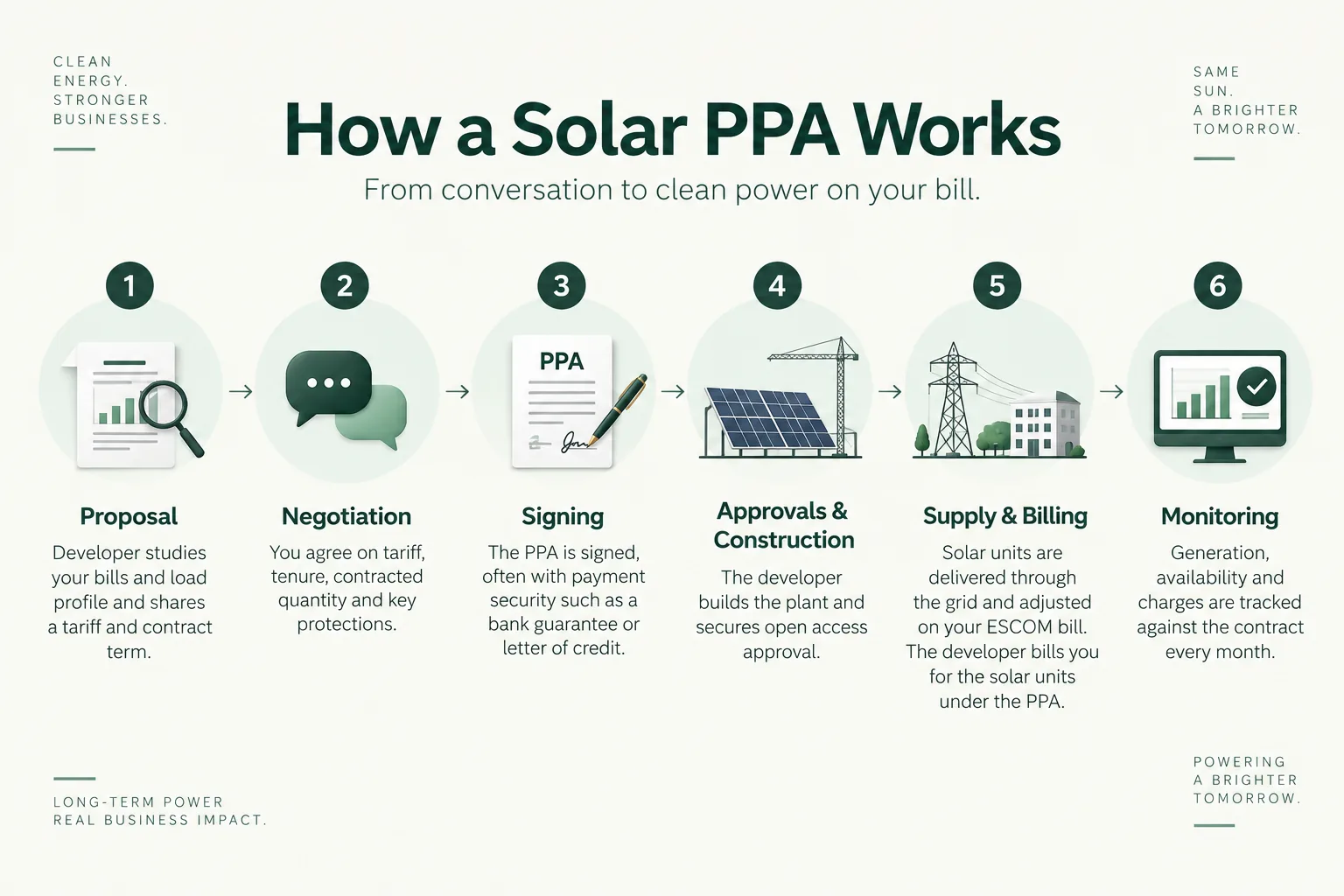
- Proposal. The developer studies your bills and load profile and offers a tariff and contract term.
- Negotiation. You agree on tariff, tenure, contracted quantity and key protections.
- Signing. The PPA is signed, often with payment security such as a bank guarantee or letter of credit.
- Approvals and construction. The developer builds the plant and secures open access approval.
- Supply and billing. Solar units are delivered through the grid and adjusted on your ESCOM bill. The developer bills you for the solar units under the PPA.
- Monitoring. Generation, availability and charges are tracked against the contract every month.
Types of Solar PPAs in India
A power purchase agreement for solar can take several forms in India, and "PPA" is used loosely for all of them. Knowing which one you are being offered avoids expensive misunderstandings.
| Type | How it works | Who it suits |
|---|---|---|
| Utility PPA | A developer sells power to a DISCOM or central agency, usually after a tender | Government and utility buyers |
| Onsite rooftop PPA (RESCO model) | The developer installs and owns a solar system on your roof and sells you the power | Businesses with good roof space and no wish to invest |
| Offsite third-party PPA | The developer owns a plant elsewhere and supplies you through open access | Businesses wanting large volumes with no investment |
| Group captive supply agreement | You buy equity in the plant's SPV and sign a supply agreement for your share of power | Mid-sized businesses wanting to avoid surcharges |
| Virtual PPA (VPPA) | A financial contract with no physical power delivery, settled against market prices, with renewable energy certificates transferred to you | Large consumers meeting renewable consumption obligations |
A Note on Virtual PPAs
Virtual PPAs are new in India. The Central Electricity Regulatory Commission issued its Guidelines for Virtual Power Purchase Agreements on 24 December 2025. Under these guidelines, a VPPA is a non-transferable bilateral contract between a consumer and a renewable generator. The generator sells its power in the market, the two sides settle the difference between an agreed strike price and the market price, and the associated renewable energy certificates go to the consumer for compliance, not for trading.
A VPPA does not lower your electricity bill directly. It helps with green energy targets and price hedging, which is a very different purpose from a physical PPA.
Key Clauses in a Solar Power Purchase Agreement
This is where most of the value in a power purchase agreement for solar sits, and most of the risk. Read each clause with your finance and legal teams.
| Clause | What it means | What to check |
|---|---|---|
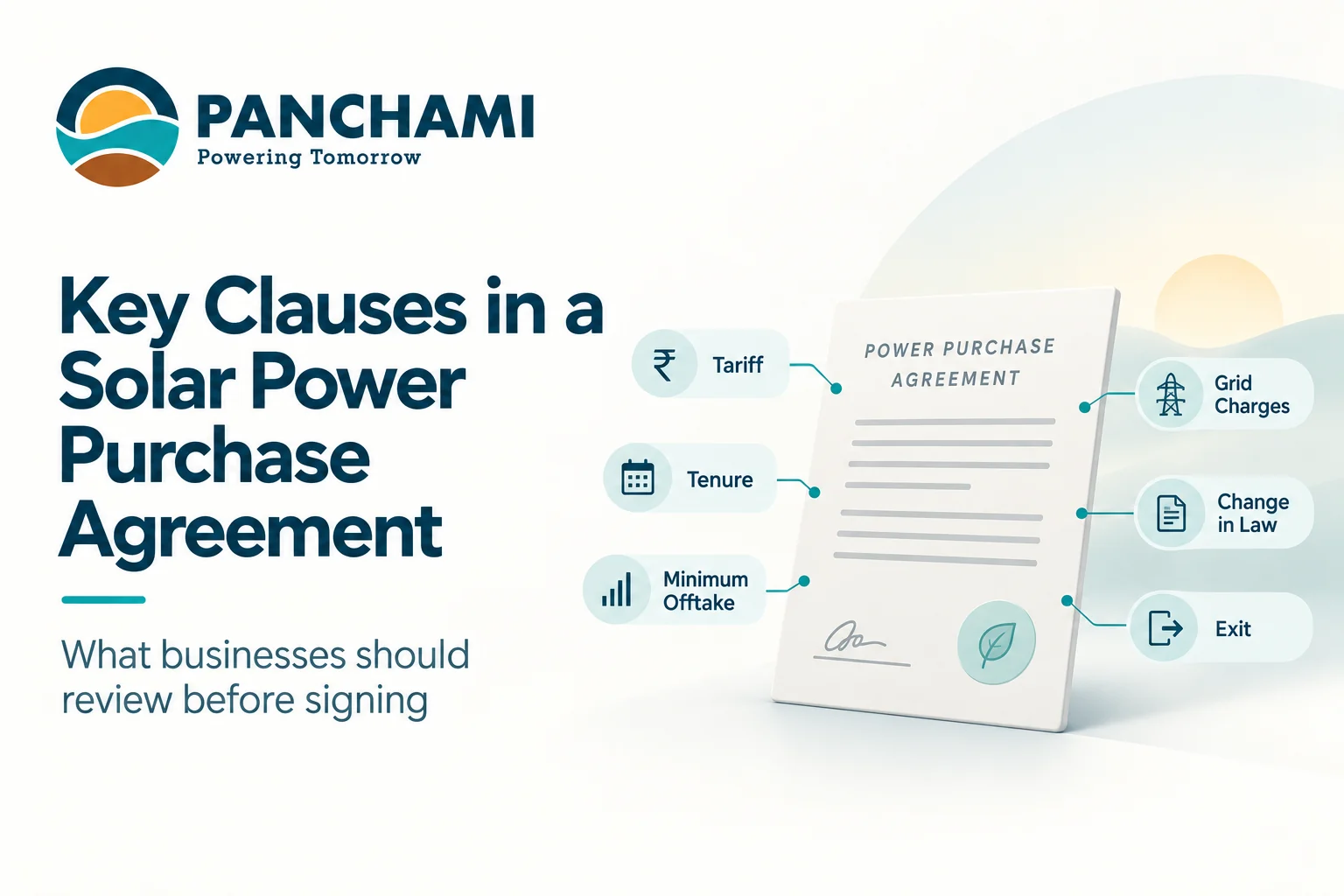
| Tenure | How long the contract runs | Does the term match the life of your business at that site? |
| Tariff and escalation | Price per unit and any yearly increase | Is it fixed, escalating, or linked to an index? |
| Contracted quantity and minimum offtake | How much you must buy or pay for | What happens if your load falls? Is there a take-or-pay penalty? |
| Generation guarantee | Minimum output the developer promises | Is there compensation if output falls short? |
| Grid charges | Who pays transmission charges, wheeling charges, losses and surcharges | Are charges a pass-through to you, and at which year's rates? |
| Change in law | Who bears new or higher charges and taxes | Is there a cap, a renegotiation right or an exit option? |
| Curtailment and deemed generation | Payment when the grid cannot take the plant's power | Will you pay for units you never received? |
| Banking | How surplus solar units are stored and used later | Who bears banking charges and lapsed units? |
| Payment security | Bank guarantee, letter of credit or deposit | How much capital does it lock up? |
| Termination and exit | Rights and payments if either side ends the contract | How is the termination payment calculated? |
| Green attributes | Who owns the environmental benefits of the power | Do the certificates and claims belong to you? |
| Force majeure | Events that excuse performance | Is the list balanced, or tilted towards the developer? |
Three Clauses That Most Often Surprise Buyers
Grid charges. Many proposals show a solar tariff but treat charges as a pass-through. If solar wheeling charges, transmission charges or surcharges rise, your landed cost rises with them. Ask for landed cost per unit, not just the tariff.
Minimum offtake. If you commit to buying a fixed quantity and your production slows, you may still pay for units you do not use. Size the contract to your firm base load, not your best year.
Green attributes. Your customers or investors may ask for proof of renewable energy use. Make sure the PPA clearly gives you the rights to claim the green power and any related certificates. Our guide to renewable energy certificates in India explains how these certificates work and why ownership matters.
Power Purchase Agreement India: Rules Affecting PPAs in 2026
- Domestic solar cell rules. Open access and net-metering projects must use solar cells from manufacturers on the government's ALMM List-II. MNRE extended the deadline for these two categories to 31 December 2026, so projects commissioned after that date must comply. Domestic cells cost more, which feeds into PPA tariffs.
- Rising tariffs already visible. Savings for solar open access consumers narrowed in most states in Q4 2025, as higher PPA tariffs raised landed costs.
- Transmission waiver phase-out. Solar and wind projects commissioned after 30 June 2025 pay inter-state transmission charges in stages, reaching full charges for projects commissioned after 1 July 2028.
- Karnataka's open access framework. In Karnataka, third-party PPAs operate under KERC's Terms and Conditions for Open Access Regulations, 2025.
- Virtual PPAs now recognised. CERC's December 2025 guidelines give large consumers a regulated way to sign VPPAs for green energy compliance.
Pro tip: If a developer's tariff looks far below others, ask whether the plant will be commissioned before or after 31 December 2026, and whether the tariff assumes cheaper non-domestic cells. A delay past that date can change the economics of the whole project.
Pros and Cons of a Solar PPA
| Pros | Cons |
|---|---|
| No or low upfront investment | Surcharges usually apply in third-party open access, reducing savings |
| Long-term price certainty | Long lock-in periods with exit payments |
| Developer handles construction and maintenance | Minimum offtake can penalise lower consumption |
| Faster to adopt than building your own plant | Charges passed through can rise over time |
| Supports green energy reporting | You do not own the asset at the end unless a buyout is agreed |
PPA or Ownership?
A power purchase agreement for solar from a third-party developer suits businesses that want no investment or expect their load to change. If you have steady demand for many years, owning part of the plant through a captive or group captive structure usually gives a lower landed cost, because the surcharges do not apply. Many businesses compare both before deciding.
Solar Power Purchase Agreement India: Checklist Before You Sign
- Landed cost: Get the landed cost per unit for year one and later years, with every charge listed.
- Escalation: Confirm whether the tariff is fixed or rises every year, and by how much.
- Tenure: Match the contract term to how long you expect to operate at that site.
- Offtake: Check the minimum quantity and any take-or-pay penalty.
- Generation guarantee: Ask for a minimum generation commitment with compensation.
- Change in law: Make sure new charges or rules do not fall entirely on you.
- Curtailment: Understand whether you pay for units the grid could not accept.
- Exit: Read how termination payments are calculated in every scenario.
- Green attributes: Confirm you own the rights to claim the renewable energy.
- Compliance dates: Check the commissioning date against the ALMM List-II deadline.
Frequently Asked Questions
What is a power purchase agreement?
A power purchase agreement is a long-term contract in which a buyer agrees to purchase electricity from a generator at a set price and on set terms for a fixed period.
What does PPA mean in a power purchase agreement?
PPA stands for power purchase agreement.
What is a PPA in solar?
A PPA in solar is a contract where a solar developer builds and usually owns a solar plant and sells its power to a business or utility at an agreed tariff.
How long is a solar power purchase agreement in India?
Commercial and industrial solar PPAs in India commonly run from about 10 to 25 years, depending on the model and the buyer's needs.
Is a solar PPA worth it for a business?
It can be, if the landed cost per unit after all charges stays clearly below your DISCOM tariff for most of the contract.
What happens if my business uses less power than the PPA?
It depends on the minimum offtake clause. Many PPAs require you to buy or pay for a minimum quantity.
Who owns the renewable energy certificates under a solar PPA?
The PPA decides this. Make sure the contract clearly transfers these rights to you if you need them for reporting or compliance.
What is a virtual power purchase agreement in India?
A virtual PPA is a financial contract between a consumer and a renewable generator with no physical delivery of power.
Conclusion
A power purchase agreement for solar can give your business years of stable, lower-cost clean power without building a plant. The tariff starts the conversation, but the clauses decide the outcome: minimum offtake, charges, change in law, green attributes and exit terms.
Your next step: Share your last 12 months of electricity bills and any PPA proposal you have received with Panchami Global. We will check the landed cost, flag risky clauses, and compare the PPA against captive and group captive options for your load.