
Every month, your factory pays the ESCOM for electricity at a tariff you have no control over. A captive power plant flips that relationship. Instead of only buying power, you own the plant that produces it, and you use that power yourself.
For decades, captive power plants in India meant large coal units attached to steel mills and aluminium smelters. Today, more businesses build them with solar. This guide explains what a captive power plant means, the legal tests it must pass, the rule changes made in 2026, and how a captive solar power plant works for industries in Karnataka.
- A captive power plant is a plant set up mainly to supply electricity for the owner's own use.
- To qualify, captive users must own at least 26% of the plant and use at least 51% of its power each year.
- Captive users do not pay cross subsidy surcharge or additional surcharge on that power when the captive requirements are met.
- Rules notified in March 2026 clarified captive structures for company groups and SPVs.
Captive Power Plant Meaning
A captive power plant is a generating plant set up by a person or company primarily to produce electricity for its own use, rather than to sell power to others. In India, such a plant does not need a generation licence, and its owners get special treatment on grid surcharges when they meet the legal tests.
Put simply, “captive power plant” means your own power plant, built for your own consumption.
Think of water supply. A municipal connection is like buying power from the ESCOM. A borewell on your own land is like an onsite captive plant. A water source you own on a farm outside town, with the water sent to you through a shared pipeline, is like an offsite captive plant. You own the source, but you still pay to use the pipeline.
What Is a Captive Power Plant Under Indian Law?
Three pieces of law decide what counts as a captive power plant in India.
| Law | What it says |
|---|---|
| Section 2(8), Electricity Act, 2003 | Defines a captive generating plant as one set up primarily for the owner's own use. |
| Section 9, Electricity Act, 2003 | Lets any person build a captive plant and gives them the right to open access to carry that power to where they use it. |
| Rule 3, Electricity Rules, 2005 | Sets the ownership and consumption requirements a plant must pass to be treated as captive. |
The 26% and 51% Requirements
Rule 3 has long required two conditions, and the 2026 amendment kept both:
- Ownership requirement: Captive users must hold at least 26% of the ownership of the plant.
- Consumption requirement: Captive users must consume at least 51% of the electricity the plant generates, checked over the financial year.
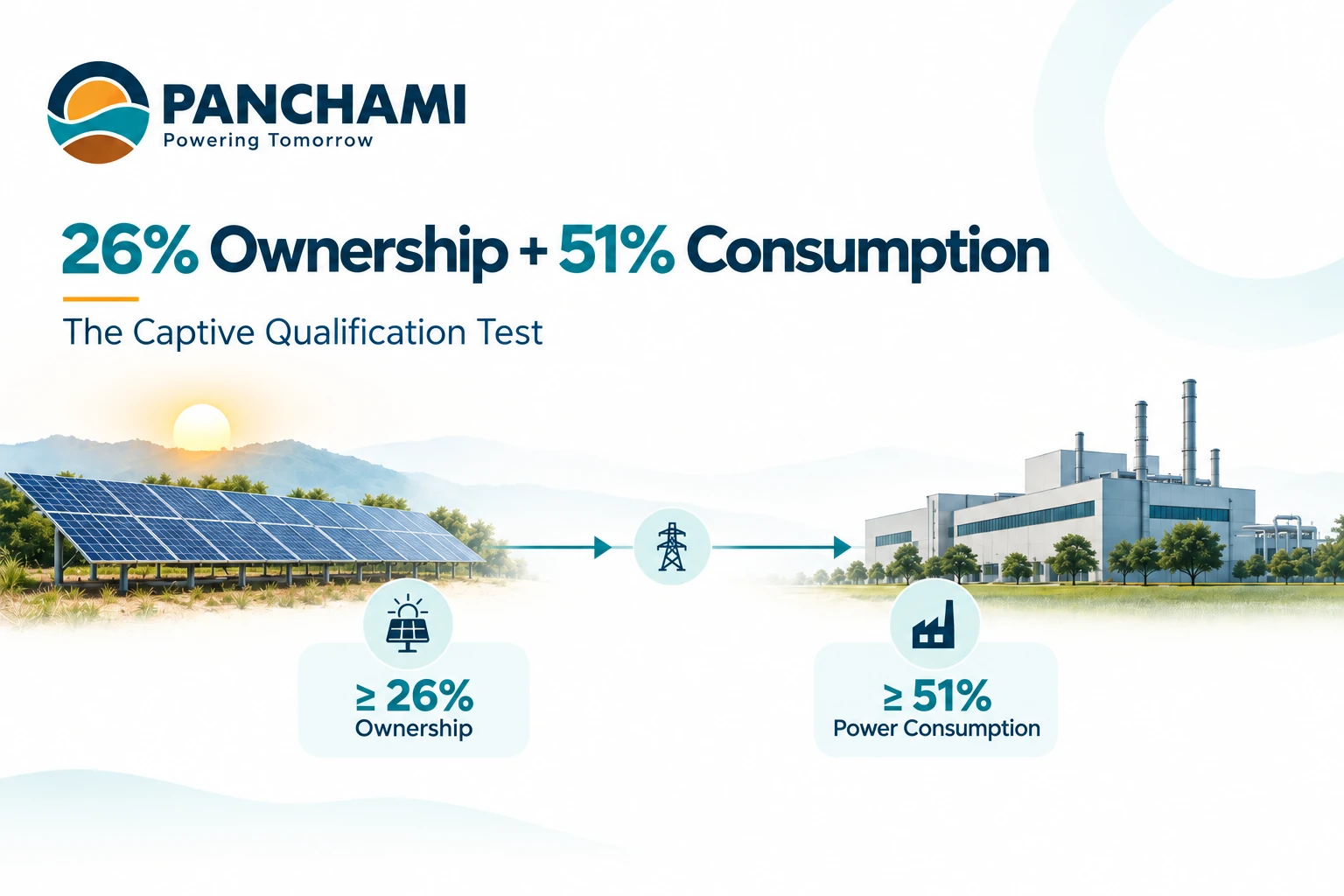
If a plant passes both requirements, its captive users do not pay cross subsidy surcharge or additional surcharge on the power they draw from it. If it fails, that power is treated like any other open access purchase and the surcharges apply.
That is why these requirements matter so much. They are not paperwork. They decide whether your savings hold up.
What Changed Under the Electricity (Amendment) Rules, 2026?
Rule 3 was the subject of years of disputes, especially for plants shared by several consumers. The Ministry of Power responded by notifying the Electricity (Amendment) Rules, 2026 on 13 March 2026, substituting Rule 3 while retaining the 26% ownership and 51% consumption thresholds.
- Company groups count as one user. A captive user that is a company now includes its subsidiaries, holding company and other subsidiaries of that holding company, treated as a single captive user.
- Storage is recognised. Power can be consumed directly or through an energy storage system and still count as captive use.
- SPVs are treated as associations of persons. A special purpose vehicle set up to own and run a generating station is treated as an association of persons.
- Consumption treatment is clearer. The amended framework changes how proportionate consumption is treated for shared captive arrangements.
- Relief during verification. Pending final verification of captive status, cross subsidy surcharge and additional surcharge are not levied when the prescribed declaration requirements are met.
These changes matter most for group captive solar projects, where several businesses share one plant through an SPV. Before signing any captive structure, have your agreements checked against the amended Rule 3.
Types of Captive Power Plants
Captive plants can be grouped by fuel, by location and by ownership.
By Fuel
- Coal and gas. The traditional form, used by energy-heavy industries such as aluminium, steel and cement.
- Solar and wind. Used by manufacturers, IT campuses, hospitals and warehouses that want lower, more stable power costs and cleaner electricity.
The scale is significant. As reported by Power Line using the Central Electricity Authority’s General Review 2025, India’s captive power capacity has crossed 80 GW.
By Location
- Onsite captive. The plant sits on your premises, such as a rooftop or ground-mounted system inside your factory boundary. Power does not travel over the public grid.
- Offsite captive. The plant sits on land elsewhere, and power reaches you through the grid under open access.
By Ownership
- Single-owner captive. One company, or one company group, owns the plant.
- Group captive. Several consumers together hold the required ownership in a plant, usually through an SPV set up for the project.
| Type | Where the plant is | Grid charges | Typical user |
|---|---|---|---|
| Onsite captive solar | On your premises | Usually none for onsite self-consumption | Sites with large roofs or spare land |
| Offsite captive solar | On land elsewhere | Transmission and wheeling charges, losses | Large users without enough space on site |
| Group captive solar | On land elsewhere, shared | Transmission and wheeling charges, losses | Businesses sharing one plant |
What Is a Captive Solar Power Plant?
A captive solar power plant is a solar plant owned by the business that uses its power, or by a group of consumers who together meet the ownership and consumption requirements. It can be built on your own premises or on land elsewhere and connected to your meter through the grid.
Most industries find their roofs cannot hold enough panels to meet demand. That is where offsite captive solar comes in. An offsite captive plant works in the same way as an open access solar power plant: the plant injects power into a substation, the power travels over the network, and your ESCOM credits the units against your consumption. The difference is that you own the plant, so captive treatment applies when the statutory requirements are met.
The right to move that power comes from the Electricity Act. If you want the legal background on how open access electricity works for any source, our explainer covers it.
How an Offsite Captive Solar Power Plant Works
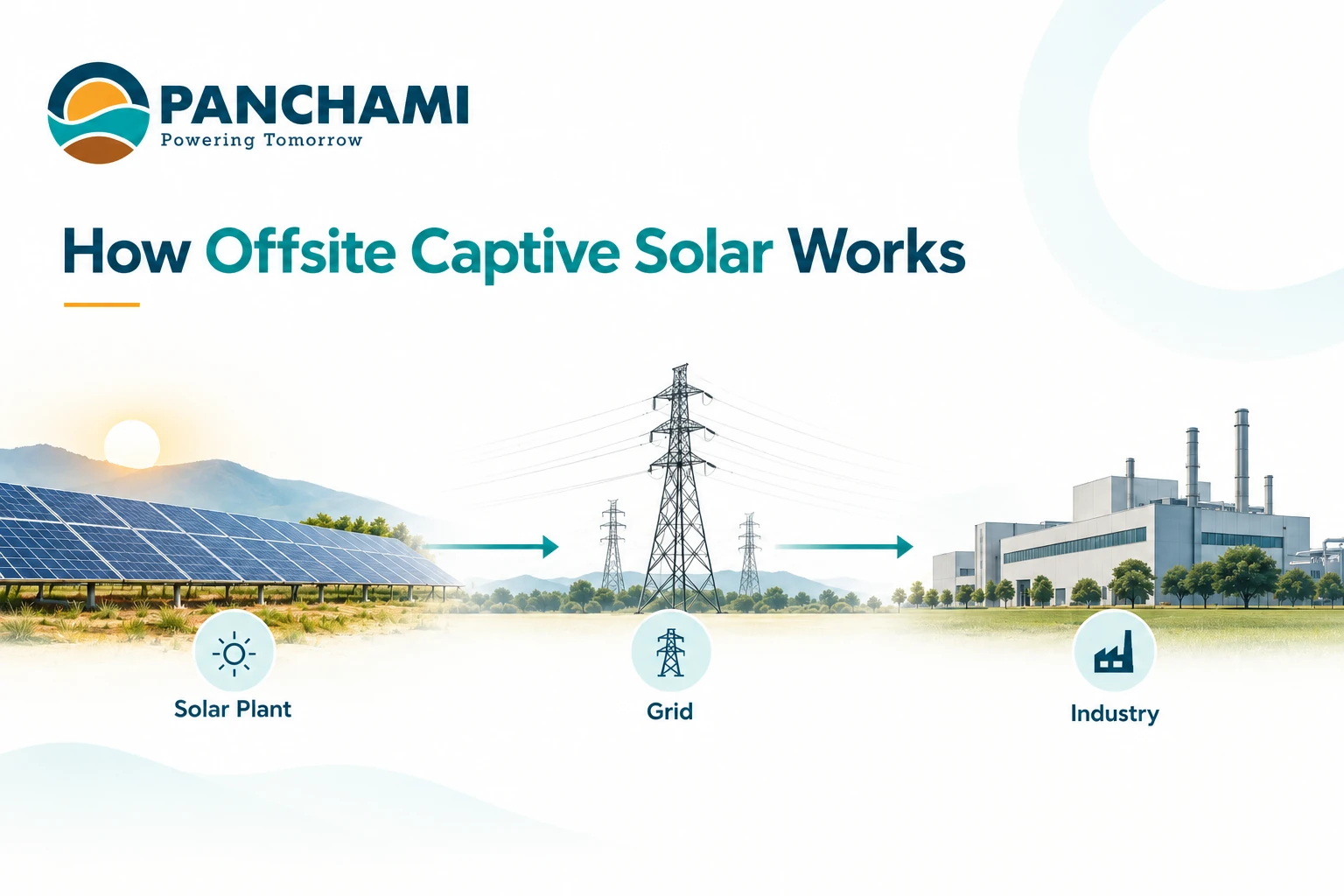
- Set up the owning company. Create a company or SPV to own the plant, or use your existing company.
- Build the plant. Secure suitable land near grid connectivity and design the plant around your load.
- Get open access approval. Apply through the relevant state process to carry power from the plant to your premises.
- Receive and adjust units. Meters record injection and consumption, and the applicable utility adjusts solar units against consumption.
- Prove captive status every year. Ownership and consumption records are verified to confirm that the plant continues to qualify.
Benefits of a Captive Power Plant
- No cross subsidy surcharge or additional surcharge when captive requirements are met. This can be a major cost advantage compared with some third-party power arrangements.
- Lower long-term power cost. Once the plant is paid for, the cost per unit is driven mainly by operations, maintenance and applicable grid charges.
- Price stability. Solar has no fuel cost, reducing exposure to fuel-price movements for the solar share of your consumption.
- An asset you own. The plant is an owned energy asset rather than only a recurring power purchase.
- Clean energy you can report. Solar units from your own plant can support sustainability reporting to customers, lenders and investors.
Costs, Risks and Compliance
A captive power plant is not the right fit for everyone. Weigh these points before deciding.
| Issue | What it means | How to manage it |
|---|---|---|
| Upfront capital | You fund most or all of the plant. | Consider group captive if capital is limited. |
| Consumption risk | If your load falls, captive consumption requirements may become harder to maintain. | Size the plant conservatively against stable load. |
| Ownership compliance | Required ownership must be maintained under the applicable rules. | Plan for restructuring, mergers and share transfers. |
| Grid charges still apply offsite | Transmission, wheeling charges and losses may remain. | Compare landed cost, not just generation cost. |
| Rule changes | Charges and verification rules can change. | Build legal review and change-in-law clauses into contracts. |
| Operations | The plant needs long-term maintenance. | Use a strong O&M contract with performance guarantees. |
How to Set Up a Captive Solar Power Plant in Karnataka
Karnataka’s open access framework allows eligible captive generating projects to use the grid, subject to the applicable regulations, approvals, metering and verification requirements. A typical project path looks like this:
- Study your load. Collect at least 12 months of bills and time-of-day data, ideally three years.
- Choose onsite, offsite or group captive. Decide based on space, capital and how much of your demand you want to cover.
- Structure ownership. Set up the owning entity so the applicable captive ownership requirements are met from the beginning.
- Secure land and connectivity. Pick a suitable site with viable grid connectivity and evacuation capacity.
- Apply for open access. File through the relevant state process with the required meters and documents.
- Commission and monitor. Track ownership and consumption through the year so annual captive verification does not become a surprise.
Frequently Asked Questions
What does captive power plant mean?
A captive power plant means a power plant set up by a person or company mainly to generate electricity for its own use. In India, it is defined in Section 2(8) of the Electricity Act, 2003.
What is a captive power plant in simple words?
It is your own power plant built for your own use. Instead of buying all your electricity from the DISCOM, you own a plant, fully or partly, and consume most of its output. It can sit on your premises or on land elsewhere, with power sent through the grid.
What are the conditions for a captive power plant in India?
Under the captive framework, ownership and annual consumption requirements determine whether a generating plant qualifies as captive. The article above explains the 26% ownership and 51% consumption thresholds and the 2026 changes.
What is a captive solar power plant?
A captive solar power plant is a solar plant owned by the business that consumes its power, or by a group of consumers who together meet the applicable ownership and consumption requirements. It can be onsite or offsite with power delivered through open access.
Do captive power plants pay cross subsidy surcharge?
Cross subsidy surcharge does not apply to qualifying captive consumption carried through open access. Other network charges and losses can still apply to offsite projects.
What changed in the captive power rules in 2026?
The 2026 amendment clarified treatment of company groups, energy storage, SPVs, proportionate consumption and captive-status verification while retaining the headline ownership and consumption thresholds.
What is the difference between captive and group captive?
In a single-owner captive arrangement, one company or company group owns the plant and uses its power. In a group captive arrangement, several consumers share ownership, commonly through an SPV, and the arrangement must satisfy the applicable captive requirements.
Conclusion
A captive power plant lets your business own its electricity source instead of relying only on grid purchases. With solar, the model can provide long-term cost visibility and cleaner power, provided the project is correctly sized, structured and monitored.
The trade-off is capital and discipline. The plant must match your real load, ownership must remain compliant, and consumption must be tracked through the year.
Find the right captive solar model for your load
Share your last 12 months of electricity bills with Panchami Global. The team can assess whether onsite, offsite or group captive solar fits your load and help estimate the landed cost per unit.