Picture a manufacturer in Mysuru with around 800 kW of demand. Its roof can hold only a small solar system. Building its own offsite plant would lock up capital it needs for machines. Buying from a third-party developer is possible, but surcharges eat into the saving.
A group captive solar power plant solves this. Several businesses share ownership of one large solar plant, each buys a small equity stake, and together they qualify for captive benefits. This guide explains how a group captive power plant works, the ownership and consumption rules after the 2026 amendment, the risks to watch, and how to join a project in Karnataka.
- A group captive solar power plant is one solar plant owned jointly by several consumers, usually through an SPV.
- Together, the consumers must own at least 26% of the plant and use at least 51% of its power each year.
- Members avoid cross subsidy surcharge and additional surcharge, which third-party buyers pay.
- The Electricity (Amendment) Rules, 2026 moved group captive compliance to a collective test, which lowers the risk of one member hurting everyone.
What Is a Group Captive Solar Power Plant?
A group captive solar power plant is a solar plant set up for the shared use of several consumers who jointly own part of it. A developer usually builds the plant through a special purpose vehicle (SPV), the consumers buy equity in that SPV, and the power is supplied to them as captive power under Indian electricity rules.
It works like a housing society. No single flat owner could afford a large generator or water treatment plant for one flat. Together, the residents share the cost, share ownership and share the output. A group captive plant does the same thing for businesses and electricity.
The idea builds on the captive model. If you are new to it, start with what is a captive power plant, which explains the legal tests that group captive projects also have to pass.
How a Group Captive Power Plant Works
A group captive power plant brings together four main parties:
- The developer, who designs, builds and usually operates the plant.
- The SPV, a company created only to own and run the plant.
- The consumers, who buy equity shares in the SPV and consume its power.
- The ESCOM and state nodal agency, which approve open access and adjust units on each consumer's bill.
Each consumer signs two sets of documents. The first is a share subscription and shareholders' agreement, which covers the equity stake, lock-in and exit terms. The second is a power supply agreement with the SPV, which fixes the tariff, tenure and minimum offtake. Since this agreement shapes your cost for many years, it helps to understand how a power purchase agreement in India is structured before you sign. Panchami's legal advisory services can support contract and regulatory review.
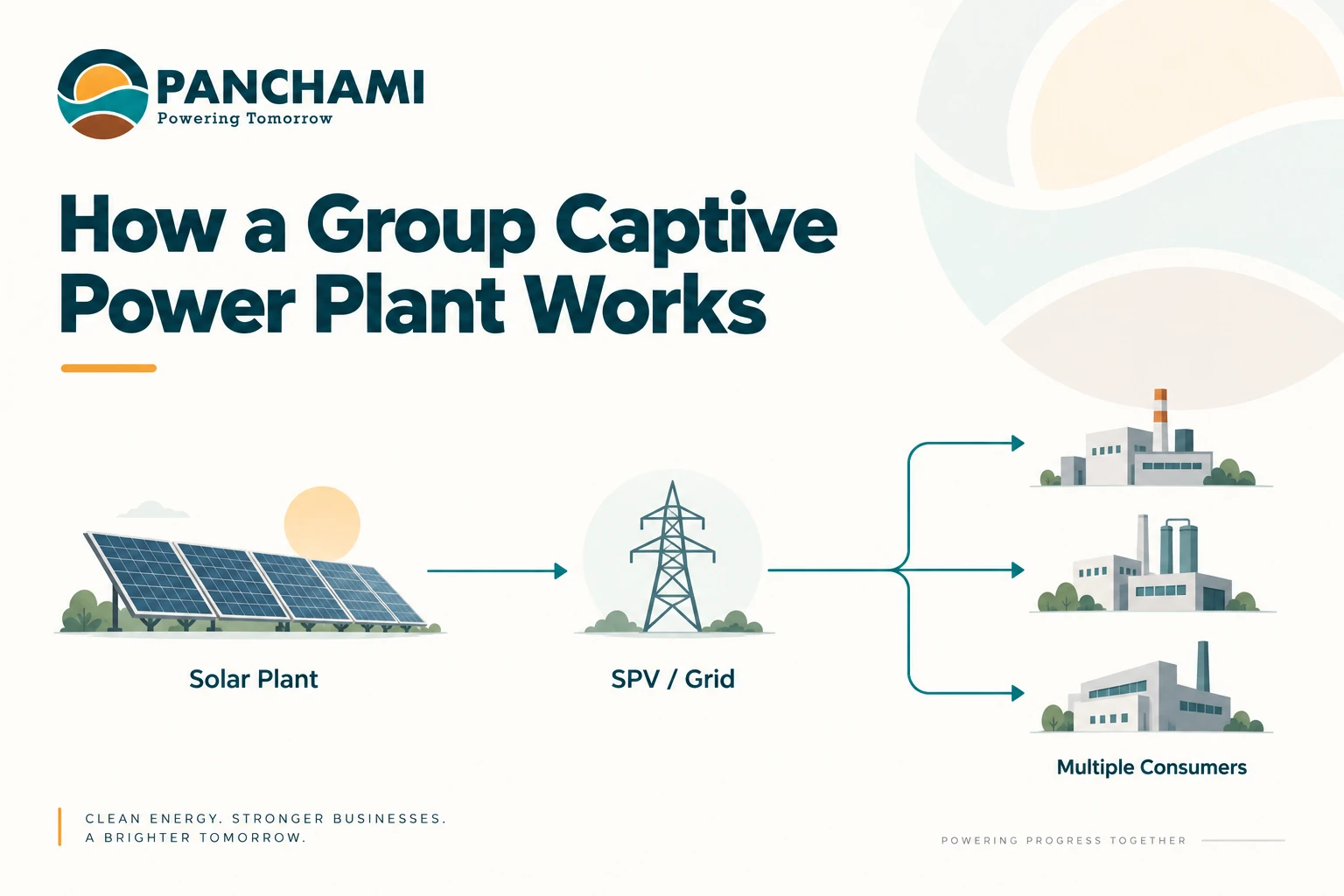
Step by Step
- The developer forms an SPV and identifies a site near a substation with spare capacity.
- Consumers sign up and subscribe to equity in proportion to the power they plan to use.
- The plant is built and connected to the grid.
- Open access approval is obtained so power can be carried to each consumer's premises.
- Each month, the solar units allocated to each consumer are adjusted on their ESCOM bill.
- At the end of each financial year, ownership and consumption are verified to confirm captive status.
A Simple Ownership Example
| Consumer | Ownership share of the plant | Share of plant's power used |
|---|---|---|
| Factory A | 10% | About 20% |
| Factory B | 8% | About 15% |
| Hotel C | 5% | About 10% |
| Warehouse D | 3% | About 6% |
| Total | 26% | About 51% |
Notice that each member uses roughly twice its ownership share. That pattern comes from the 26% and 51% tests, which works out to about 1.96% of consumption for every 1% of ownership.
Group Captive Rules After the 2026 Amendment
For years, group captive projects carried a hidden risk. Under earlier court rulings, each member had to consume power broadly in proportion to its shareholding, within a 10% variation. If one member fell short, the captive status of the whole plant could be questioned, and every member could face surcharges.
The Ministry of Power addressed this through the Electricity (Amendment) Rules, 2026, dated 13 March 2026. According to an analysis published by Law.asia, the rules keep the 26% and 51% thresholds but move group captive plants to a collective compliance framework.
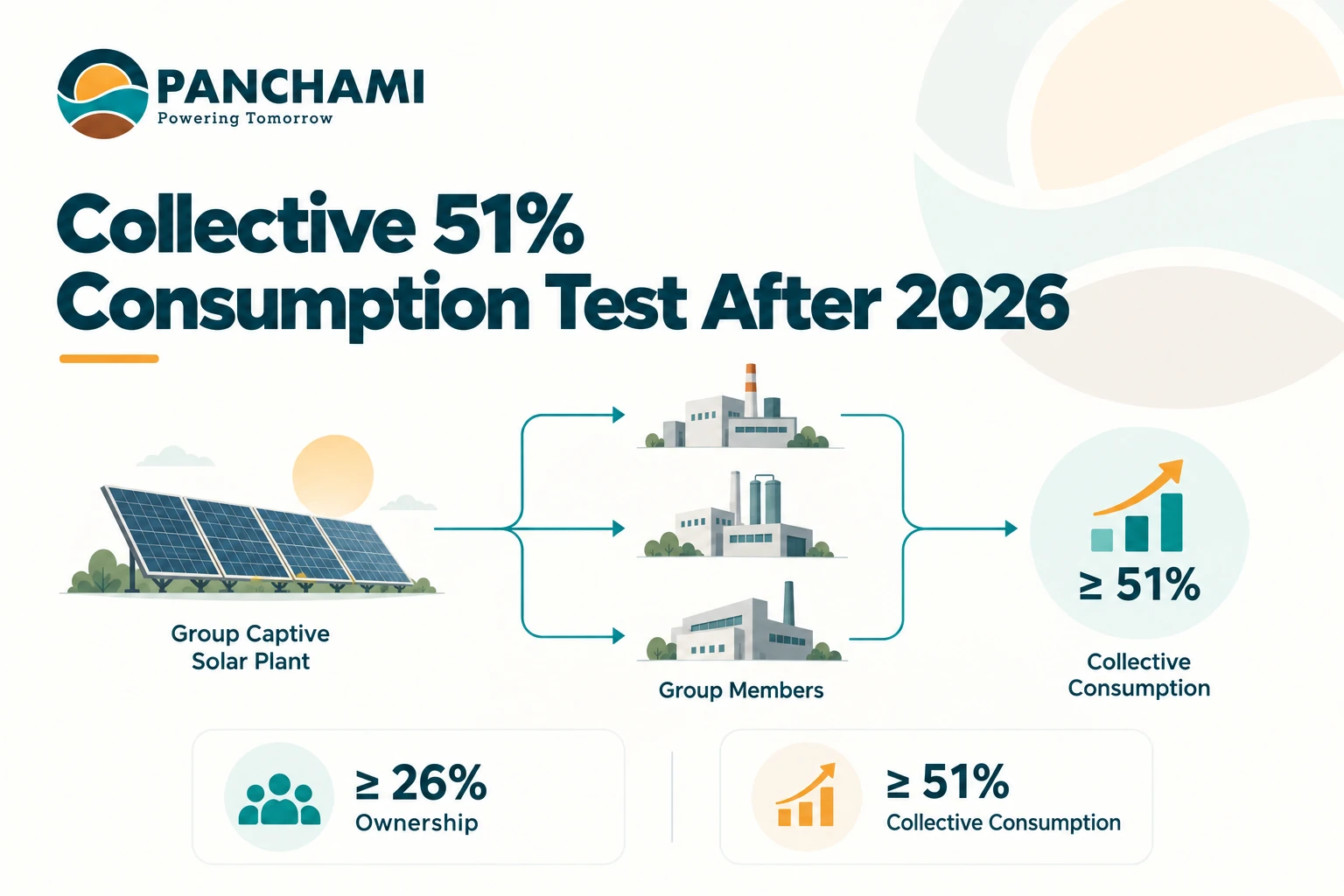
Here is what that means in practice:
| Question | Before the 2026 amendment | After the 2026 amendment |
|---|---|---|
| How is the 51% test checked? | Proportionality applied to each member. | Aggregate consumption of all members decides qualification. |
| What if one member uses more than its share? | Could put the whole plant's status at risk. | Excess does not count as that member's captive use, but still counts towards the plant's 51%. |
| What about a member holding 26% or more? | Same proportionality rules. | No proportionate ceiling, all its consumption is captive. |
| Are SPVs covered? | Settled by courts as associations of persons. | Written into the rules as associations of persons. |
| What if shareholding changes during the year? | Unclear. | Weighted average shareholding over the year is used. |
| Who verifies captive status? | Varied. | A state-designated nodal agency for intra-state plants, NLDC for inter-state plants. |
Two more points matter for your cash flow:
- During verification, members do not pay cross subsidy surcharge or additional surcharge if they file the prescribed declaration.
- If the plant fails the 51% test for the year, all its generation is treated as ordinary supply, and surcharges become payable along with carrying costs.
The collective test is good news, but it does not remove the need to plan. If enough members cut their consumption, the whole plant can still fall short.
Group Captive vs Captive vs Third Party
Group captive sits between owning a plant yourself and simply buying power. The comparison below shows why many mid-sized businesses choose it for open access solar in India.
| Factor | Captive | Group Captive | Third Party |
|---|---|---|---|
| Who owns the plant | You or your company group | Several consumers share equity in an SPV | Developer |
| Upfront investment | High | Equity stake only | None |
| Cross subsidy surcharge | Not applicable if rules are met | Not applicable if rules are met | Payable |
| Additional surcharge | Not applicable if rules are met | Not applicable if rules are met | Payable where applicable |
| Control over the plant | Full | Shared, set by shareholders' agreement | None |
| Best fit | Large users with capital | Mid-sized users with steady load | Users who want zero investment |
For businesses evaluating full ownership instead of shared ownership, Panchami's Captive Model explains the dedicated captive approach in more detail.
Benefits of Group Captive Solar
Joining a group captive solar power plant offers five main advantages.
- Captive savings without building a whole plant. Members get relief from cross subsidy surcharge and additional surcharge while investing only in an equity stake.
- Lower landed cost than third party. Because the surcharges do not apply, group captive usually lands at a lower cost per unit than a third-party supply from a similar plant.
- Long-term price certainty. The tariff is agreed for a long period, so a large part of your power cost stays predictable.
- Professional operation. The developer handles construction, maintenance and grid scheduling, so you do not need an in-house power team.
- Clearer rules since 2026. Collective compliance reduces the chance that another member's changing load affects your savings.
This matters more now because margins are tighter. According to Mercom India, savings for solar open access consumers narrowed in most states in late 2025 as PPA tariffs and charges rose, with the squeeze felt especially under the third-party model.
Illustrative Savings Comparison
For a business using 1,50,000 solar units a month (illustrative figures only):
| Option | Cost per unit | Monthly cost | Monthly saving vs ESCOM |
|---|---|---|---|
| ESCOM supply | ₹7.00 | ₹10,50,000 | Not applicable |
| Third-party open access | ₹6.00 | ₹9,00,000 | ₹1,50,000 |
| Group captive solar | ₹4.50 | ₹6,75,000 | ₹3,75,000 |
Risks and How to Manage Them
Every group captive solar power plant carries a few risks that you should plan for before signing.
| Risk | What can go wrong | How to manage it |
|---|---|---|
| Consumption shortfall | Members together fall below 51% in a year | Size the plant to firm, long-term demand and track monthly |
| Developer quality | Poor construction or maintenance lowers output | Check the developer's track record and generation guarantees |
| Lock-in and exit | You may not be able to sell shares or exit early | Read lock-in, exit price and transfer clauses closely |
| Rule and charge changes | Wheeling, banking or verification rules change | Include change-in-law clauses and model higher charges |
| Rising project costs | New module rules raise capex and tariffs | Lock the tariff and understand escalation terms before signing |
| Business changes | A merger or restructuring changes your shareholding | Plan ownership around the weighted average shareholding rule |
Questions to Ask a Group Captive Developer
- What is the landed cost per unit for my connection, with every charge listed?
- How much equity do I need, and what happens to it at exit?
- What is the lock-in period, and can I transfer my shares?
- How will you track the 51% test across all members during the year?
- Who pays if the plant loses captive status because of another member?
- What generation guarantee do you offer, and what compensation applies if output falls short?
How to Join a Group Captive Solar Project in Karnataka
Karnataka is India's largest market for open access solar, and KERC's Open Access Regulations, 2025 make captive generating projects eligible for open access. A typical path to join a group captive solar power plant looks like this:
- Share your bills and load profile. At least 12 months, ideally three years.
- Confirm eligibility. Check your connection type and the 100 kW threshold for open access in Karnataka.
- Get a landed cost comparison. Compare group captive against third party and ESCOM supply.
- Review the documents. Have the shareholders' agreement and power supply agreement checked against the 2026 amendment.
- Subscribe to equity and sign. Complete your equity investment and power supply contract.
- Apply for open access and start supply. The developer usually coordinates the application through the State Nodal Agency.
Frequently Asked Questions
What is a group captive solar power plant?
A group captive solar power plant is a solar plant jointly owned by several consumers, usually through an SPV set up by a developer. Together, the consumers must own at least 26% of the plant and consume at least 51% of its power each year to get captive benefits, such as exemption from cross subsidy surcharge.
How does a group captive power plant work?
A developer builds the plant through an SPV. Consumers buy equity in the SPV and sign a power supply agreement. Power is carried to each consumer through open access, adjusted on their electricity bills, and captive status is verified at the end of each financial year.
What is the 26% and 51% rule for group captive?
Captive users must together hold at least 26% of the plant's ownership and consume at least 51% of the electricity it generates in a financial year. Under the 2026 amendment, the 51% test is checked on the members' combined consumption, not member by member.
Do group captive solar users pay cross subsidy surcharge?
No, as long as the plant meets the captive ownership and consumption tests. Group captive users do not pay cross subsidy surcharge or additional surcharge. They still pay transmission charges, wheeling charges, losses and banking charges where applicable.
What changed for group captive in 2026?
The Electricity (Amendment) Rules, 2026 introduced collective compliance. Excess use by one member no longer disqualifies the plant, SPVs are treated as associations of persons, a member with 26% or more has no proportionate ceiling, and verification is done by state nodal agencies or NLDC.
How much do I need to invest in group captive solar?
You invest in an equity stake in the SPV, not the full cost of the plant. The amount depends on the plant size, how the project is financed and the share of power you plan to use. Ask the developer for your exact equity amount, lock-in terms and exit value.
Is group captive better than a third-party PPA?
For businesses with steady, long-term demand, group captive usually gives a lower landed cost because cross subsidy surcharge and additional surcharge do not apply. A third-party PPA needs no equity and suits businesses that prefer zero investment or expect their load to change.
Conclusion
A group captive solar power plant gives mid-sized businesses the biggest advantage of owning a captive plant, freedom from surcharges, without the capital burden of building one alone. The 2026 amendment has made the model safer by judging consumption collectively, but good planning still matters. Size the plant to steady demand, choose a developer carefully, and read the equity and supply agreements closely.
Your next step: Share your last 12 months of electricity bills with Panchami Global. We will check whether group captive solar suits your load and show you the landed cost per unit compared with third-party supply and your current ESCOM tariff.
Check whether Group Captive Solar fits your business
Share your electricity bills and load profile with Panchami Global to compare group captive solar with third-party supply and your current ESCOM tariff.