
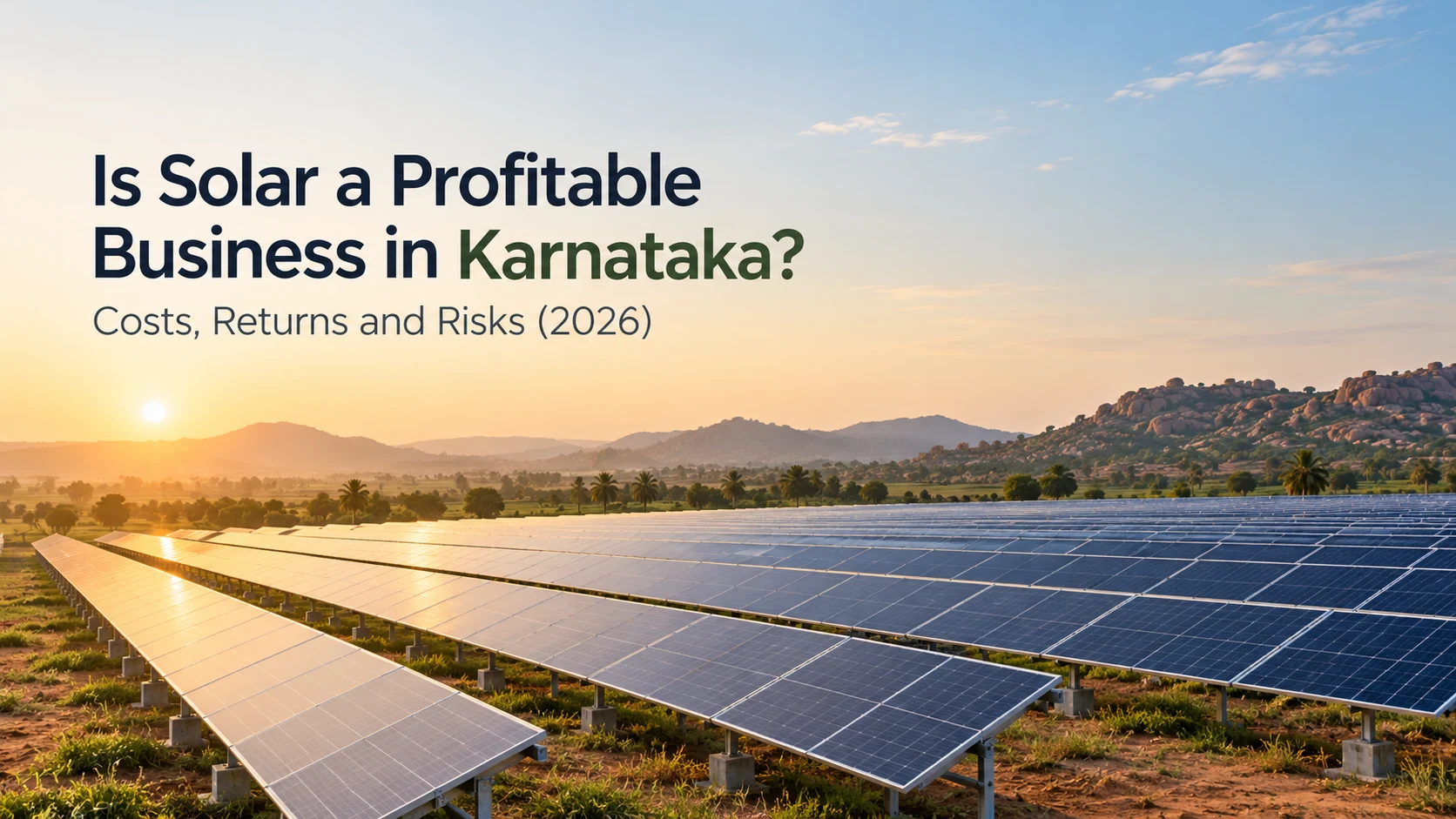
Yes, solar can be a profitable business in Karnataka, but profit depends on which part of the business you are in. Owning a solar farm that sells power on a long-term contract can generate steady returns, while installing or reselling panels earns margins rather than long-term power-sale income.
Karnataka is one of the strongest solar markets in India. It had 11,535 MW of solar installed as of June 2026, and it leads the country's open access solar market, where solar farms sell power directly to businesses.
Panchami Global is a solar company in Karnataka that develops solar farms and supplies their power to businesses. This guide explains where the money in solar comes from, what returns can look like, and the risks to plan for before you invest.
The Four Ways to Make Money from Solar
“Solar business” covers very different businesses with very different profit structures. Before asking whether solar is profitable, decide which of these four models you mean.
| Model | How you earn | Upfront investment | Main risk | Suits |
|---|---|---|---|---|
| Solar farm selling to a DISCOM | Fixed tariff per unit for about 25 years | High | Low tariffs, payment delays | Investors who want a government-backed buyer |
| Solar farm selling to businesses (open access, group captive) | Agreed rate per unit | High | Buyer's credit, rule changes | Investors seeking higher income per unit |
| Leasing land to a developer | Fixed yearly rent | None | Very low | Landowners who want passive income |
| Installation, EPC or dealership | Margin on each project or sale | Low to medium | Competition, thin margins | People who want to run a services business |
The first three can create recurring income over many years once the plant is built. Installation and dealership work is different: profit depends on the number and margin of projects you win each year. The rest of this guide focuses on solar farms, where the long-term investment economics sit.
Where the Money Comes From in a Solar Farm
A solar farm earns money in one simple way: units generated × selling price per unit. Profit is what remains after building, operating and financing the plant.
Here are the main numbers for a 1 MW ground-mounted plant, based on a SolarQuarter cost guide from October 2026:
| Item | Typical figure |
|---|---|
| Building cost | ₹3.5 to ₹5 crore per MW, excluding land |
| Land | 4 to 5 acres per MW, bought or leased |
| Generation | 14 to 17 lakh units per MW per year |
| Gross income at ₹3 per unit (illustrative) | About ₹42 lakh to ₹51 lakh per MW per year |
The ₹3 per unit figure is only an illustration, not a Panchami quote or guaranteed Karnataka PPA rate. Your actual selling price depends on the buyer, project model, grid charges and the contract you sign.
From gross income you pay for maintenance, insurance, land lease if any, grid-related charges and loan interest. Panels also lose some output over time. For a per-acre breakdown of these numbers, see how much profit a 1 acre solar plant makes in Karnataka.
What Returns Look Like
An April 2026 study by CEEW, IISD and CSTEP, which included fieldwork in Karnataka, estimated average returns of 11% to 16% for landowners who invested in their own solar plants. The same study reported around ₹30,000 per acre per year for landowners who leased land instead.
Returns move with three things: the price you sell power at, how much the plant generates, and how you finance it. Debt can increase returns on your own equity, but it also adds interest, repayment pressure and risk. Treat unusually high return claims carefully and ask what assumptions sit behind them.
Why Karnataka Is a Good Place for a Solar Business
Karnataka combines strong sunlight, an experienced solar ecosystem and a large base of commercial and industrial consumers already buying renewable power.
- A ready market of buyers. Karnataka holds 21% of India's 36 GW of open access solar, the largest share of any state, according to the source cited in the draft.
- Strong business demand. Mercom has noted that rising grid electricity tariffs are strengthening the case for solar for commercial and industrial consumers.
- Rooftop and off-site options coexist. Businesses can combine rooftop solar with off-site power models depending on their load, roof and investment preference.
The Risks to Plan For
Solar is a long-term business, so the main risks are the ones that can change over a 25-year project life.
- Rule changes. Karnataka's open access framework has changed several times. KERC published draft General Network Access regulations in June 2026. Because the supplied source does not verify whether those draft regulations are now final, do not base an investment decision on the draft terms alone.
- Equipment costs. Higher commodity prices and currency movements can increase module and balance-of-system costs.
- Panel sourcing rules. The source notes that ALMM List-II requirements can affect cell sourcing and project cost for projects commissioned after the stated exemption period.
- Buyer risk. Your income depends on the buyer paying over the life of the contract. Buyer credit matters as much as the tariff.
- Land and grid connection. A site far from a substation, or with unclear title, can make a project uneconomic before construction starts.
Is a Solar Business Right for You?
The right route depends on what you bring to the table:
- You own suitable land but do not want to invest: consider leasing it to a developer for steady rent.
- You have capital and want long-term income: consider investing in a solar farm with a long-term buyer.
- You run a business with high power bills: you may not need to become a solar investor at all. Buying solar through open access may reduce your energy cost without owning the plant.
Frequently Asked Questions
Is solar business profitable?
It can be, if you pick the right model. Owning a solar farm with a long-term buyer can provide steady income for about 25 years, while installation and dealership businesses earn project margins instead. The 2026 study cited in this guide estimated average returns of 11% to 16% for landowners who invested in their own solar plants.
How much does it cost to start a solar farm in Karnataka?
A ground-mounted solar farm is estimated at about ₹3.5 to ₹5 crore per MW excluding land, and needs roughly 4 to 5 acres per MW. Land, approvals and grid connection costs vary by site.
What is a good return on a solar farm investment?
The cited 2026 study estimated average returns of 11% to 16% for landowners who invested in their own plants. Your actual return depends on tariff, generation, operating costs and financing.
Is it better to sell solar power to a DISCOM or to businesses?
A DISCOM offers a government-backed buyer but often at a lower tariff. Selling to businesses through open access or group captive may produce a higher rate per unit, but adds buyer-credit and regulatory risk.
How long does a solar farm earn money?
Solar plants are typically built and contracted for about 25 years. Output generally declines gradually over time, so project models should account for degradation and maintenance.
The Bottom Line
Solar can be a profitable business in Karnataka when the project is built on a good site, sold to a reliable buyer and planned around real costs and changing rules. It rewards patience: the money comes steadily over many years, not all at once.
Panchami is one of the solar companies in Karnataka that develops solar farms with investors and landowners and supplies their power to businesses.
Considering a Solar Investment?
Share your land, budget or power-sale objective with Panchami Global. We can help you compare the project models and understand the economics and risks before you commit capital.