
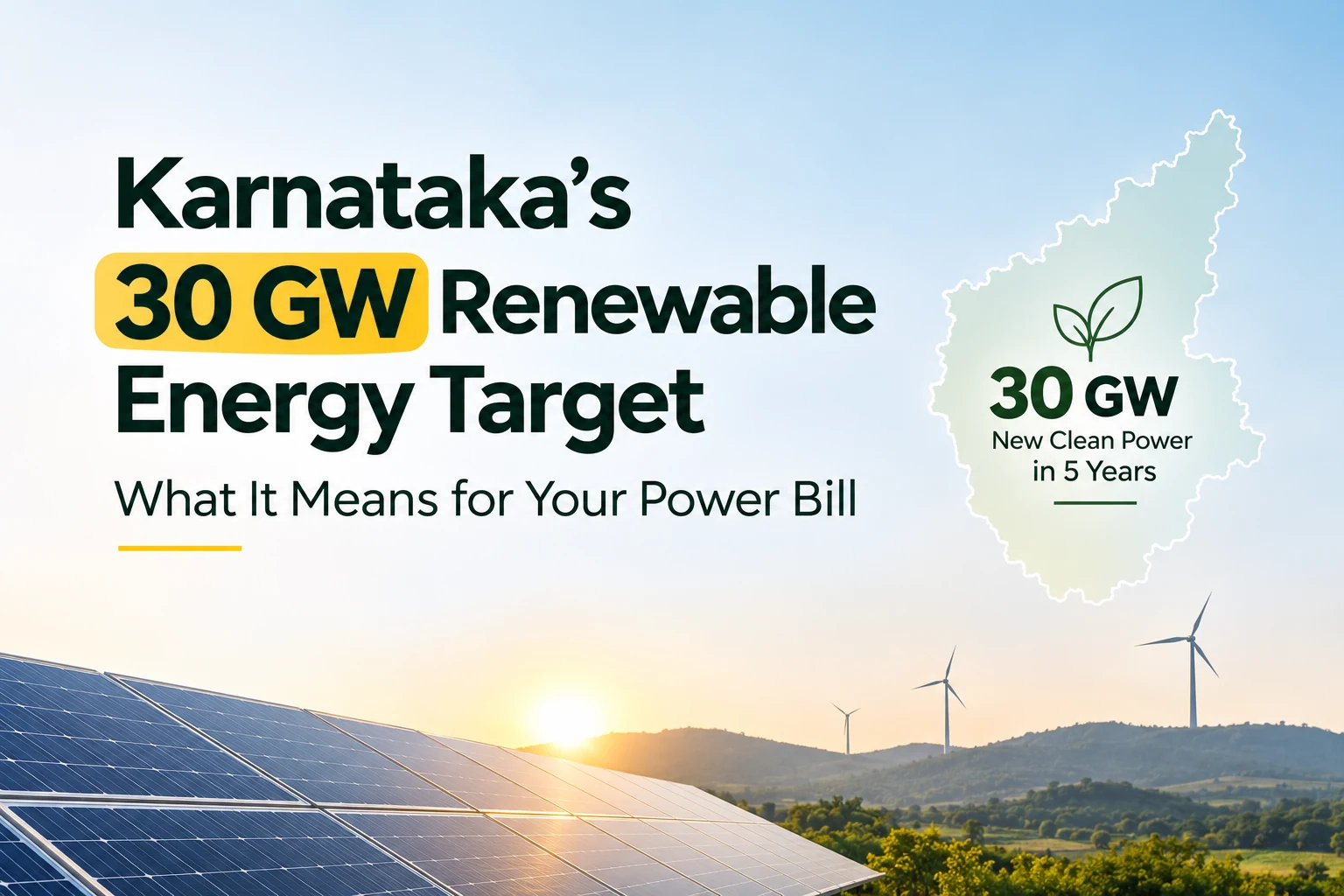
Karnataka wants to add about 30 GW of new renewable energy capacity over the next five years and attract roughly ₹3 lakh crore in investment, according to a Whalesbook report published on November 5, 2026. For factories, warehouses and commercial buildings, this Karnataka renewable energy target matters for one reason: it shapes the power market you will be buying from over the next decade.
This guide explains the plan in plain words, what changed this week, and what a business owner can do about it now.
What Is Karnataka's 30 GW Renewable Energy Target?
Karnataka's 30 GW target is a state push to add about 30 GW of solar, wind and storage capacity over five years. The government wants around ₹3 lakh crore of investment. It has also asked the power regulator, KERC, to let market bidding set prices for new projects instead of fixed tariff caps.
The push builds on a roadmap the state shared in September 2026. Additional Chief Secretary (Energy) Gaurav Gupta said Karnataka plans to grow installed capacity from over 39 GW to 66 GW by 2030, and that this growth will remain overwhelmingly green, according to Deccan Chronicle / PTI reporting from September 3, 2026.
Karnataka Power at a Glance
| Figure | Reported number | Source in supplied draft |
|---|---|---|
| Installed capacity today | Over 39 GW | Energy Department via PTI, Sep 2026 |
| Share from hydro and renewables | About two-thirds | Energy Department via PTI, Sep 2026 |
| Capacity target by 2030 | 66 GW | Energy Department via PTI, Sep 2026 |
| New renewable push | About 30 GW in five years | Whalesbook, Nov 2026 |
| Private investment expected | ₹2–3 lakh crore | PTI, Sep 2026; Whalesbook, Nov 2026 |
Why Does Karnataka Need So Much More Clean Power?
Karnataka needs more electricity because demand is expected to rise sharply over the next decade. The Energy Department links that growth to industrial expansion, electric vehicles and large data centres in Bengaluru, Mysuru and Mangaluru.
The state is also adding ways to store and move that power. The supplied source points to the 2,000 MW Sharavathi pumped-storage project, large batteries at KPTCL substations and the expansion of the Pavagada solar ecosystem.
New generation is already being added. Tata Power commissioned a 300 MW solar project in Koppal during the same week this article was prepared.
What Is the Tariff Change Karnataka Has Asked KERC For?
The state has asked KERC to move away from fixed tariff caps for new renewable projects and allow competitive bidding to discover prices. The argument is that fixed caps can fail to reflect actual equipment and financing costs.
The draft also notes that KERC moved in the opposite direction in an August 2026 rooftop-solar benchmark order, setting the rate for rooftop solar power sold to the grid at ₹3.89 per unit, excluding subsidy, according to a Drishti IAS summary dated August 28, 2026.
What Does the 30 GW Push Mean for Karnataka Businesses?
For businesses, the push means more solar and wind supply, more project developers competing for buyers, and more grid and storage infrastructure. It does not automatically reduce your grid tariff.
The practical saving comes from comparing your current effective grid cost with long-term solar procurement through models such as open access or group captive solar.
- More choice of supply. More projects in the state can mean more developers offering long-term solar contracts to businesses.
- A stronger grid. The supplied source reports transmission losses below 3% and continued investment in lines and substations.
- Your grid bill remains exposed to tariff changes. Long-term solar contracts can reduce some of that price uncertainty by fixing the solar component for many years.
As an example, the supplied Panchami draft uses a group-captive delivered price of about ₹4.73 per unit with a small equity stake, or about ₹5.03 per unit with zero upfront investment. It compares this with many HT industrial consumers paying ₹7 or more per unit after demand charges and surcharges, and positions the gap as the basis for savings of up to 30% or more. Your actual result depends on your load, tariff category, contract structure and applicable charges.
If you are comparing suppliers, look for a solar company in Karnataka that handles KERC approvals, wheeling and banking paperwork end to end. Panchami's open access model page explains the off-site solar structure.
What Should a Factory Owner Do Now?
A factory owner should first calculate the true effective cost of grid power, then compare it with the solar options available to the business. The goal is to compare long-term delivered cost rather than only the first-year rate.
- Pull your last 12 months of electricity bills. Note total units, contract demand and your effective cost per unit including all charges.
- Check your eligibility. The supplied source cites Karnataka's draft open-access rules as proposing a 100 kW contract-demand minimum for most consumers, with captive consumers exempt from that limit.
- Compare 15 to 25 years, not one year. Put your expected grid-cost trend next to the long-term solar PPA structure.
- Get a bill analysis before signing. Your load shape, contract demand and tariff category can materially change the economics.
For a deeper look at eligibility, market growth and the draft 2026 framework, read our guide to open access solar in Karnataka.
Frequently Asked Questions
Is Karnataka's 30 GW target official policy?
The 30 GW figure was reported on November 5, 2026 as a state push with a request to KERC on tariffs. It builds on the September 2026 roadmap to reach 66 GW of installed capacity by 2030. The next things to watch are KERC's formal response and new project or tender announcements.
Will the 30 GW plan reduce my electricity bill?
Not directly. More renewable supply can strengthen the market over time, but your grid tariff is still set under KERC's tariff framework. A business can separately compare long-term solar power through open access or group captive with its current effective grid cost.
What is the difference between a tariff cap and market bidding?
A tariff cap sets a maximum price for power from a project. Market bidding lets developers compete to supply power at discovered prices. Karnataka has asked KERC to rely more on competitive bidding for new renewable projects.
Can a small factory benefit from Karnataka's renewable push?
Potentially yes. The source cites a draft 100 kW open-access minimum for most consumers, while smaller businesses with suitable roofs can evaluate rooftop solar. The right route depends on the current rules and the site's power profile.
Who regulates solar tariffs in Karnataka?
The Karnataka Electricity Regulatory Commission sets electricity tariffs, open-access rules and solar benchmark rates. BESCOM, MESCOM, HESCOM, GESCOM and CESC apply the relevant rules to their consumers.
Get Your Free Power Cost Analysis
Want to know what Karnataka's renewable push means for your own bill? Share your latest electricity bill with Panchami Global and get a free savings analysis within 24 hours.