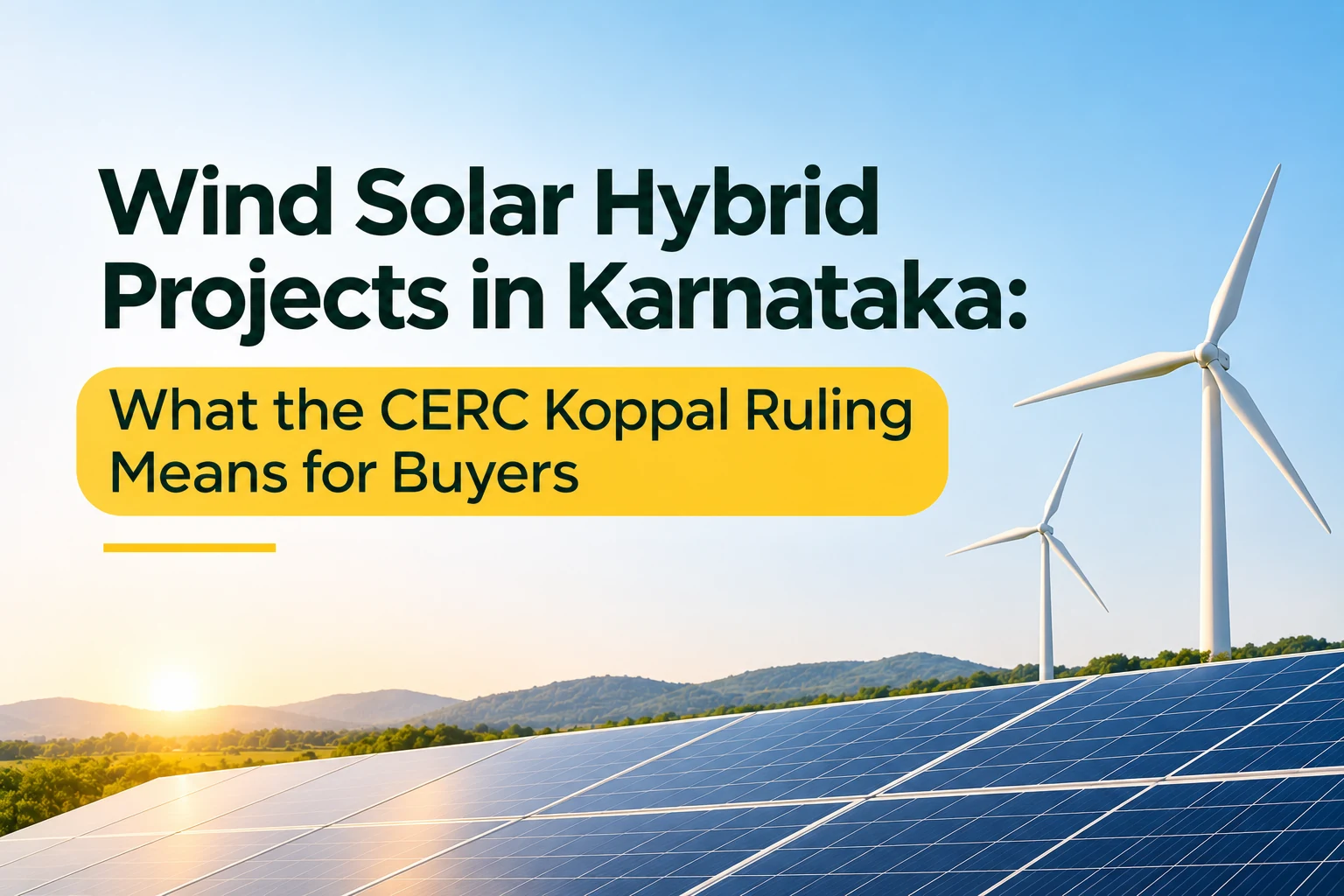
A wind solar hybrid project in Karnataka has just set an important rule for the sector. On November 2, 2026, the Central Electricity Regulatory Commission (CERC) refused to treat a 160 MW blended wind-solar project in Koppal as a wind-only plant for deviation penalties, according to the SolarQuarter report cited in the supplied article. The practical message is simple: if a project mixes solar with wind, it follows hybrid rules.
This post explains the case in plain words and what it means if your business is thinking about hybrid power.
What Did CERC Decide in the Koppal Hybrid Case?
CERC dismissed a petition from Vena Energy Vidyuth Private Limited, which wanted its 160 MW Koppal project treated only as a wind plant when calculating deviation penalties. Because the project combines wind and solar, CERC kept it in the hybrid category under the Deviation Settlement Mechanism Regulations, 2024.
| Case detail | Fact |
|---|---|
| Project | 160 MW blended wind-solar, Koppal district |
| Mix | 129.6 MW wind (81%) and 30.4 MW solar (19%) |
| Developer | Vena Energy Vidyuth Private Limited |
| Built under | MNRE 2020 Blended Wind Guidelines, with minimum 80% wind in the supplied source |
| What it asked for | Wind-only treatment for deviation penalties |
| CERC order | November 2, 2026: petition dismissed, hybrid status retained |
The supplied article also notes that the project sells power to SECI under a 25-year agreement, based on an ICRA rating note from October 2024, and that the winning tariff was ₹2.99 per unit according to Mercom India.
What Is the Deviation Settlement Mechanism?
The Deviation Settlement Mechanism, or DSM, is the set of grid rules that charge power plants when actual output differs too much from the generation they scheduled. Renewable generators forecast how many units they will inject into the grid. If actual generation moves outside the permitted band, deviation charges can apply.
Think of it like booking transport for a delivery. If the amount sent is very different from what was planned, someone still has to absorb the mismatch. The grid has the same balancing problem when renewable generation differs from forecast.
The supplied article says the allowed deviation margin for hybrid projects was tightened from up to 10% earlier to 5% from April 2026, based on SolarQuarter reporting. CERC did not allow the Koppal project to switch to wind-only treatment for this purpose.
Karnataka also has state-level forecasting, scheduling and deviation-settlement rules for renewable generators, including wind, solar and hybrid sellers, according to the KERC summaries referenced in the supplied article.
Why Does the Ruling Matter for Hybrid Power Buyers?
The ruling matters because it confirms that blended wind-solar projects will continue to be judged under hybrid rules. For developers, that means better forecasting, stronger scheduling systems and, in some projects, storage can become more important to manage deviation risk.
For a business buyer, three things matter:
- Forecasting quality becomes a real project cost. Developers with better weather data, forecasting software and operations teams may manage deviation exposure more effectively.
- Storage becomes more attractive. A battery can help smooth differences between forecast and actual renewable output. Read our guide to solar with battery storage in Karnataka.
- Contract terms matter. A well-written power purchase agreement should clearly state who bears deviation charges rather than leaving the risk ambiguous.
Is Wind Solar Hybrid Power a Good Fit for Karnataka Factories?
Wind-solar hybrid power can suit factories that operate for long hours, especially into the evening or night. Solar generation is concentrated in daylight hours, while wind generation in Karnataka can complement that pattern, including during periods when solar output is weaker.
Koppal and the wider North Karnataka belt are attractive for hybrid development because the region combines strong wind conditions, good sunshine and important grid infrastructure. That is one reason mixed renewable projects are clustering there, as covered in our guide to the Koppal solar hub.
| Your factory profile | What usually fits |
|---|---|
| Day shift only, around 8–10 hours | Solar through open access or group captive |
| Two shifts with some evening load | Solar with banking where allowed, or a solar-wind hybrid |
| Round-the-clock operation | Wind-solar hybrid, potentially with storage |
| Smaller load with usable roof space | Rooftop solar |
Panchami develops solar farms and renewable-energy solutions for Karnataka industries. Businesses evaluating off-site procurement should also compare open access and group captive structures based on load profile, investment preference and contract risk.
Frequently Asked Questions
What is a wind solar hybrid project?
A wind-solar hybrid project combines wind turbines and solar panels at one site or connection point and sells their combined output. Because wind and solar often peak at different times, the combination can provide renewable power across more hours than either source alone.
What did CERC decide in the Koppal case?
On November 2, 2026, CERC dismissed Vena Energy's request to treat its 160 MW blended wind-solar project in Koppal as wind-only for deviation penalties. The project remains classified as a hybrid project for the purpose described in the supplied source.
What is the Deviation Settlement Mechanism?
It is a set of grid rules that impose charges when actual generation differs from scheduled generation beyond the allowed range. The supplied article says the hybrid deviation band was tightened to 5% from April 2026.
Does this ruling affect my factory's power bill?
Not directly. Deviation charges are paid at the project level, but they affect project economics and can influence the price a developer offers. Check the PPA to see who bears deviation-related charges.
Is hybrid power better than solar alone for industries?
For factories that operate in the evening, at night or around the clock, hybrid power can cover more hours of consumption with renewable energy. For day-only operations, solar alone may be simpler. A load study is the better way to compare the options.
Get Your Free Power Cost Analysis
Not sure whether solar or hybrid suits your load? Send Panchami your last 12 months of electricity bills and get a free analysis of the best mix for your plant.