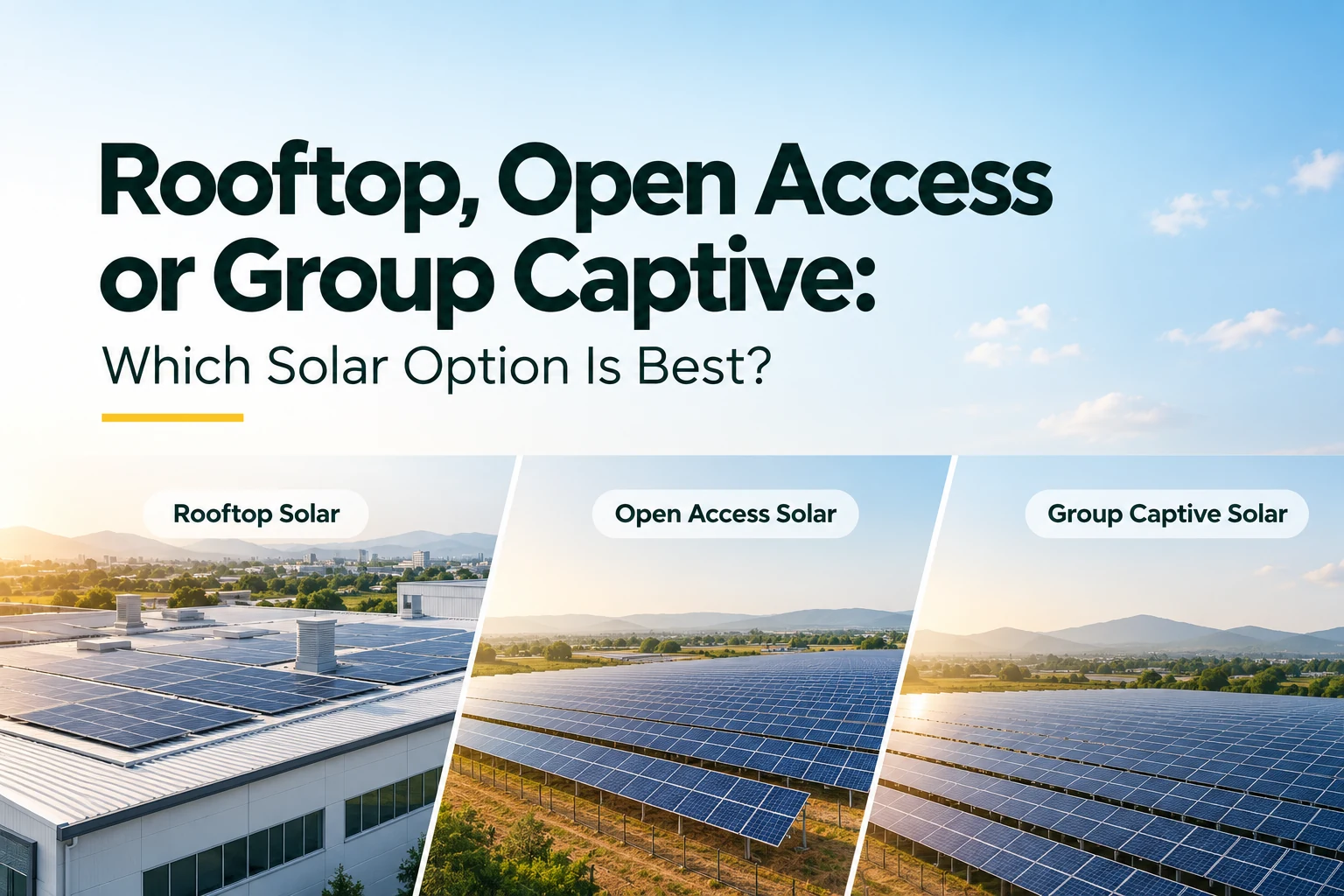
The best solar option for a business depends on three things: how much roof you have, how much power you use, and whether you want to invest. Rooftop solar suits businesses with large, strong roofs. Open access suits high power users with little roof space. Group captive suits high power users who want a lower delivered rate and can invest in a share of a plant.
There is no single best type of solar power plant for every business in India. A small office, a textile mill and a cold-storage warehouse can each end up with a different answer, even in the same town. This guide compares the main options side by side so you can see which fits your business.
Panchami Global is a solar company in Karnataka that offers rooftop, open access and group captive solar, so the comparison starts with your load, roof and investment preference rather than one fixed product.
Types of Solar Power Plant: A Quick Map
Solar power plants can be grouped in three ways: how they connect to the grid, where they sit, and who owns them. For a business comparing options, ownership and commercial model matter most because they decide investment, control, billing and risk.
| Grouped by | Types | What it means for a business |
|---|---|---|
| Grid connection | On-grid, off-grid, hybrid | Most businesses use on-grid plants alongside grid power |
| Location | Rooftop, ground-mounted | Rooftop uses your building; ground-mounted plants sit on land, often away from your site |
| Ownership and model | CAPEX rooftop, OPEX rooftop, open access, group captive, captive | Decides who pays, who owns the plant and how power is billed |
The rest of this guide compares the three ownership models most Karnataka businesses choose between: rooftop, open access and group captive.
Rooftop vs Open Access vs Group Captive at a Glance
| Rooftop solar | Open access (third party) | Group captive | |
|---|---|---|---|
| Where the plant sits | On your roof | On a solar farm elsewhere | On a solar farm elsewhere |
| Who owns it | You (CAPEX) or a developer (OPEX) | The developer | You and other participating consumers own a share |
| Upfront investment | Full cost under CAPEX; none under OPEX | None under the third-party model | A share of the plant's equity |
| Size | Limited by roof and applicable net-metering rules | Designed for larger loads | Designed for larger loads |
| Grid charges | Limited because power is used on site | Open-access charges apply | Captive treatment changes the applicable charge structure while captive status is maintained |
| Best for | Businesses with large, strong roofs | High power users with little roof space | High power users willing to invest for a lower delivered rate |
Rooftop Solar: Best When You Have the Roof
Rooftop solar is best suited to businesses with a large, shadow-free, structurally sound roof and steady daytime consumption. The electricity is generated and used on site, so it avoids many of the network charges associated with off-site power.
Karnataka's 2026 distributed solar regulations, as cited in the source, allow net-metered systems up to 1,000 kW for consumer categories covered by the regulations.
The limit is space. A common planning figure is around 100 square feet per kW. You can own the plant under CAPEX or let a developer fund it under OPEX. See Panchami's commercial rooftop solar page or our guide to commercial rooftop solar installation in Karnataka.
Open Access: Best When Roof Space Runs Out
Open access solar is suited to businesses with high electricity use but little or unsuitable roof space. The solar plant sits on a farm elsewhere in Karnataka, and the power reaches the business through the existing grid. Under the third-party model, the developer owns the plant and the customer pays for the electricity supplied.
The trade-off is grid-related charges. Open-access power uses the transmission and distribution network, so its delivered cost includes charges that rooftop power can avoid.
The source cites KERC's June 2026 draft General Network Access regulations as proposing a 100 kW minimum sanctioned load or contract demand for open-access consumers.
Learn more about Panchami's open access model.
Group Captive: Best for Businesses Willing to Invest
Group captive solar is designed for high power users who are willing to invest in a share of a solar plant. Several businesses participate in the same plant and consume its power through the grid.
The consumers together must own at least 26% of the plant and use at least 51% of its output each year to maintain group-captive status under the rule described in the source.
If the group fails the required consumption test, the expected captive benefits can be affected. That makes consumption forecasting and ongoing group management important. See Panchami's group captive solar model.
The source does not provide a verified current cross-subsidy surcharge figure for Karnataka HT industrial consumers, so this article does not assign a specific rupee saving to group captive. The delivered saving should be calculated using the current KERC charge structure when the project is evaluated.
What About Captive Solar?
Captive solar generally means one business owns the plant and uses the power itself. It offers more control than shared ownership but requires significantly more capital and enough electricity demand to absorb the plant's generation. It normally suits very large consumers.
Can You Combine Options?
Yes. A business may use rooftop solar for part of its daytime base load and open access or group captive for additional demand. The combination has to fit the applicable metering, open-access and contractual rules, so sizing should be done as one integrated energy model rather than as separate products.
Which Solar Option Fits Your Business?
Use this as a starting point. Your actual electricity bills, load profile, roof survey and contract terms decide the final answer.
| Your situation | Likely best fit |
|---|---|
| Large, strong roof, daytime load, money to invest | Rooftop solar, CAPEX |
| Large, strong roof, prefer not to invest | Rooftop solar, OPEX |
| High power bill, little roof space, no upfront investment preference | Open access, third-party model |
| High power bill, willing to invest for a lower delivered rate | Group captive |
| Very large single site, wants full ownership and control | Captive solar |
| Smaller load that does not suit open access | Rooftop solar |
Each option has its own drawbacks, from daylight-only output to changing grid rules. Our guide to the disadvantages of solar energy explains how businesses handle those limitations.
Frequently Asked Questions
What is the best solar option in India for a business?
There is no single best option. Rooftop solar suits businesses with a large, strong roof and daytime load. Open access suits high power users with little roof space and no wish to own the plant. Group captive suits high power users willing to invest in a share of a plant.
What are the types of solar power plant?
Solar power plants can be grouped by grid connection, location and ownership model. For businesses, common ownership models include CAPEX rooftop, OPEX rooftop, open access, group captive and captive solar.
What is the difference between open access and group captive solar?
Under third-party open access, the developer owns the plant and the customer pays for power. Under group captive, participating consumers own at least 26% of the plant and collectively consume at least 51% of its output to maintain captive status.
Is rooftop solar cheaper than open access?
Rooftop can have a lower delivered energy cost because the power is used on site and avoids several grid-related charges. But rooftop capacity is limited by usable roof area. Open access can serve much larger loads.
Can a small business use open access solar?
Open access generally suits larger consumers. The source for this article cites a June 2026 KERC draft proposing a 100 kW minimum, but does not verify that the proposal is now final. Smaller businesses often evaluate rooftop solar first.
The Bottom Line
The best solar option is the one that matches your roof, electricity demand and willingness to invest. Many businesses eventually use more than one model: rooftop for what the roof can carry, and open access or group captive for the rest.
Panchami is one of the solar companies in Karnataka that works across these models, so the comparison can start with your site rather than with one fixed solution.
Which Solar Model Fits Your Business?
Bring your last 12 months of electricity bills and basic roof details. Panchami Global can compare rooftop, open access and group captive for your actual load and investment preference.