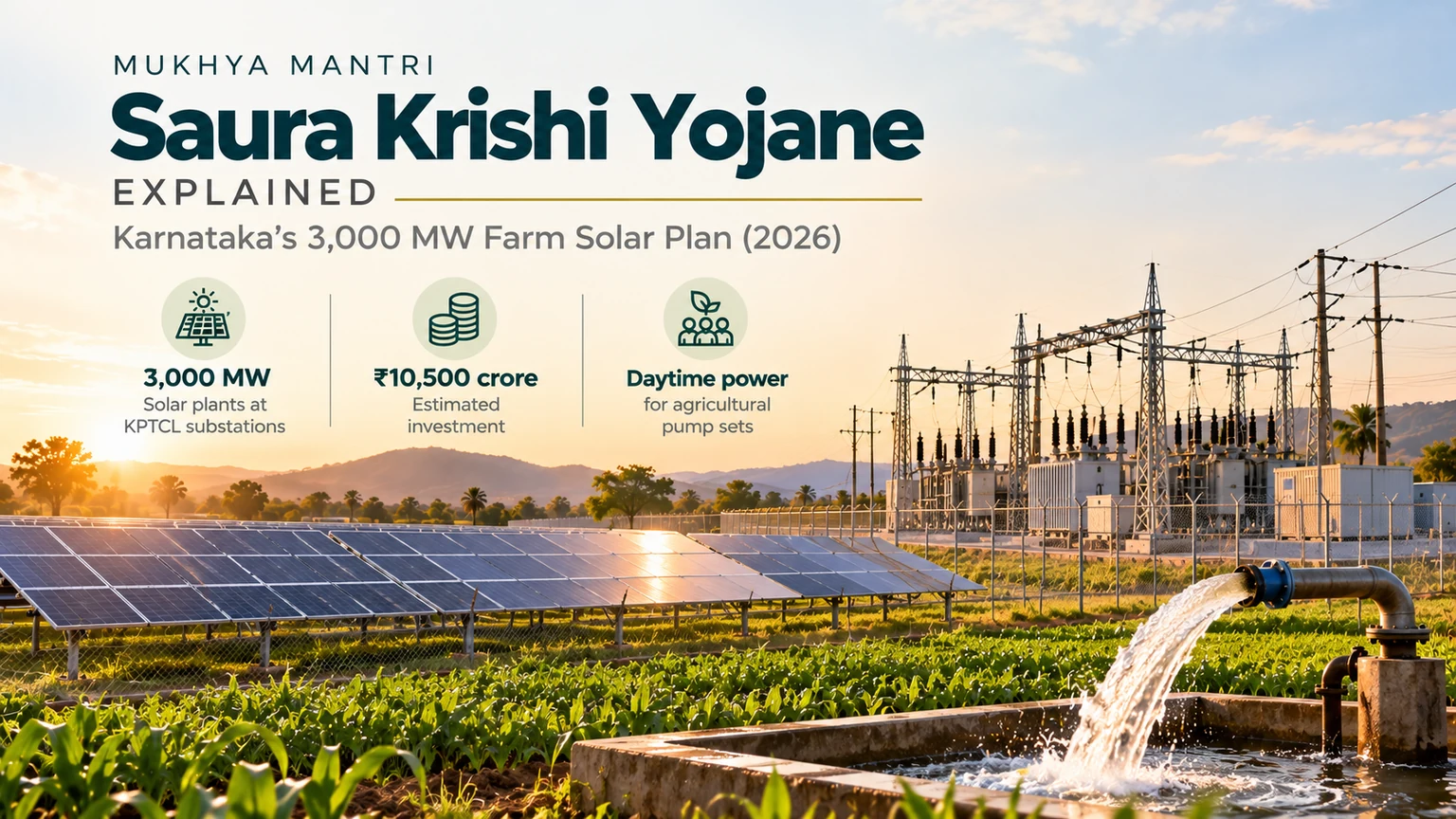
Mukhya Mantri Saura Krishi Yojane is a Karnataka government scheme to build 3,000 MW of solar power plants at KPTCL substations, so that farm pump sets get reliable electricity during the day. Chief Minister Siddaramaiah announced it in the Budget 2026-27. Private developers will build and run the plants at an estimated cost of Rs 10,500 crore.
The scheme is Karnataka's own version of PM-KUSUM Component C, and it is the biggest single step in the state's push for farm solar in Karnataka. Farmers do not have to buy panels or pay anything upfront.
This guide explains how Saura Krishi Yojane works, who benefits, what farmers need to do and where the scheme stands today.
Saura Krishi Yojane Karnataka: Key Facts
Here is the scheme in one view, based on the Budget 2026-27 announcement.
| Detail | Saura Krishi Yojane |
|---|---|
| Full name | Mukhya Mantri Saura Krishi Yojane (also written Mukhyamantri Saur Krishi Yojana) |
| Announced | March 6, 2026, Karnataka Budget 2026-27 |
| Announced by | Chief Minister Siddaramaiah |
| Capacity | 3,000 MW of solar plants |
| Location | KPTCL substations (sub-centres) |
| Model | RESCO, based on PM-KUSUM Component C |
| Estimated investment | Rs 10,500 crore |
| Main benefit | Daytime power for agricultural pump sets |
| Farmer cost | No upfront payment |
How Mukhya Mantri Saura Krishi Yojane Works
The scheme puts solar plants right next to the substations that serve farm feeders. Power travels a short distance to the pump sets during daylight hours, which cuts line losses and frees up grid power for other users. Under the KUSUM-C model it follows, the flow works like this:
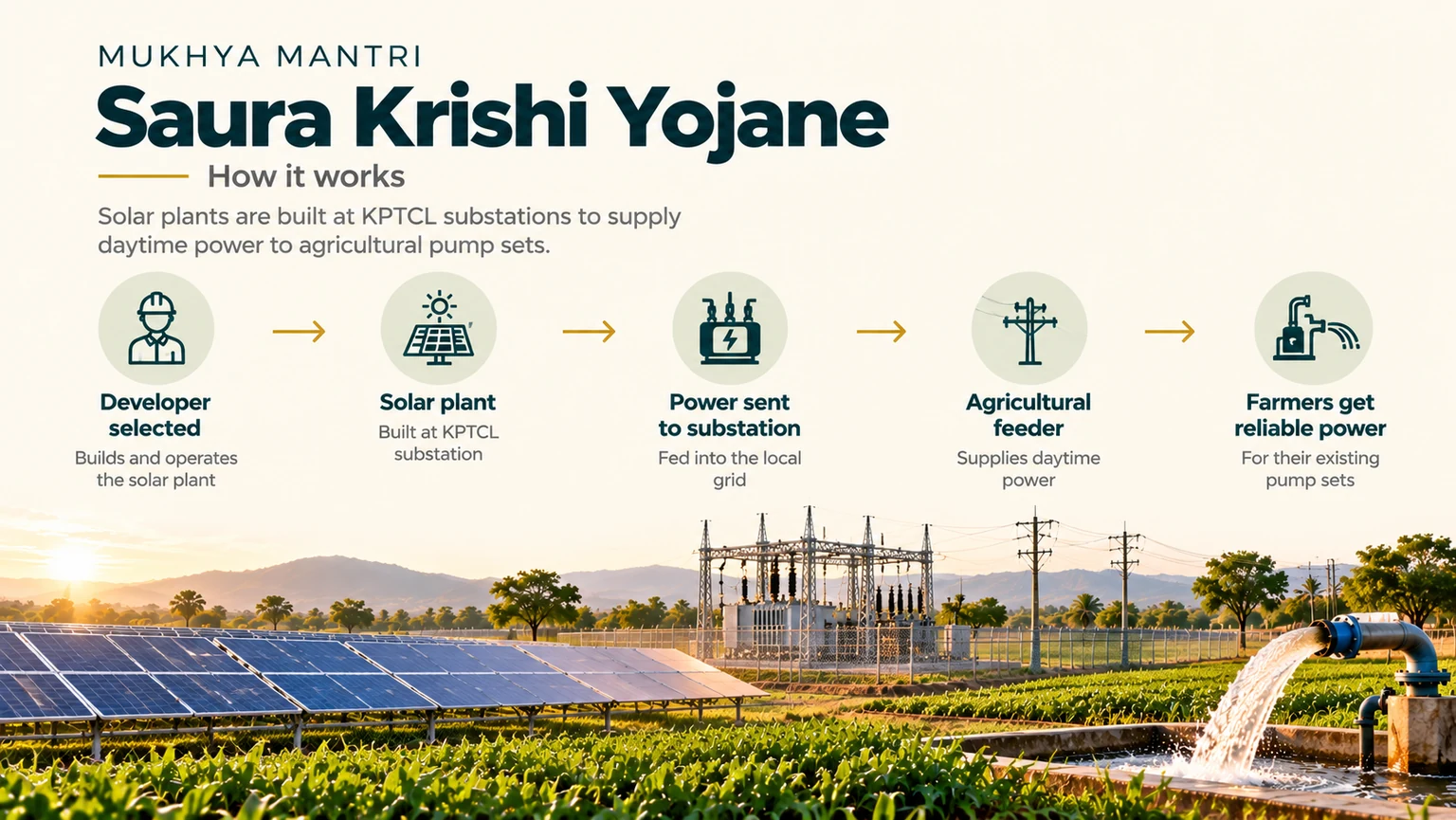
- Substations are chosen. KPTCL sub-centres that supply agricultural feeders are identified for solar plants.
- Developers are selected. Private companies bid to build the plants under the RESCO model and arrange land near each substation, usually on lease.
- Plants are built and run. The developer pays for, installs and maintains the solar plant. About 4 acres are needed per MW.
- Farms get daytime power. The plant feeds the substation, and the agricultural feeder carries that power to irrigation pump sets during the day.
- The ESCOM pays the developer. The local ESCOM buys the power at a fixed tariff under a long-term agreement. Farmers continue to receive free power as before.
The land figure comes from Energy Minister K J George's July 2025 statement on KUSUM-C (The Week (PTI), July 2025). For the project-finance side, read how the RESCO model works for developers.
Why Karnataka Launched the Karnataka 3000 MW Solar Scheme
Karnataka launched Saura Krishi Yojane for two reasons: free farm power costs the state a great deal, and much of that power reaches farmers at night. Solar plants near substations produce cheaper power during the day, which is exactly when farmers want to irrigate.
The cost is large and rising. The state has spent Rs 48,000 crore on free electricity for farmers over three years, covering 36 lakh IP sets and 21 lakh farmers, and has set aside Rs 19,290 crore for 2026-27 (Energetica India, March 2026).
Night-time supply is the other problem. Farmers who irrigate in the dark face snakebites, accidents and lost sleep. Under KUSUM-C, the government has committed to a dependable seven-hour daytime supply for farm pump sets (The Week (PTI), June 2025).
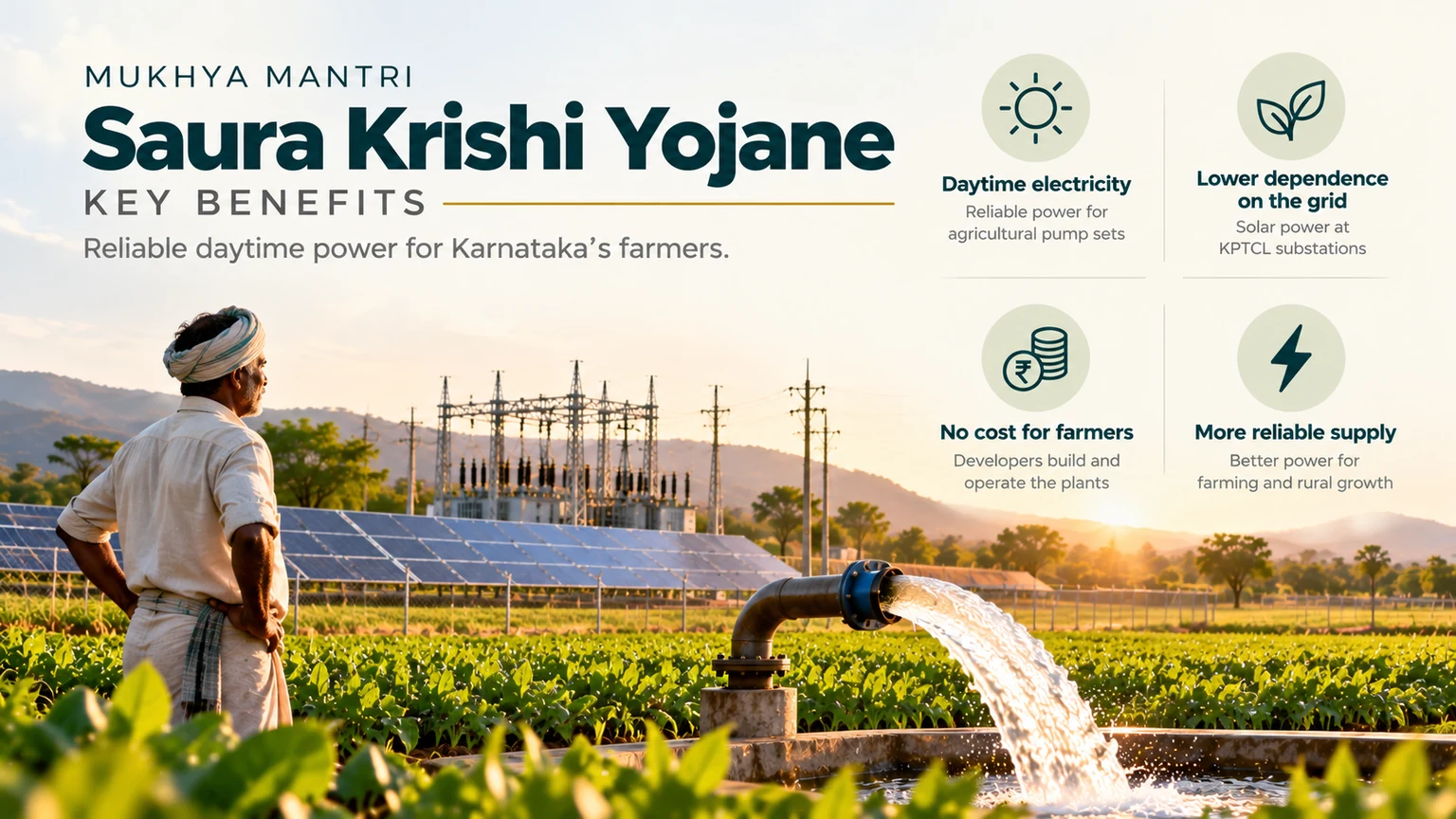
This is why the state is steadily moving farm feeders to solar. The supplied source also points to the wider shift in IP-set power supply, though that supporting cluster article has not yet been published.
How It Builds on KUSUM-C in Karnataka
Saura Krishi Yojane is a state-funded extension of the work Karnataka has already done under PM-KUSUM Component C. KUSUM-C laid the groundwork by solarising farm feeders since 2025. The new scheme adds a further 3,000 MW using the same model.
| Milestone | What happened | Source |
|---|---|---|
| June 2025 | 389 substations being solarised to serve 6,32,794 pump sets | The Week (PTI) |
| July 2025 | State sets a 2,400 MW feeder solarisation target under KUSUM-C | The Week (PTI) |
| March 2026 | Saura Krishi Yojane announced for 3,000 MW more | Deccan Herald |
| July 2026 | 2,767 MW awarded under KUSUM-C, 540 MW complete, 2,227 MW under construction | Deccan Herald |
The central scheme and the state scheme work side by side. To understand the framework both follow, read our guide to PM-KUSUM in Karnataka.
Who Benefits from Saura Krishi Yojane
Four groups gain from the scheme: farmers, landowners near substations, solar developers and the state's power companies. Each gains in a different way.
- Farmers on grid-connected pump sets get steadier power during the day, with no change to free supply and no installation cost.
- Landowners near substations can earn lease income from land that is barren or not used for farming. Under KUSUM-C, the state has said developers must pay a minimum of Rs 25,000 per acre for private land (The Week (PTI), July 2025). The supplied source does not confirm the final Saura Krishi Yojane lease terms.
- Solar developers and EPC firms get access to a 3,000 MW pipeline worth an estimated Rs 10,500 crore, with an assured buyer in the ESCOM.
- ESCOMs and the state buy cheaper daytime solar instead of costlier grid power, which over time can reduce the burden of the farm power subsidy.
Saura Krishi Yojane Eligibility: What Farmers Need to Do
Farmers do not apply individually for Saura Krishi Yojane. The scheme works at the substation and feeder level, so every farmer on a selected agricultural feeder benefits automatically. Eligibility depends on whether your feeder is included, not on a personal form.
When the scheme was announced, officials said detailed timelines and procurement steps would be shared by the energy department later (Construction World, March 2026). What you can do now:
- Ask your ESCOM section office whether your agricultural feeder is planned for solarisation.
- Make sure your IP set connection is authorised. Karnataka had 4.5 lakh unauthorised IP connections in 2025, of which two lakh had been regularised (The Week (PTI), July 2025).
- If you own unused land near a substation, register your interest with developers or KREDL for land leasing.
- If your farm is far from any feeder, a standalone pump is the better route. Read how to apply for a solar pump with an 80% subsidy.
Karnataka Budget 2026 Solar Scheme: Funding and Status
The Karnataka Budget 2026 solar scheme carries an estimated Rs 10,500 crore investment, mostly from private developers under the RESCO model. The same budget set aside Rs 3,400 crore for battery storage to back up solar on the grid. As of October 10, 2026, the state had not yet published a detailed rollout list for the 3,000 MW.
The storage plan is moving faster. The budget proposed 2,000 MWh of battery storage at the Huliyur, Pavagada and Kushtagi substations (Energetica India, March 2026). KREDL has since issued a global tender for 450 MW / 900 MWh of this storage at Kushtagi and Huliyurdurga, with bids due by September 28, 2026 (Saur Energy, September 2026).
The budget also announced the Anantha scheme, which plans solar microgrids in every gram panchayat through public-private partnership (Saur Energy, March 2026).
Rollout status: The supplied source does not contain the first Saura Krishi Yojane tender or a published substation list. Those details should be added only when an official rollout is available.
Challenges to Watch
The scheme's success will depend on how quickly plants get built. KUSUM-C shows the gap between awarding projects and finishing them: by July 2026, only 540 MW of 2,767 MW awarded was complete (Deccan Herald, July 2026). Three issues stand out.
- Land and grid connections. MNRE Secretary Santosh Kumar Sarangi has pointed to delays in land acquisition and connectivity, and said the state is working with district administrations to speed up transmission (Construction World, 2026).
- Financing. Under the central PM-KUSUM scheme, banks were slow to lend, and MNRE had to extend deadlines for financial closure (SolarQuarter, April 2026).
- Solar timing. Solar output peaks at noon, while farm demand starts in the morning and continues after sunset. The state's battery storage plans and the proposed storage in PM-KUSUM 2.0 are meant to close this gap.
For farmers, the practical point is simple: daytime supply will arrive feeder by feeder, not all at once.
Frequently Asked Questions
What is Mukhya Mantri Saura Krishi Yojane?
Mukhya Mantri Saura Krishi Yojane is a Karnataka scheme announced in the Budget 2026-27. It will set up 3,000 MW of solar plants at KPTCL substations under the RESCO model, at an estimated cost of Rs 10,500 crore. The aim is to give farm pump sets reliable daytime electricity.
Who is eligible for Saura Krishi Yojane?
There is no individual eligibility test. Every farmer whose pump set is on a selected agricultural feeder benefits once the nearby substation is solarised. Landowners near those substations can also benefit by leasing land to developers. Check with your ESCOM to know whether your feeder is included.
How do farmers apply for Mukhya Mantri Saura Krishi Yojane?
Farmers do not need to apply. The scheme is carried out at the substation level by KPTCL, KREDL, ESCOMs and private developers. Farmers far from the grid who want their own solar system can apply for a solar pump under PM-KUSUM Component B instead.
Is Saura Krishi Yojane the same as PM-KUSUM?
No, but they are closely linked. Saura Krishi Yojane is a state scheme that follows the PM-KUSUM Component C model of feeder solarisation. PM-KUSUM is the central scheme, which also covers solar pumps under Component B and farmer-owned plants under Component A.
Do farmers have to pay for the solar plants?
No. Private developers pay for, build and run the plants under the RESCO model. The ESCOM buys the power at a fixed tariff. Farmers continue to receive free power for their irrigation pump sets, now supplied during the day.
When will farmers get daytime power under the scheme?
The state has not yet published a full timeline for the 3,000 MW. Power will reach farms feeder by feeder as each substation plant is completed. Under the related KUSUM-C work, 540 MW was complete by July 2026, with 2,227 MW more under construction.
Disclaimer
This article is for general information only. It is based on government announcements and news reports available as of October 10, 2026, and is not legal, financial or investment advice.
Scheme details, timelines, eligibility rules and land lease payments can change without notice and may differ by district or ESCOM. Always confirm the latest details with KREDL, KPTCL or your local ESCOM before making any decision.
Want to understand where farm solar fits your land or project?
Panchami Global can help farmers, landowners and solar developers understand feeder solarisation, land requirements and RESCO project models before taking the next step.