
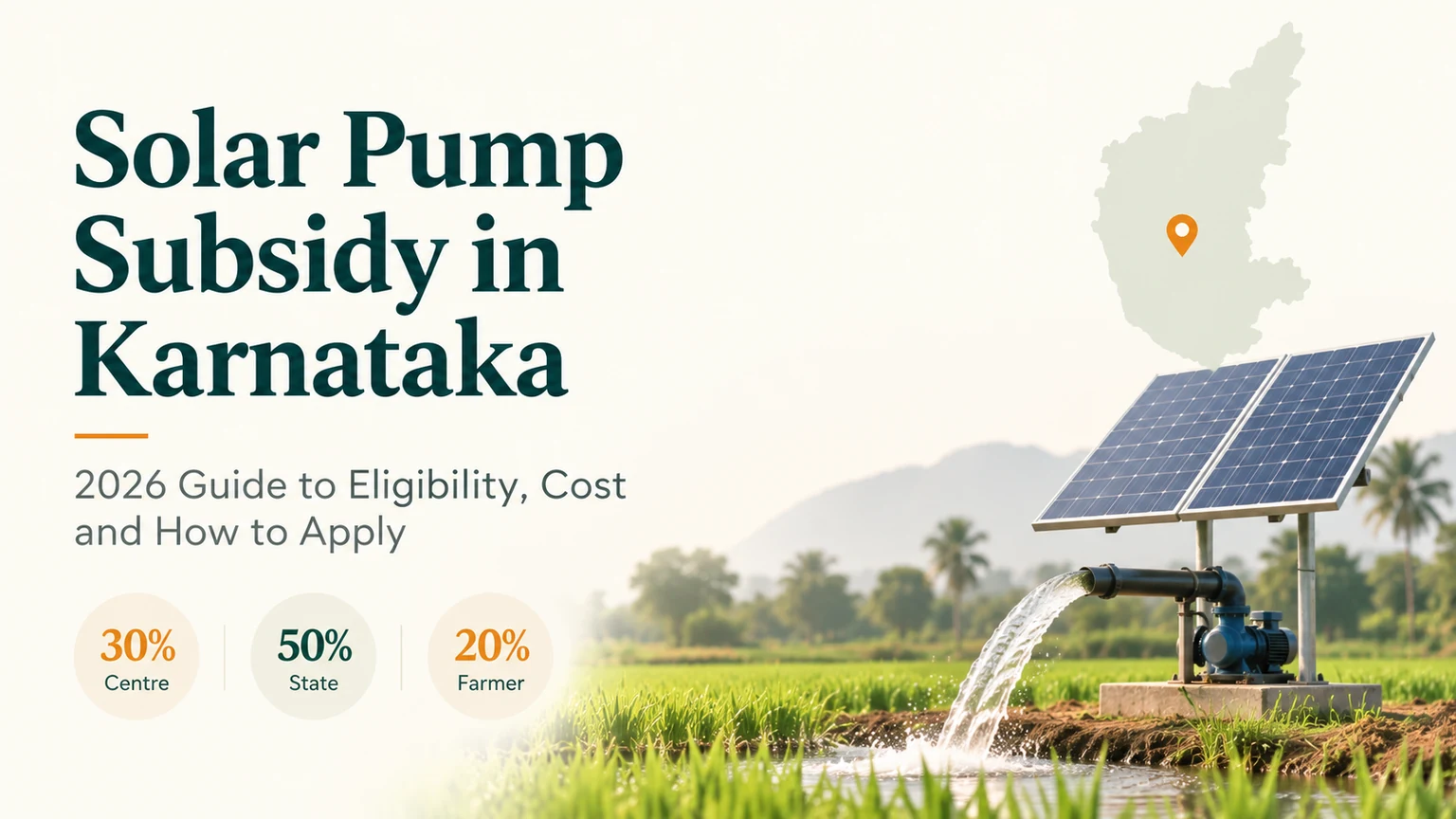
The solar pump subsidy in Karnataka covers 80% of the cost of a standalone solar irrigation pump under PM-KUSUM Component B. The central government pays 30%, the state pays 50% and the farmer pays only 20%. Applications are handled by KREDL and the ESCOMs when a district quota opens.
This is one of the most generous solar pump subsidies in India, and it is one part of a wider set of state support covered in our complete guide to farm solar in Karnataka.
Below, you will find who is eligible, what a solar pump costs after subsidy, the documents you need and how to apply.
Solar Water Pump Subsidy in Karnataka at a Glance
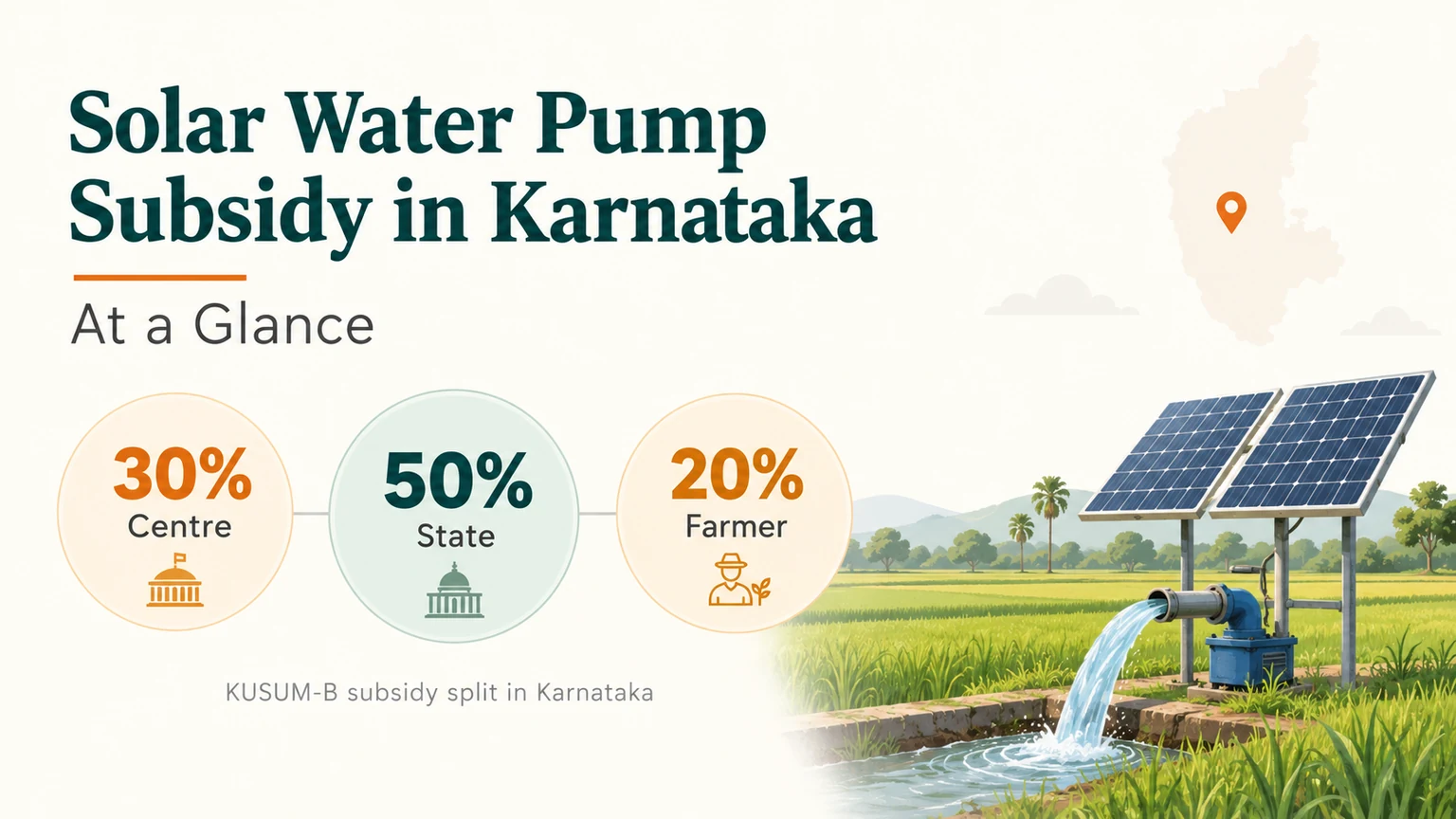
Karnataka farmers pay far less for a solar water pump than farmers in most other states. The state raised its share from the standard 30% to 50% in 2024, which cut the farmer's share in half.
| Who pays | Karnataka (KUSUM-B) | Standard PM-KUSUM pattern |
|---|---|---|
| Central government | 30% | 30% |
| State government | 50% | 30% |
| Farmer | 20% | 40% (bank loan allowed for up to 30%) |
The solar pump subsidy comes under Component B of the central scheme. To understand all three parts and how PM-KUSUM works, read our component guide.
Who Is Eligible for the Solar Pump Subsidy in Karnataka
The subsidy is meant for farmers whose pump sets are far from the electricity grid. In Karnataka, pump sets located more than 500 metres from the grid get a solar pump under KUSUM-B, while those closer are served by grid lines and transformers.
The main conditions are:
- Own agricultural land in Karnataka, backed by an RTC (Pahani) record.
- Pump set more than 500 metres from the grid, as stated by Energy Minister K J George (India.com, 2025).
- One solar pump per farmer. Each farmer is allowed only one solar pumpset connection (Deccan Herald).
- Pump size up to 7.5 HP for full central support. Larger pumps are allowed, but central aid is capped at the 7.5 HP level (Vikaspedia).
- A working water source, such as a borewell or open well.
Farmers with unauthorised pump sets far from the grid are a priority. KREDL has said it plans to allot pumps on a first-come, first-served basis while regularising such connections (Deccan Herald).
Solar Pump Price with Subsidy in Karnataka
A solar pumpset in Karnataka costs between Rs 2 lakh and Rs 5 lakh, depending on its size (Deccan Herald). With the 80% subsidy, the farmer's share works out to roughly Rs 36,000 to Rs 90,000 for the most common sizes.
| Pump size | Typical farm size | Approx. system cost | Farmer pays at 20% |
|---|---|---|---|
| 3 HP | 1 to 2 acres | Rs 1.8 to 2.2 lakh | Rs 36,000 to 44,000 |
| 5 HP | 2 to 5 acres | Rs 2.8 to 3.2 lakh | Rs 56,000 to 64,000 |
| 7.5 HP | 5 acres and above | Rs 3.8 to 4.5 lakh | Rs 76,000 to 90,000 |
System costs are market estimates from CitizenNest, 2026. The farmer's share is calculated at 20%. The actual price is set by KREDL's tender with empanelled vendors, so your demand letter may show a different figure.
The best size depends on your borewell depth and water need, not just land area. A deeper borewell needs a bigger pump.
Solar Pump Scheme Karnataka: How to Apply Online
You apply for a KREDL solar pump online or at your ESCOM's KUSUM counter when your district quota opens. After verification and selection, you pay your 20% share, and an empanelled vendor installs the pump. The whole process usually moves in six steps.
- Check that your district quota is open. KREDL opens registrations district by district as pump quantities are approved.
- Register. Apply on the KREDL portal or at your ESCOM's KUSUM counter with your land and pump details.
- Upload or submit documents. See the list below.
- Verification. Officials check your land record, water source and distance from the grid.
- Pay your share. Once selected, you receive a demand letter and pay your 20% share. There is no separate application fee for this.
- Installation and commissioning. An empanelled vendor installs the pump, and the subsidy is settled after the system is commissioned.
This follows KREDL's current process as described by Heaven Green Energy, 2026.
Documents you need
- Aadhaar card
- RTC (Pahani) land record in the farmer's name
- Bank passbook or account details
- Water source details (borewell or open well)
- Existing pump details and connection status, if any
Apply only through KREDL, your ESCOM or the official PM-KUSUM portal. Do not pay any agent or website that asks for a registration fee.
KUSUM-B Solar Pumps in Karnataka: Progress So Far
Karnataka had installed more than 27,700 solar pumps by July 2026, against a target of 40,000 (UNI, July 2026). Demand jumped once the subsidy rose to 80%. Around 24,000 farmers applied online after the increase, compared with only 5,000 registrations in the previous nine years (Deccan Herald).
The state has committed real money to this. In July 2025, it approved 40,000 pumps and planned to spend Rs 752 crore, with another 25,000 farmers already in the queue (The Week (PTI), July 2025).
The pumps also save the state money. The installed pumps are expected to cut ESCOM power purchase costs by about Rs 146 crore a year, and the farm power subsidy bill by more than Rs 200 crore a year (UNI, July 2026). That is why solar pumps are central to the state's plans for IP set power supply and solar.
Solar Pump or Feeder Solarisation: Which Fits Your Farm?
A standalone solar pump is the right choice if your farm is far from the grid or you run a diesel pump. If your pump is already on a grid feeder, you will most likely get solar power through feeder solarisation instead, at no cost to you.
| Your situation | Best route | What you pay |
|---|---|---|
| Pump more than 500 m from the grid | Standalone solar pump (KUSUM-B) | 20% of pump cost |
| Running a diesel pump | Standalone solar pump (KUSUM-B) | 20% of pump cost |
| Grid-connected pump on an agricultural feeder | Feeder solarisation (KUSUM-C or Saura Krishi Yojane) | Nothing |
| Unused land near a substation | Lease land to a solar developer | Nothing; you earn rent |
Feeder plants are built by private developers under the RESCO model in solar, so farmers on those feeders do not install anything. Read more about agricultural feeder solarisation and the state's new plan in Saura Krishi Yojane explained.
If you own spare land close to a substation, a land lease for a solar plant can bring in steady income alongside farming.
Before You Apply: A Quick Checklist
Most delays come from small paperwork gaps or the wrong pump size. Run through this list before you register.
- The name on your RTC, Aadhaar and bank account is spelled the same way.
- You know the approximate distance from your pump to the nearest power line.
- You know your borewell depth and water yield, so the vendor can size the pump correctly.
- You have chosen a pump size you actually need. A bigger pump costs more, and central aid stops at 7.5 HP.
- You will deal only with KREDL-empanelled vendors and official counters.
- You will keep copies of your application, demand letter, payment receipt and commissioning report.
Common mistakes to avoid
- Paying an agent to "speed up" the application. The official process has no such fee.
- Applying for a pump on land where the RTC is not in your name.
- Picking a pump that is too small for a deep borewell, which leads to weak water flow.
Frequently Asked Questions
How much is the solar pump subsidy in Karnataka?
Karnataka farmers get an 80% subsidy on a solar pump under PM-KUSUM Component B. The central government pays 30% and the state government pays 50%. The farmer pays the remaining 20% after being selected and receiving a demand letter from KREDL.
What is the price of a solar pump with subsidy in Karnataka?
A solar pumpset costs Rs 2 lakh to Rs 5 lakh depending on size. At a 20% farmer share, a 3 HP pump works out to roughly Rs 36,000 to Rs 44,000, and a 5 HP pump to about Rs 56,000 to Rs 64,000. The final price depends on KREDL's tender.
Who is eligible for a KUSUM-B solar pump in Karnataka?
Farmers who own agricultural land in Karnataka and whose pump set is more than 500 metres from the grid are the main beneficiaries. Each farmer can get one solar pump. Farmers with unauthorised pump sets far from the grid are being prioritised.
How do I apply for a KREDL solar pump?
Register on the KREDL portal or at your ESCOM's KUSUM counter when your district quota opens. Submit Aadhaar, the RTC (Pahani), bank details and water source details. After verification, pay your 20% share and an empanelled vendor installs the pump.
What size solar pump can I get under the scheme?
Central support covers pumps up to 7.5 HP. You can choose a bigger pump, but the central aid is capped at the 7.5 HP level. Most small and medium farms choose a 3 HP or 5 HP pump, depending on borewell depth.
Can I get a solar pump if my farm already has a grid connection?
Usually not under KUSUM-B, which is aimed at farms far from the grid. Grid-connected pumps are covered by feeder solarisation under KUSUM-C and Mukhya Mantri Saura Krishi Yojane, which give daytime solar power at no cost to the farmer.
Disclaimer
This article is for general information only. It is based on government announcements, news reports and market estimates available as of October 10, 2026, and is not legal, financial or investment advice.
Subsidy rates, pump prices, eligibility rules and application steps can change without notice and may differ by district or ESCOM. Always confirm the latest details with KREDL or your local ESCOM before applying or paying any amount.
Planning a solar project in Karnataka?
If you are evaluating a solar pump, farm-solar opportunity, land-based solar project or another renewable-energy model, Panchami Global can help you understand the technical and commercial options.