The RESCO model in solar is an arrangement where a private developer, called a Renewable Energy Service Company, pays for, builds, owns and runs a solar plant, then sells the power to a buyer at a fixed tariff. The buyer pays nothing upfront. It pays only for the units it uses, usually under a long-term agreement.
In Karnataka, the RESCO model is how most farm feeder solar plants get built, including the 3,000 MW planned under the state's newest scheme. It quietly powers much of the solar subsidy for farmers in Karnataka.
This guide explains what the RESCO model is, how it compares with CAPEX, how developers earn and where the opportunities lie in Karnataka right now.
What Is the RESCO Model?
RESCO stands for Renewable Energy Service Company. Under this model, the developer carries the full investment and risk of the solar plant, and the buyer simply pays for the power it receives. Ownership stays with the developer for the life of the agreement.
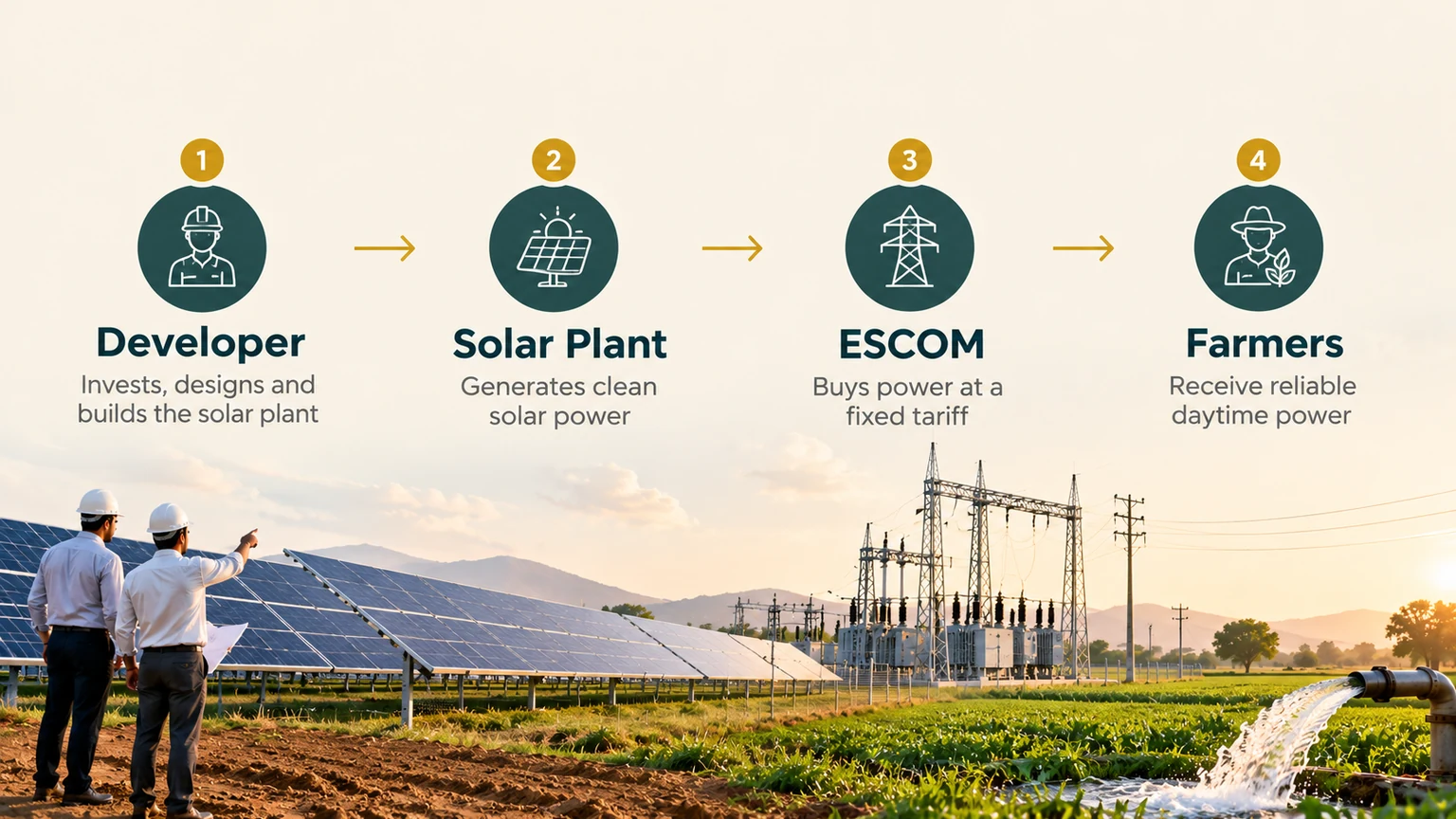
The money flows in a simple loop:
- The developer invests. It funds, designs and builds the plant, usually with bank loans plus its own equity.
- The plant generates power. The developer runs and maintains it for the full contract period.
- The buyer pays per unit. The buyer (an ESCOM, a company or a government body) pays a fixed tariff for every unit delivered.
- The developer recovers its cost. Over the contract period, these payments repay the loan and give the developer its return.
RESCO is widely used in India. For example, a 1 MW rooftop plant at Rashtrapati Bhavan was awarded under RESCO, with the developer handling design, installation and maintenance so the buyer avoided upfront spending. Delhi Metro has tendered RESCO rooftop solar with a 25-year maintenance contract (Energetica India).
RESCO vs CAPEX Model
The difference between RESCO and CAPEX comes down to who pays upfront and who owns the plant. In CAPEX, the buyer pays for and owns the plant. In RESCO, the developer pays and owns it, and the buyer only pays for power. MNRE allows both routes under PM-KUSUM (MNRE).
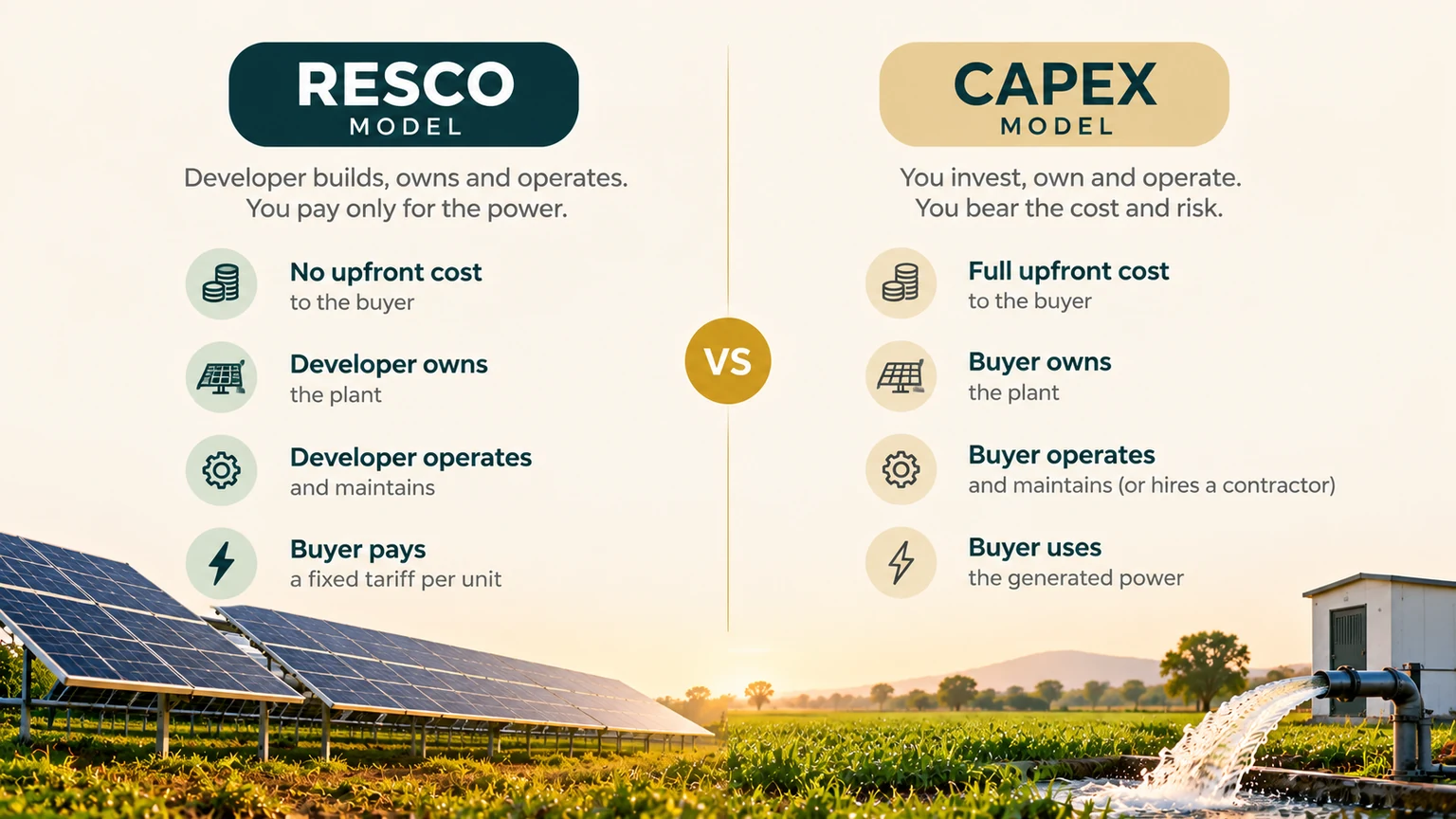
| RESCO | CAPEX | |
|---|---|---|
| Upfront cost to the buyer | None | Full plant cost (minus any subsidy) |
| Who owns the plant | Developer | Buyer |
| Who runs and maintains it | Developer | Buyer, or a contractor the buyer hires |
| What the buyer pays | A fixed tariff per unit, over many years | One-time cost plus maintenance |
| Who carries performance risk | Developer | Buyer |
| Long-term savings for the buyer | Lower, because the developer earns a margin | Higher, once the plant pays for itself |
| Best for | Buyers with little capital or no technical team | Buyers with capital who want maximum savings |
A farm example makes this clear. A pump under the KUSUM B solar pump scheme follows the CAPEX model: the farmer pays 20% and owns the pump. A feeder solar plant under KUSUM-C usually follows RESCO: the developer owns it, and the ESCOM pays for the power.
RESCO Model in KUSUM-C and Karnataka's Farm Solar
The RESCO model is central to PM-KUSUM Component C in Karnataka. Developers build feeder-level solar plants near substations, and the ESCOMs buy the power to supply farm pump sets. This lets the state solarise thousands of pumps without spending capital upfront.
Two programmes use it:
- KUSUM-C feeder solarisation. By July 2026, 439 projects worth 2,767 MW had been awarded (Deccan Herald, July 2026).
- Mukhya Mantri Saura Krishi Yojane. The state's new farm solar plan will commission 3,000 MW at KPTCL substations under RESCO, at an estimated Rs 10,500 crore (Deccan Herald, March 2026).
Central support still applies under RESCO. MNRE provides 30% of the cost of feeder plants, up to Rs 1.05 crore per MW, and releases it in stages as work progresses (MNRE).
To see the technical side, read how substation solar plants work. For the full central framework, see our guide to KUSUM Yojana for Karnataka farmers.
How RESCO Developers Earn Under KUSUM-C
A RESCO developer earns by selling every unit of solar power to the ESCOM at a tariff fixed through competitive bidding. Central support of 30% of project cost brings down the investment, which is why KUSUM-C tariffs are low. Land, financing and plant uptime decide the final return.
HESCOM's December 2025 tender for 108 MW of KUSUM-C feeder plants shows how the numbers work in Karnataka (SolarQuarter, December 2025):
| Term | HESCOM KUSUM-C tender |
|---|---|
| Ceiling tariff | Bids must be below Rs 2.13 per kWh |
| Extra generation | Up to 10% above the agreed amount bought at 75% of the tariff; anything beyond is supplied free |
| Land | Arranged by the bidder; government land available at Rs 25,000 per acre with 5% escalation every two years |
| Bid security | Rs 1 lakh per MW |
| Performance security | Rs 1 lakh per MW |
| Minimum net worth | Rs 1.05 crore per MW |
On top of the tariff, MNRE provides central financial assistance of up to Rs 1.05 crore per MW for feeder solarisation, with no mandatory state share (IBEF).
PPA term: Check the latest KREDL or ESCOM KUSUM-C tender before bidding, because the supplied source does not confirm the current contract term.
Solar Developer Opportunities in Karnataka
Karnataka has a large and active pipeline for RESCO farm solar. Between ongoing KUSUM-C work and the new state scheme, more than 5,000 MW of feeder solar is either under construction or planned. Battery storage and village microgrids add further room.
| Opportunity | Size | Status |
|---|---|---|
| Mukhya Mantri Saura Krishi Yojane | 3,000 MW, about Rs 10,500 crore | Announced March 2026; rollout details awaited |
| KUSUM-C feeder plants | 2,227 MW | Under construction as of July 2026 |
| Battery storage at substations | 2,000 MWh planned at Huliyur, Pavagada and Kushtagi | KREDL tender for 450 MW / 900 MWh closed September 28, 2026 |
| Anantha solar microgrids | All gram panchayats, PPP model | Announced in Budget 2026-27 |
The bigger driver is demand. Karnataka plans to grow installed power capacity from about 39 GW to 66 GW by 2030, mostly from clean energy (Energetica India, September 2026). The state also wants to cut the cost of free farm power, which keeps farm solar a priority.
Risks Developers Should Plan For
RESCO puts the investment risk on the developer, so the margin for error is small. With tariffs capped near Rs 2 per kWh, delays and cost overruns eat directly into returns. These are the risks to price in before bidding.
- Thin tariffs. HESCOM's KUSUM-C ceiling was Rs 2.13 per kWh, and generation beyond 10% of the agreed amount is supplied free (SolarQuarter, December 2025).
- Land and grid connection. The MNRE Secretary has pointed to delays in land acquisition and connectivity in Karnataka (Construction World, 2026).
- Financing. Banks were slow to lend for PM-KUSUM projects, which pushed MNRE to extend deadlines (SolarQuarter, April 2026).
- Hard deadlines. Financial closure for current KUSUM-C projects is due by November 30, 2026, and MNRE says there will be no extension beyond March 31, 2027 for completion (Energetica India, October 2026).
- Execution pace. Only 540 MW of 2,767 MW awarded under KUSUM-C was complete by July 2026, a sign of how long these projects take on the ground.
What RESCO Means for Farmers and Landowners
For farmers, RESCO means solar power with no cost and no responsibility. The developer builds and maintains the plant, the ESCOM pays for the power, and farmers on the feeder simply get daytime supply while their free power continues.
For landowners near substations, RESCO creates a steady rent stream. Developers need about 4 acres per MW. The state has set a minimum of Rs 25,000 per acre for private land under KUSUM-C (The Week (PTI), July 2025). HESCOM's tender priced government land at the same Rs 25,000 per acre, with a 5% increase every two years (SolarQuarter, December 2025).
Landowners who prefer to own the plant themselves can look at PM-KUSUM Component A instead, or compare it with the simpler KUSUM A land lease option.
Frequently Asked Questions
What is the RESCO model in solar?
The RESCO model is an arrangement where a Renewable Energy Service Company pays for, builds, owns and runs a solar plant, then sells the power to a buyer at a fixed tariff. The buyer makes no upfront investment and pays only for the units it uses under a long-term agreement.
What is the difference between RESCO and CAPEX?
In CAPEX, the buyer pays for the plant upfront and owns it. In RESCO, the developer pays for and owns the plant, and the buyer pays a per-unit tariff. CAPEX usually gives bigger long-term savings, while RESCO avoids upfront cost and technical responsibility.
How is the RESCO model used in KUSUM-C?
Under KUSUM-C, developers build feeder-level solar plants near substations under RESCO and sell the power to ESCOMs, which supply it to farm pump sets. MNRE supports up to Rs 1.05 crore per MW. Karnataka's new 3,000 MW Saura Krishi Yojane also uses RESCO.
What tariff do RESCO developers get in Karnataka?
Tariffs are set through competitive bidding. In HESCOM's December 2025 KUSUM-C tender for 108 MW, bids had to be below a ceiling of Rs 2.13 per kWh. The actual tariff depends on each tender and the winning bid.
Do farmers pay anything under RESCO farm solar plants?
No. Farmers on a solarised feeder pay nothing and install nothing. The developer owns and maintains the plant, the ESCOM pays for the power, and farmers continue to get free electricity, now during the day.
What are the main risks for RESCO developers in Karnataka?
The main risks are low tariffs, delays in land and grid connections, slow bank financing and strict deadlines. Financial closure for current KUSUM-C projects is due by November 30, 2026, and completion by March 31, 2027.
Disclaimer
This article is for general information only. It is based on government sources, tender notices and news reports available as of October 10, 2026, and is not legal, financial or investment advice.
Tariffs, tender terms, subsidy amounts and deadlines change with each tender and policy update. Developers and investors should study the latest tender documents and take professional advice before bidding or investing.
Evaluating a RESCO or farm-solar opportunity in Karnataka?
Panchami Global can help developers, businesses and landowners understand project models, site requirements, commercial structures and solar execution options before they commit.