
Free electricity for farmers in Karnataka covers about 36 lakh irrigation pump sets and 21 lakh farmers, and it will cost the state Rs 19,290 crore in 2026-27. Free power is not going away. What is changing is where that power comes from: the state is moving farm feeders and pump sets to solar to cut costs and give farmers power during the day.
This shift ties together all farm solar schemes in Karnataka, from substation solar plants to subsidised solar pumps.
This article explains how IP set free power works, what it costs, why the state is solarising IP sets and what it means for farmers.
How IP Set Free Power Works in Karnataka
Karnataka supplies free electricity to agricultural irrigation pump sets (IP sets) of up to 10 HP. The state pays the ESCOMs a subsidy to cover the cost, so farmers do not receive a bill for this power. The government has promised a seven-hour daily supply.
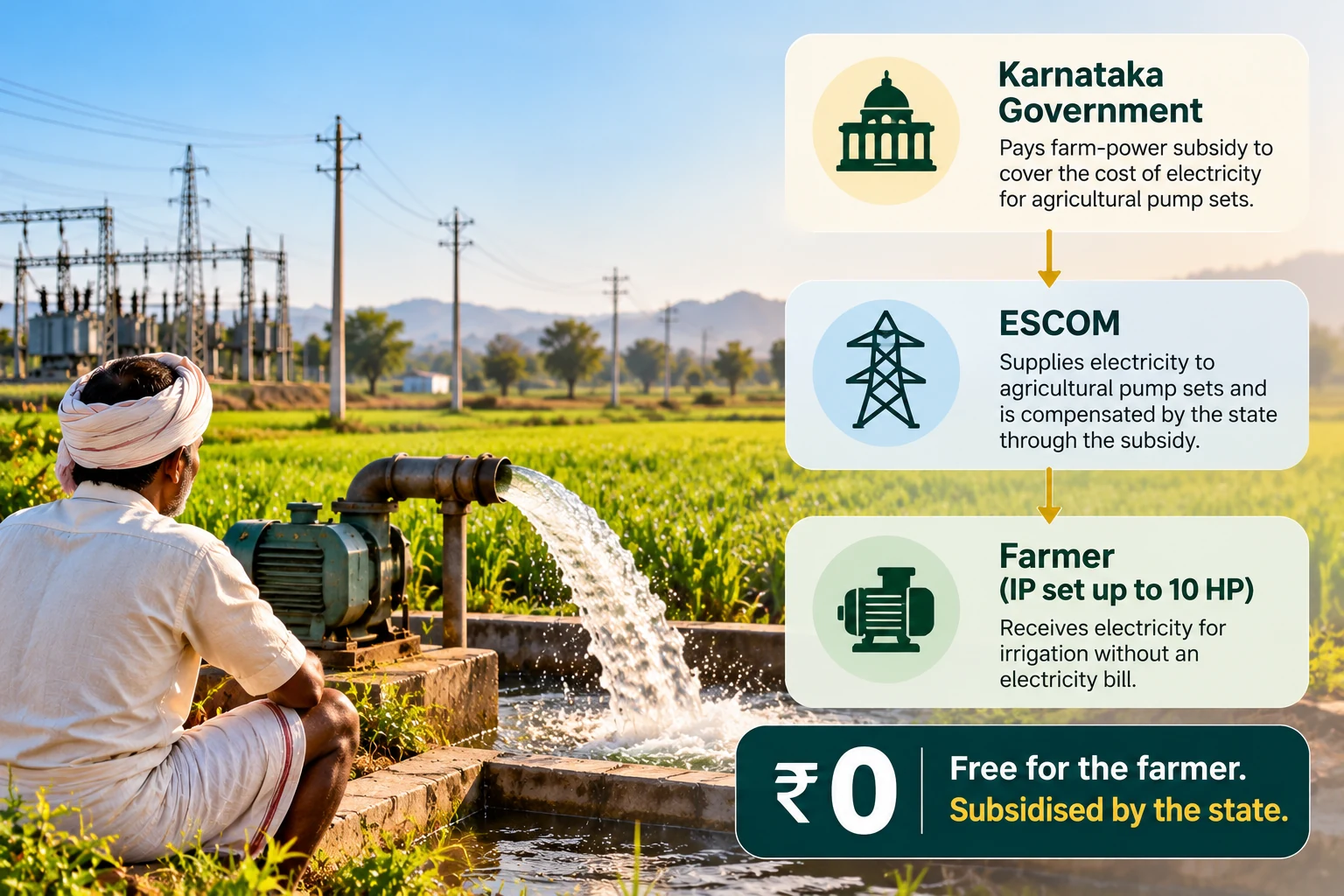
The scheme dates back to 2008, when the state budget announced free power for IP sets up to 10 HP from August 1 that year (PTI via India Environment Portal). It has continued under successive governments since.
Energy Minister K J George has said that linking Aadhaar to the RR numbers of pump sets is only to measure how much power farmers use and how many connections exist. He confirmed that free electricity will continue for agricultural pump sets up to 10 HP, with a seven-hour supply (Deccan Herald).
Small and medium coffee growers were brought under a similar power subsidy for pump sets up to 10 HP in 2022, paid as a reimbursement through direct benefit transfer (Deccan Herald, July 2022).
The Cost of Karnataka's Farm Power Subsidy
The Karnataka farm power subsidy has grown roughly ninefold since free power began. It cost about Rs 2,050 crore a year in 2008-09 and is budgeted at Rs 19,290 crore for 2026-27.
| Year | Farm power subsidy | Source |
|---|---|---|
| 2026-27 | Rs 19,290 crore (budgeted) | Energetica India, March 2026 |
| Three years to March 2026 | Rs 48,000 crore over three years | Energetica India, March 2026 |
| 2013-14 | Rs 5,250 crore | Deccan Herald |
| 2008-09 | About Rs 2,050 crore a year, including free power | PTI via India Environment Portal |
The current bill covers 36 lakh IP sets and 21 lakh farmers. For comparison, the state's Gruha Jyothi free household power scheme has an allocation of Rs 10,578 crore in the same year (Energetica India, March 2026). Farm power is the bigger of the two.
This is the core reason the state wants cheaper power for agriculture. Every rupee saved on supplying farm feeders reduces this subsidy.
Problems with Agricultural Power Supply in Karnataka
Free power has helped farmers for nearly two decades, but the way it is delivered has three long-running problems: when the power comes, how much of it is lost, and how many connections sit outside the system.
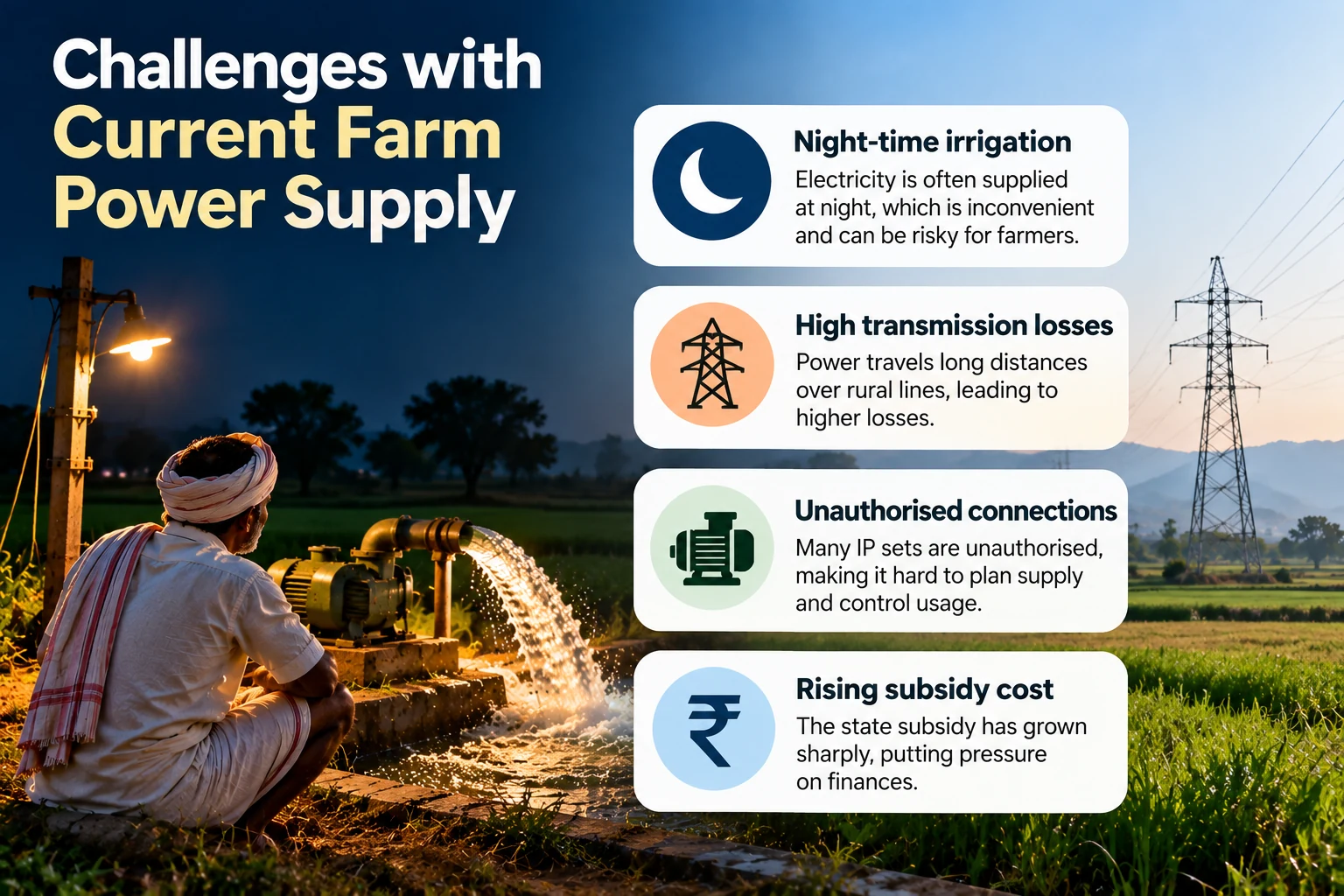
- Power at odd hours. Farm supply has often come at night, forcing farmers to irrigate in the dark. The state's promise of a dependable seven-hour daytime supply under KUSUM-C is a direct response to this (The Week (PTI), June 2025).
- Losses on long lines. Power that travels far from central plants to rural feeders loses energy on the way. The Chief Minister has said feeder solarisation will reduce this power wastage (The Week (PTI), June 2025).
- Unauthorised connections. Of about 4 lakh illegal pump sets in the state, 2.5 lakh had been regularised. Pump sets within 500 metres of a feeder get transformers, while those farther away are being moved to solar pumps under KUSUM-B (Deccan Herald).
All three problems point the same way: produce power closer to the farm, during the day, at lower cost.
Solarisation of IP Sets: How Solar Changes the Picture
Solarisation of IP sets keeps free power in place but changes its source. Karnataka is doing this in two ways: solar plants that power whole farm feeders, and standalone solar pumps for farms far from the grid. Both lower the cost of supply and shift farm power to daytime.
Solar feeders. Under KUSUM-C, 2,767 MW of feeder solar had been awarded by July 2026, with 540 MW running (Deccan Herald, July 2026). These plants give reliable daytime power through solar feeders. The state's new 3,000 MW scheme extends this. Read what Mukhya Mantri Saura Krishi Yojane offers farmers.
Solar pumps. More than 27,700 solar pumps were installed by July 2026. They are expected to save ESCOMs about Rs 146 crore a year in power purchase and cut the farm power subsidy by over Rs 200 crore a year (UNI, July 2026). Farmers pay only 20% of the pump cost; see the solar pump price after subsidy.
Who pays for it. Most feeder plants are built by private developers who sell power to ESCOMs, so the state avoids large upfront spending. This is what RESCO means for farmers and developers. Both routes are supported under the central PM-KUSUM scheme.
Will Free Electricity for Farmers Continue?
Yes, based on everything the state has said so far. Karnataka has budgeted Rs 19,290 crore for free farm power in 2026-27, and the Energy Minister has publicly confirmed that free electricity will continue for pump sets up to 10 HP.
Rumours that free power would end spread when the state began linking Aadhaar with pump set RR numbers. K J George clarified that the linking is only to measure power use and count connections, not to stop free supply (Deccan Herald). A previous Energy Minister, D K Shivakumar, had also said there was no plan to discontinue free power to IP sets (Deccan Herald).
What is changing is the supply side. More of the free power will come from solar plants near farms, delivered during the day. For farmers, that means the same free connection with better timing.
What Farmers Should Do Now
Farmers do not need to give up anything as the state moves to solar, but a few simple steps help you get the most from the change.
- Link Aadhaar to your pump set's RR number when your ESCOM asks. It does not end free power.
- Regularise an unauthorised connection. Pump sets near a feeder get transformers; those farther away can get a solar pump.
- Ask about your feeder. Check with your ESCOM section office whether your feeder is due for solarisation and daytime supply.
- Consider a solar pump if you are far from the grid or still use diesel, with an 80% subsidy.
- Explore leasing spare land near a substation. renting unused land for solar farms can add a steady income.
Frequently Asked Questions
Is electricity free for farmers in Karnataka?
Yes. Karnataka supplies free electricity to agricultural irrigation pump sets of up to 10 HP. The state pays the ESCOMs a subsidy to cover the cost, and has promised a seven-hour daily supply. About 36 lakh IP sets and 21 lakh farmers benefit.
How much does Karnataka spend on free farm power?
Karnataka has budgeted Rs 19,290 crore for free farm electricity in 2026-27. Over the three years to March 2026, the state spent Rs 48,000 crore on this subsidy. When free power began in 2008-09, the yearly cost was about Rs 2,050 crore.
Will free power for IP sets stop in Karnataka?
No such plan has been announced. Energy Minister K J George has said free electricity will continue for pump sets up to 10 HP. Linking Aadhaar to pump set RR numbers is only meant to measure usage and count connections.
What is solarisation of IP sets?
Solarisation of IP sets means supplying farm pump sets with solar power instead of grid power. In Karnataka, this is done mainly through solar plants that power whole agricultural feeders under KUSUM-C, and through standalone solar pumps under KUSUM-B.
Will solar change free power for farmers?
Solar changes the source and timing of power, not the price to farmers. Farmers on solarised feeders still get free electricity, but more of it comes during the day. Farmers who take a solar pump pay 20% of its cost once.
What happens to unauthorised pump connections?
Karnataka is regularising them. Of about 4 lakh illegal pump sets, 2.5 lakh had been regularised. Pump sets within 500 metres of a feeder get transformers, while those farther away are offered solar pumps under KUSUM-B.
Disclaimer
This article is for general information only. It is based on government budgets, official statements and news reports available as of October 10, 2026, and is not legal, financial or policy advice.
Power subsidy rules, eligibility limits and supply hours are set by the state government and can change. Always confirm the latest position with your local ESCOM or the Karnataka Energy Department.
Want to understand which farm-solar route fits your situation?
Panchami Global can help farmers, landowners, businesses and project partners understand solar options, site suitability and the right project model in Karnataka.