
PM-KUSUM Yojana in Karnataka is the central government's farm solar scheme, delivered in the state through KREDL and the ESCOMs. It has three parts: Component A for small solar plants on farm land, Component B for standalone solar pumps, and Component C for solarising grid-connected pumps and feeders. Karnataka farmers get an 80% subsidy on solar pumps under Component B.
PM-KUSUM is one of several solar schemes for Karnataka farmers, and it is the base that the state's newer schemes are built on.
This guide explains each component in plain terms, shows what it means in Karnataka, and walks through how to apply online.
What Is PM-KUSUM?
PM-KUSUM (Pradhan Mantri Kisan Urja Suraksha evam Utthaan Mahabhiyaan) is a national scheme run by the Ministry of New and Renewable Energy (MNRE). It was launched in 2019 to help farmers replace diesel and grid power with solar, and to let them earn from solar on their land.
The scheme aims to add about 34,800 MW of solar capacity across India (Vision IAS, September 2024). It is demand-driven, so there are no fixed state-wise quotas. Each state decides how much to take up under each component (Rajya Sabha reply, December 2023).
In Karnataka, KREDL is the state nodal agency, and the ESCOMs (BESCOM, CESC, HESCOM, GESCOM and MESCOM) handle feeder and grid work.
PM-KUSUM Component A, B and C Compared
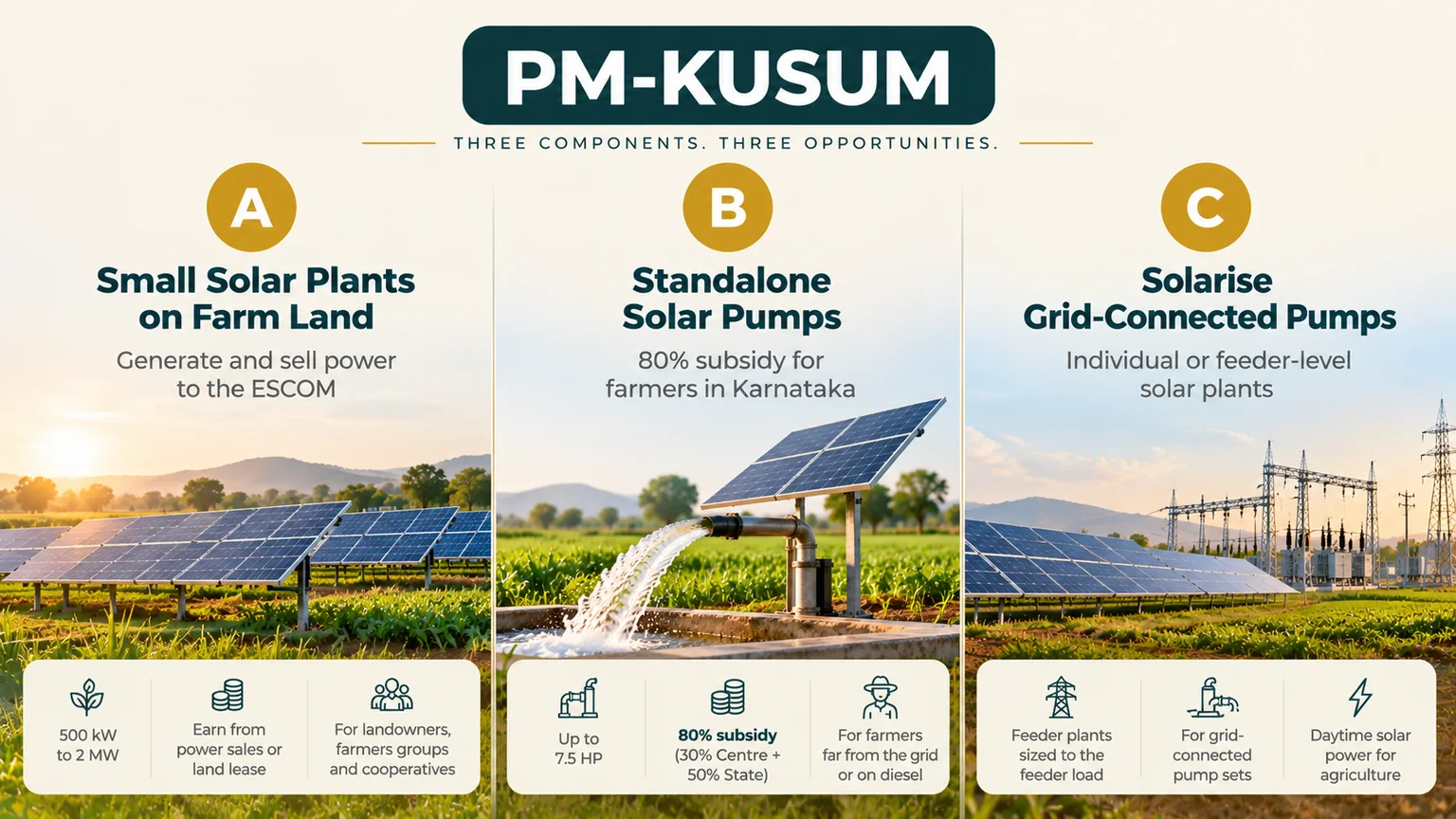
The three PM-KUSUM scheme components serve different farmers. Component A is about earning from land, Component B is about owning an off-grid pump, and Component C is about solarising pumps that are already on the grid.
| <br> | Component A | Component B | Component C |
|---|---|---|---|
| What it does | Small solar plants on farm land, power sold to the ESCOM | Standalone, off-grid solar pumps | Solar for grid-connected pumps, individually or at feeder level |
| National target | 10,000 MW | 14 lakh pumps | 35 lakh pumps |
| Plant or pump size | 500 kW to 2 MW | Up to 7.5 HP for full central support | Feeder plants sized to the feeder load |
| Who gains | Landowners, farmer groups, cooperatives | Farmers far from the grid or on diesel | Farmers on grid-connected pump sets |
| Farmer pays (Karnataka) | No capital subsidy; earns from power sales or lease rent | 20% of pump cost | Nothing for feeder-level plants |
| Karnataka focus | Slowest-moving component nationally | 40,000 pumps approved | Main focus: 2,767 MW awarded |
In 2023, the central government raised the Component C target from 35 lakh to 49 lakh pumps (Rajya Sabha reply, December 2023).
PM-KUSUM Component A in Karnataka
Component A lets farmers, farmer groups and cooperatives set up a grid-connected solar plant of 500 kW to 2 MW on their own land and sell the power to the ESCOM. Farmers who do not want to invest can lease the land to a developer instead. Either way, unused land starts earning.
The national target is 10,000 MW, but this component has moved the slowest. A 2024 study by the Centre for Science and Environment found that most progress had come under Component B, with Components A and C seeing little uptake (Vision IAS summary, August 2024). Land aggregation and bank loans are the usual hurdles. SBI has issued separate lending guidelines for Component A plants (MNRE).
For most Karnataka landowners, leasing is the simpler route. A solar plant needs about 4 acres per MW, so a 2 MW plant uses around 8 acres. Read how to earn income from your land with solar before talking to a developer.
PM-KUSUM Component B in Karnataka: Solar Pumps
Component B gives farmers a standalone solar pump that runs without any grid connection. In Karnataka, the farmer pays just 20% of the cost. The central government pays 30% and the state pays 50% (The Week (PTI), July 2025).
That is far better than the standard national pattern, where the centre and state pay 30% each and the farmer pays 40%, often through a bank loan (Vision IAS, September 2024).
Karnataka approved 40,000 solar pump sets under this component. By July 2026, more than 27,700 had been installed and commissioned (UNI, July 2026). Pump sets more than 500 metres from a power feeder are steered to Component B instead of a new grid connection.
Costs depend on pump size and site. See our guide on solar pump eligibility and cost for pump-by-pump details.
PM-KUSUM Component C in Karnataka
PM-KUSUM Component C solarises pumps that are already on the grid. It works in two ways: individual pump solarisation, where one farmer's pump gets its own panels, and feeder-level solarisation, where one solar plant powers an entire agricultural feeder. Karnataka has chosen the feeder route.
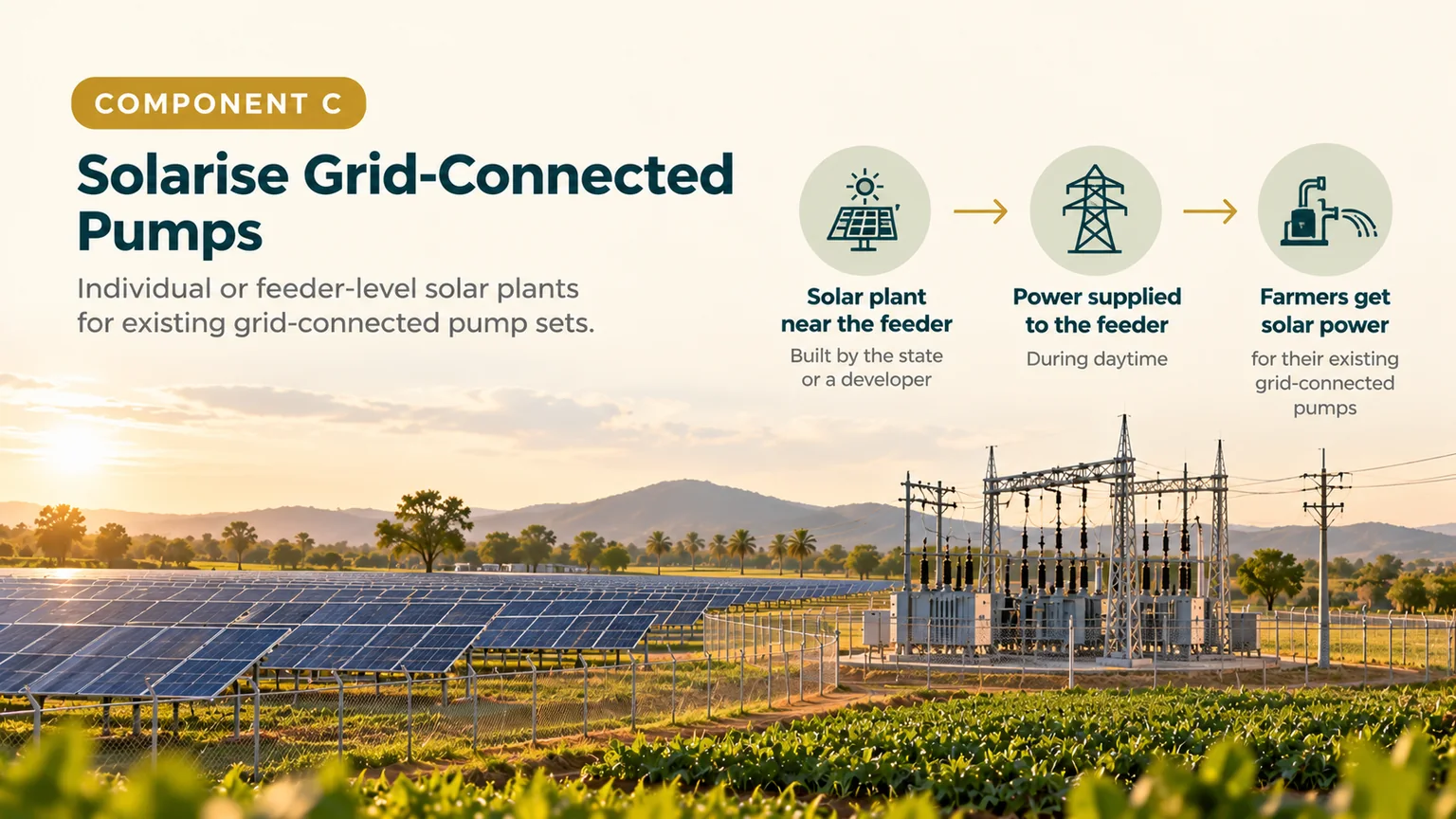
For feeder plants, the centre gives 30% of the cost, up to Rs 1.05 crore per MW (MNRE). Developers build most of these plants in Karnataka under RESCO contracts. If you are a developer, compare RESCO vs CAPEX before you bid.
Progress is now visible. As of July 2026, Karnataka had awarded 439 projects worth 2,767 MW under KUSUM-C, with 540 MW complete and 2,227 MW in progress (Deccan Herald, July 2026). The goal is a dependable seven-hour supply of daytime power for farmers.
The state is now going further with Mukhya Mantri Saura Krishi Yojane, Karnataka's 3,000 MW farm solar scheme, which uses the same Component C model.
How to Apply for PM-KUSUM Yojana Online in Karnataka
Only Component B (solar pumps) needs an individual application from farmers. Component C feeder plants are set up by the ESCOM and developers, and Component A projects are offered through KREDL tenders for land or plant owners. For a solar pump, the usual process runs like this:
- Watch for your district quota. KREDL opens farmer registrations district by district when new pump quantities are approved.
- Register online or at the ESCOM. Apply on the KREDL portal or at your ESCOM's KUSUM counter.
- Submit documents. Keep Aadhaar, the RTC (Pahani) land record, bank details and details of your water source and pump ready.
- Get verified. The nodal agency checks your land, water source and pump size.
- Pay your share. After selection, you pay the farmer share of 20% of the pump cost.
- Installation and inspection. An empanelled vendor installs the pump, and the subsidy is released after commissioning.
This process is based on KREDL's current practice as described by Heaven Green Energy, 2026. Apply only through KREDL, your ESCOM or the official PM-KUSUM portal linked from MNRE's scheme page. Never pay registration fees to an unofficial website or agent.
Application availability note: The supplied source does not confirm the current KREDL application URL or whether a district quota is open. Check KREDL, your local ESCOM or MNRE before applying.
PM-KUSUM Deadlines and What PM-KUSUM 2.0 Will Change
The current PM-KUSUM scheme was due to end on March 31, 2026, but projects already under way have more time. MNRE has extended financial closure for Components A and C to November 30, 2026. Projects with agreements signed by December 31, 2025 must be completed by March 31, 2027, with no further extension (Energetica India, October 2026).
A new PM-KUSUM 2.0 is being finalised, and existing commitments will carry over into it (SolarQuarter, April 2026). The biggest expected change is battery storage, so that solar can run pumps in the morning and after sunset. The Ministry of Power has suggested up to four hours of storage, while MNRE proposed two hours (Vision IAS, March 2026).
For Karnataka farmers, this points to longer solar supply hours and less dependence on the free grid power the state pays for. Read more on the future of free power for farmers in the state.
Frequently Asked Questions
What is PM-KUSUM Yojana in Karnataka?
PM-KUSUM is a central government scheme run by MNRE that helps farmers use solar power. In Karnataka, it is delivered by KREDL and the ESCOMs. It covers solar plants on farm land (Component A), standalone solar pumps (Component B) and solarisation of grid-connected pumps and feeders (Component C).
What are the three components of PM-KUSUM?
Component A supports 500 kW to 2 MW solar plants on farm land, with power sold to the ESCOM. Component B provides standalone, off-grid solar pumps. Component C solarises grid-connected pumps, either one pump at a time or through a solar plant that powers a whole agricultural feeder.
How much subsidy does Karnataka give under PM-KUSUM?
For solar pumps under Component B, Karnataka farmers pay 20% of the cost. The central government pays 30% and the state government pays 50%. Under feeder-level Component C, farmers pay nothing, as developers build the plants and the centre supports 30% of the cost.
What is PM-KUSUM Component C?
Component C solarises agricultural pumps that are already connected to the grid. In Karnataka, this is done mainly at feeder level, where one solar plant near a substation powers an entire farm feeder. By July 2026, the state had awarded 2,767 MW under Component C.
How do I apply for PM-KUSUM Yojana online in Karnataka?
For a solar pump, register through the KREDL portal or your ESCOM's KUSUM counter when your district quota opens. Submit Aadhaar, the RTC (Pahani) land record, bank details and pump details. After verification and selection, pay your 20% share and an empanelled vendor installs the pump.
Is PM-KUSUM still available in 2026?
Yes, for projects already under way. MNRE extended financial closure for Components A and C to November 30, 2026, and projects with agreements signed by December 31, 2025 must finish by March 31, 2027. PM-KUSUM 2.0, likely with battery storage, is being finalised.
Disclaimer
This article is for general information only. It is based on government sources and news reports available as of October 10, 2026, and is not legal, financial or investment advice.
Subsidy rates, eligibility rules, application steps and deadlines can change without notice and may differ by district or ESCOM. Always confirm the latest details with KREDL, your local ESCOM or MNRE before applying or investing.
Not sure which PM-KUSUM component applies to you?
Panchami Global can help farmers, landowners and solar developers understand the right solar route, site requirements and project model before taking the next step.