

The main solar scheme for farmers in Karnataka in 2026 is the Mukhya Mantri Saura Krishi Yojane, a 3,000 MW plan to build solar plants at power substations so farms get steady daytime electricity. It sits alongside PM-KUSUM, which gives farmers solar pumps at an 80% subsidy and lets landowners lease land to solar developers.
Karnataka already leads India in clean power. Energy Minister K J George said in September 2026 that about 70% of the state's roughly 18,000 MW demand is met from renewable sources (ThePrint, 2026). Agriculture is now the next big target.
This guide explains every Karnataka solar scheme for farmers in one place: what each one offers, who pays what, how to apply and what is coming next. Each section also identifies the deeper subtopic Panchami plans to cover separately.
Farm Solar in Karnataka at a Glance
Karnataka runs four connected routes for solar in agriculture: substation solar plants, solar pumps, land leasing and a long-term shift away from free grid power. The table below shows who each one is for.
| Scheme or route | What it gives | Who it suits | What the farmer pays |
|---|---|---|---|
| Mukhya Mantri Saura Krishi Yojane (state, 2026) | 3,000 MW of new solar plants at KPTCL substations for daytime farm power | Farmers on grid-connected IP sets | Nothing directly |
| PM-KUSUM Component C (feeder solarisation) | Solar plants that power whole agricultural feeders | Farmers within reach of a feeder | Nothing directly |
| PM-KUSUM Component B (solar pumps) | Standalone off-grid solar pump sets | Farmers far from the grid, or with diesel pumps | 20% of pump cost |
| PM-KUSUM Component A and land lease | Lease income from land used for solar plants | Landowners with barren or unused land | Nothing; the farmer earns rent |
Mukhya Mantri Saura Krishi Yojane: Karnataka's 3,000 MW Plan
Mukhya Mantri Saura Krishi Yojane is Karnataka's new state scheme to build 3,000 MW of solar plants at KPTCL substations. Chief Minister Siddaramaiah announced it in the Budget 2026-27 speech. The plants will feed agricultural feeders, so farmers get reliable daytime power instead of night-time supply.
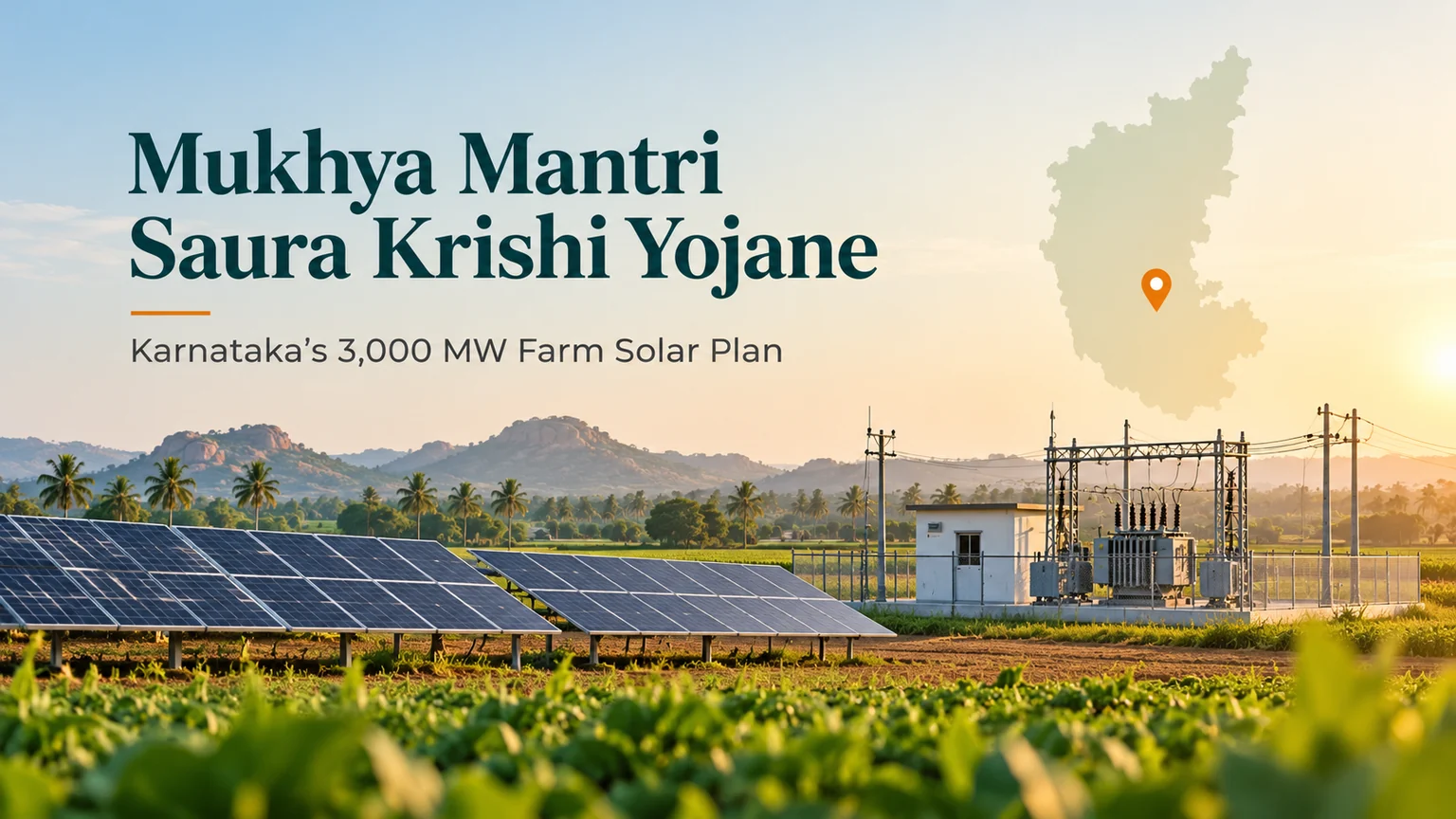
The scheme follows the PM-KUSUM Component C model. Private developers will build and run the plants under the RESCO model, at an estimated investment of Rs 10,500 crore (Energetica India, March 2026).
The same budget set aside Rs 3,400 crore for battery energy storage to support grid stability (Ornate Solar, 2026). Storage matters because solar peaks at noon, while farm demand runs from morning into the evening.
For eligibility rules, timelines and district rollout, the planned deeper guide is Mukhya Mantri Saura Krishi Yojane.
How PM-KUSUM Works in Karnataka
PM-KUSUM is the central government's farm solar scheme, launched by the Ministry of New and Renewable Energy (MNRE) in 2019. It has three parts. Component A pays farmers for land or power from small solar plants, Component B gives standalone solar pumps, and Component C solarises grid-connected pumps and feeders.
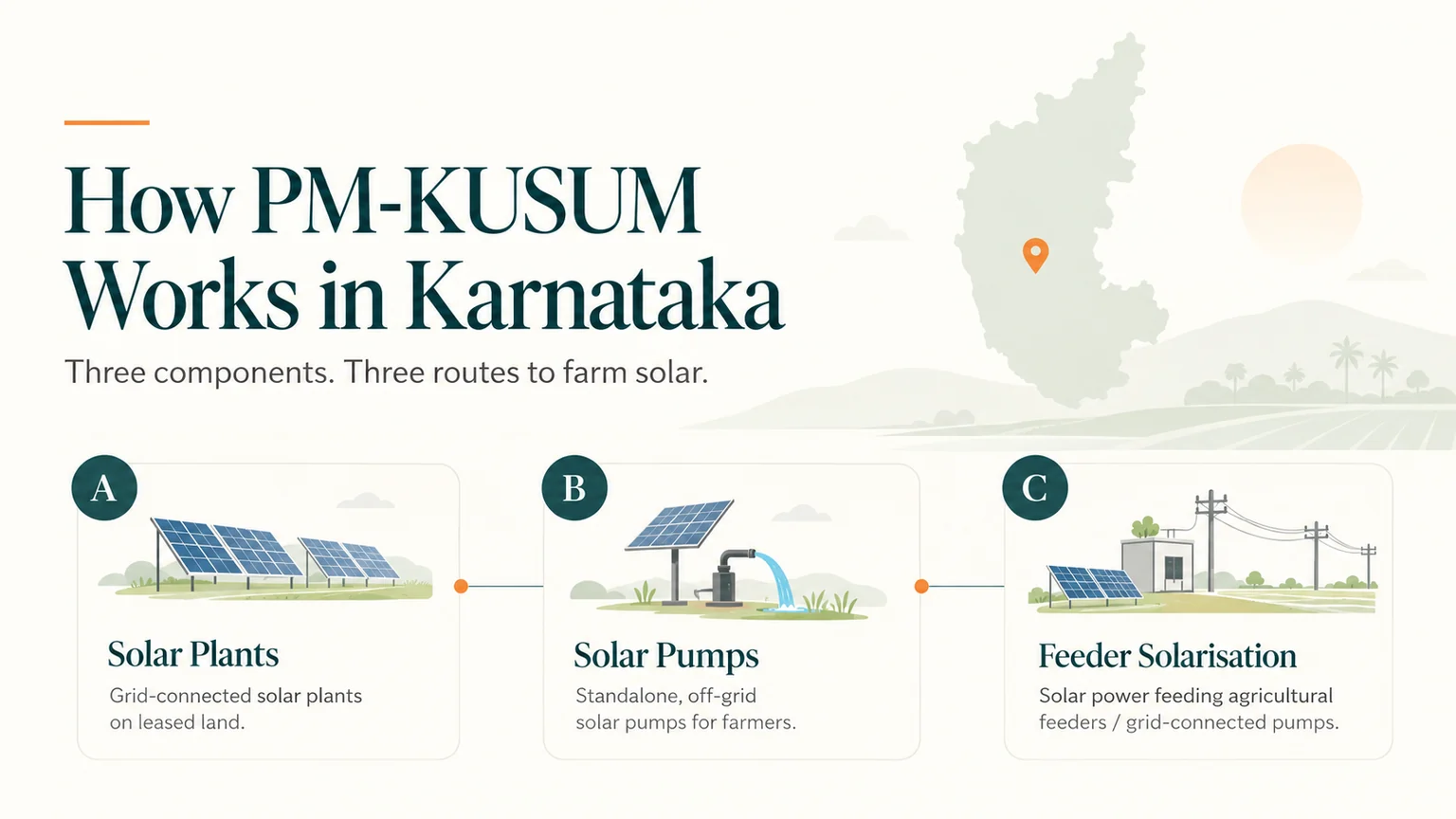
Nationally, the scheme targets about 34,800 MW of solar capacity (Business Today, January 2026). Karnataka has put most of its effort into Components B and C.
| Component | What it does | Karnataka focus |
|---|---|---|
| A | Small grid-connected solar plants on farm land, with power sold to the ESCOM | Land lease route for landowners |
| B | Off-grid solar pump sets for individual farmers | 40,000 pumps approved |
| C | Solar for grid-connected pumps, mostly at feeder level | 2,767 MW awarded, plus the new 3,000 MW state plan |
The planned deeper guide, PM-KUSUM components A, B and C, will compare each route and the documents needed.
Solar Pump Subsidy for Farmers in Karnataka
Karnataka farmers pay only 20% of the cost of a solar pump under PM-KUSUM Component B. The central government pays 30% and the state pays 50%, which is higher than the 30% state share most other states offer. This makes it one of the strongest solar subsidies for farmers in India.
The state approved 40,000 pump sets, and another 25,000 farmers have applied, with the state planning to spend Rs 752 crore (The Week (PTI), July 2025). By July 2026, more than 27,700 solar pumps had been installed and commissioned (UNI, July 2026).
The same report says those pumps should save ESCOMs about Rs 146 crore a year in power purchase costs. The state expects to save over Rs 200 crore a year in farm power subsidy.
Solar pumps are mainly for farms that are hard to reach with the grid. In 2025, the Energy Minister said pump sets beyond 500 metres of a feeder would get solar pumps under KUSUM-B (The Week (PTI), July 2025).
Farmers usually apply through KREDL or their ESCOM when a district quota opens, with Aadhaar, the RTC (Pahani) land record and bank details. The planned solar pump subsidy in Karnataka guide will cover costs by pump size and the full process.
Feeder-Level Solarisation: Daytime Power for Farms
Feeder-level solarisation means a solar plant near a substation powers an entire agricultural feeder, which then supplies every irrigation pump set on that line. Farmers do not install anything. They simply get power during the day instead of at night, which is safer and easier for irrigation.
The state has promised a dependable seven-hour daytime supply under KUSUM-C. In June 2025, Chief Minister Siddaramaiah said 389 substations were being solarised to serve 6,32,794 farm pump sets (The Week (PTI), June 2025).
Progress is now picking up. As of July 2026, 439 projects totalling 2,767 MW had been awarded, with 540 MW complete and 2,227 MW under construction (Deccan Herald, July 2026).
“By solarising agricultural feeders, we are ensuring reliable daytime power for farmers.”K J George, Energy Minister, Karnataka — Deccan Herald, July 2026
The planned feeder-level solarisation explainer will show how a substation plant connects to agricultural feeders.
The RESCO Model: Who Builds Farm Solar Plants
In the RESCO (Renewable Energy Service Company) model, a private developer pays for, builds, owns and runs the solar plant. The developer then sells the power to the ESCOM at a fixed tariff under a long-term agreement. Neither farmers nor the government pay the upfront cost.
Karnataka will deliver the full 3,000 MW under Mukhya Mantri Saura Krishi Yojane through this route (Energetica India, March 2026). This opens a large pipeline for solar EPC firms and investors in the state.
Timelines are tight. MNRE has extended the financial closure deadline for PM-KUSUM Components A and C to November 30, 2026, and projects with agreements signed by December 31, 2025 must finish by March 31, 2027 (Energetica India, October 2026).
Developers weighing this opportunity can compare the planned RESCO model guide with CAPEX ownership.
Can Farmers Earn by Leasing Land for Solar?
Yes. Farmers with unused or low-yield land can lease it to solar developers under PM-KUSUM and earn a steady income without farming it. In Karnataka, about 4 acres of land is needed for every 1 MW of solar, so even a mid-sized plot can host a plant.
In July 2025, Energy Minister K J George said developers using private land under KUSUM-C must pay landowners a minimum of Rs 25,000 per acre (The Week (PTI), July 2025). The cited report does not clearly confirm whether this amount is paid annually, so landowners should verify the payment frequency and standard lease term with KREDL or the relevant ESCOM before relying on the figure.
Land near a substation is the most valuable, because plants under Saura Krishi Yojane and KUSUM-C connect at the substation. Barren land, dryland and plots with poor water access are good candidates.
Before signing, check the lease period, rent escalation, who pays land tax and what happens to the land after the agreement ends. The planned lease your land for solar guide will explain typical terms and the questions to ask a developer.
Why Karnataka Is Moving Farm Power to Solar
Karnataka gives free electricity to farm pump sets, and that bill keeps growing. Solar plants close to farms cut the cost of supplying this power and reduce losses on long transmission lines. Free power stays, but more of it will come from the sun.
The numbers explain the urgency. The state allocated Rs 48,000 crore to free farm power over three years, covering 36 lakh IP sets and 21 lakh farmers. It has earmarked Rs 19,290 crore for 2026-27 alone (Energetica India, March 2026).
Solar also helps the state bring unauthorised pump connections into the system. Of 4.5 lakh unauthorised IP connections, two lakh had been regularised by July 2025, with the rest being prioritised under KUSUM-B (The Week (PTI), July 2025).
Chief Minister Siddaramaiah has called KUSUM-C “a blessing for farmers, particularly those in dryland areas” (The Week (PTI), June 2025). The planned free farm power vs solar analysis will examine that transition in more detail.
What's Next: PM-KUSUM 2.0 and Battery Storage
The next phase of farm solar will add batteries. MNRE is finalising PM-KUSUM 2.0, and storage is the main change under discussion, so solar power can run pumps after sunset. Karnataka is already building this storage at its substations.
According to Vision IAS's summary of March 2026 reports, the Ministry of Power suggested up to four hours of battery storage, while MNRE proposed two hours for the first rollout (Vision IAS, March 2026).
Karnataka implemented a 1,000 MWh battery system across seven substations during 2025-26 (Energetica India, March 2026). The state is also building the 2,000 MW Sharavathy pumped storage project (Energetica India, September 2026).
For farmers, this points to longer and more reliable solar supply in the coming years. For developers, solar plus storage is likely to become the standard bid.
How to Get Started with Farm Solar in Karnataka
The right first step depends on your situation. Use this checklist to find yours.
- Farmer with a grid-connected pump set: ask your ESCOM section office whether your feeder is in the KUSUM-C or Saura Krishi Yojane list, and when daytime supply will start.
- Farmer far from the grid or using a diesel pump: keep Aadhaar, RTC (Pahani) and bank details ready, and register with KREDL or your ESCOM when the KUSUM-B quota for your district opens.
- Landowner with unused land: measure the distance from your plot to the nearest substation, then compare lease offers from approved developers.
- Solar developer or EPC firm: track KREDL and ESCOM tenders, and plan financial closure before the November 30, 2026 deadline.
Frequently Asked Questions
What is the main solar scheme for farmers in Karnataka?
The biggest new scheme is Mukhya Mantri Saura Krishi Yojane, announced in the 2026-27 state budget. It will build 3,000 MW of solar plants at KPTCL substations to give farmers daytime power. It works alongside PM-KUSUM, the central scheme that covers solar pumps, feeder solarisation and land leasing.
How much subsidy do farmers get for a solar pump in Karnataka?
Under PM-KUSUM Component B, Karnataka farmers get an 80% subsidy on a solar pump. The central government pays 30% and the state government pays 50%. The farmer pays the remaining 20%. Applications open through KREDL or the local ESCOM when a district quota is announced.
Do farmers pay anything under Mukhya Mantri Saura Krishi Yojane?
No direct payment is needed. Private developers build and run the substation solar plants under the RESCO model and sell power to the ESCOM. Farmers on the connected feeders simply receive daytime electricity for their irrigation pump sets, while free farm power continues as before.
How much can a farmer earn by leasing land for solar in Karnataka?
The state has said developers using private land under KUSUM-C must pay at least Rs 25,000 per acre. However, the cited report does not clearly state whether that figure is annual. A 1 MW plant needs about 4 acres. Actual rent also depends on the lease term, distance to the substation and the developer, so confirm the payment period and compare offers before signing.
What is the difference between KUSUM-B and KUSUM-C?
KUSUM-B gives individual farmers standalone, off-grid solar pumps, mostly for farms far from the grid. KUSUM-C solarises grid-connected pumps, usually by powering a whole agricultural feeder from a nearby solar plant. In Karnataka, pump sets beyond 500 metres of a feeder are steered towards KUSUM-B.
Is PM-KUSUM still open in 2026?
Yes, for projects already in progress. MNRE extended financial closure for Components A and C to November 30, 2026, and projects with agreements signed by December 31, 2025 must finish by March 31, 2027. A new PM-KUSUM 2.0, likely with battery storage, is being finalised.
Disclaimer
This article is for general information only. It is based on government announcements and news reports available as of October 10, 2026, and is not legal, financial or investment advice.
Scheme names, subsidy rates, eligibility rules, land lease payments and deadlines can change without notice and may differ by district or ESCOM. Always confirm the latest details with KREDL, your local ESCOM or MNRE before applying, signing a lease or investing.
Need help evaluating a farm-solar opportunity?
Talk to Panchami Global if you are evaluating solar land, a farm-solar project, a RESCO opportunity or a larger solar development in Karnataka.