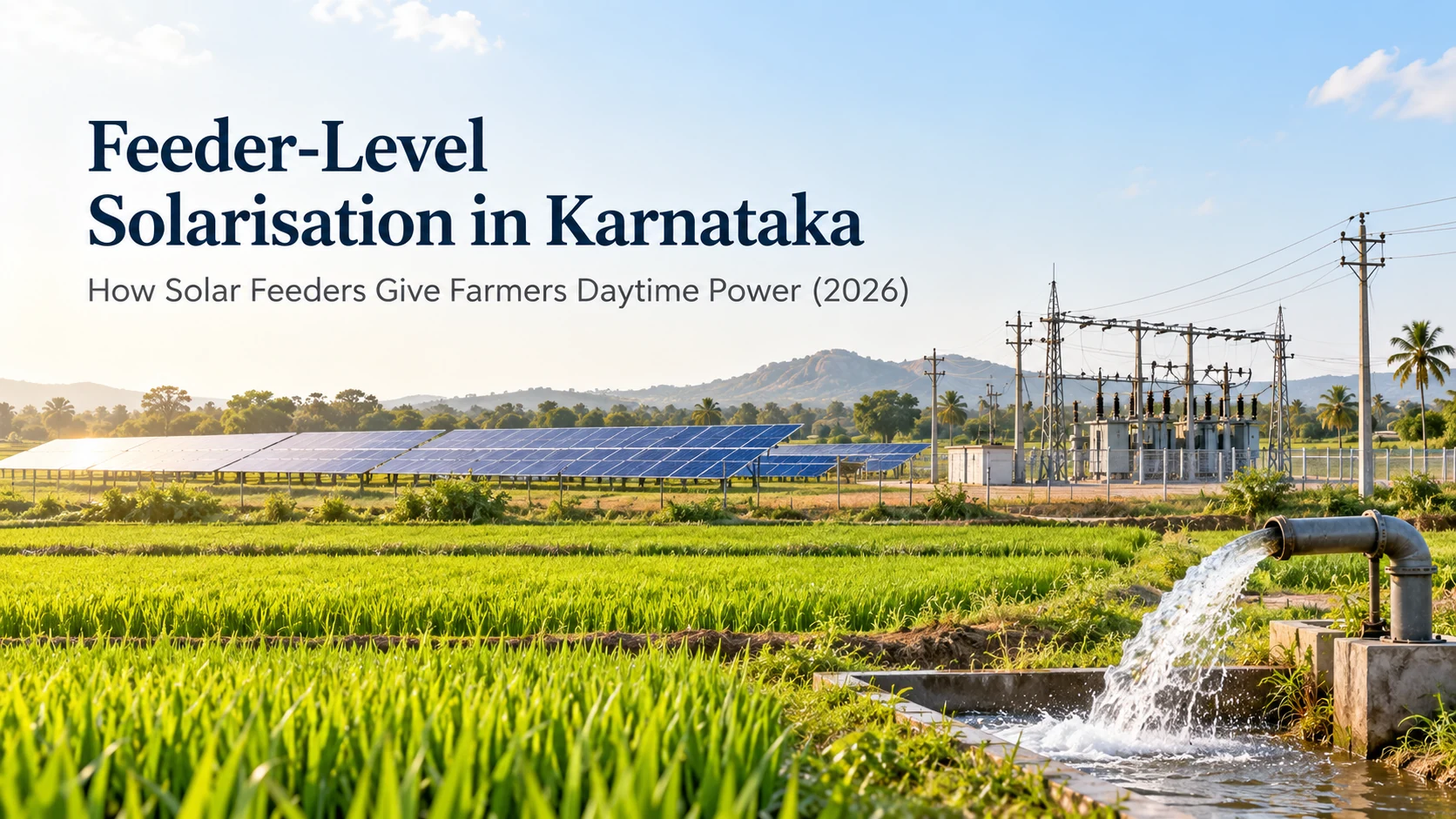
Feeder level solarisation means building one solar power plant next to a substation and using it to supply an entire agricultural feeder, the power line that serves many farm pump sets. Every farmer on that feeder gets solar power during the day without installing anything or paying anything.
Karnataka uses this model under PM-KUSUM Component C to give farm pump sets a dependable seven-hour daytime supply. It is now the backbone of solar for agriculture in Karnataka.
This guide explains how solarisation of agricultural feeders works, how far Karnataka has come and what it means for farmers, ESCOMs and landowners.
How Feeder Level Solarisation Works
A solar power plant at a substation feeds power into the agricultural feeders that leave that substation. Because the plant sits close to the farms it serves, power travels a short distance and very little is lost on the way. The process runs in five steps:
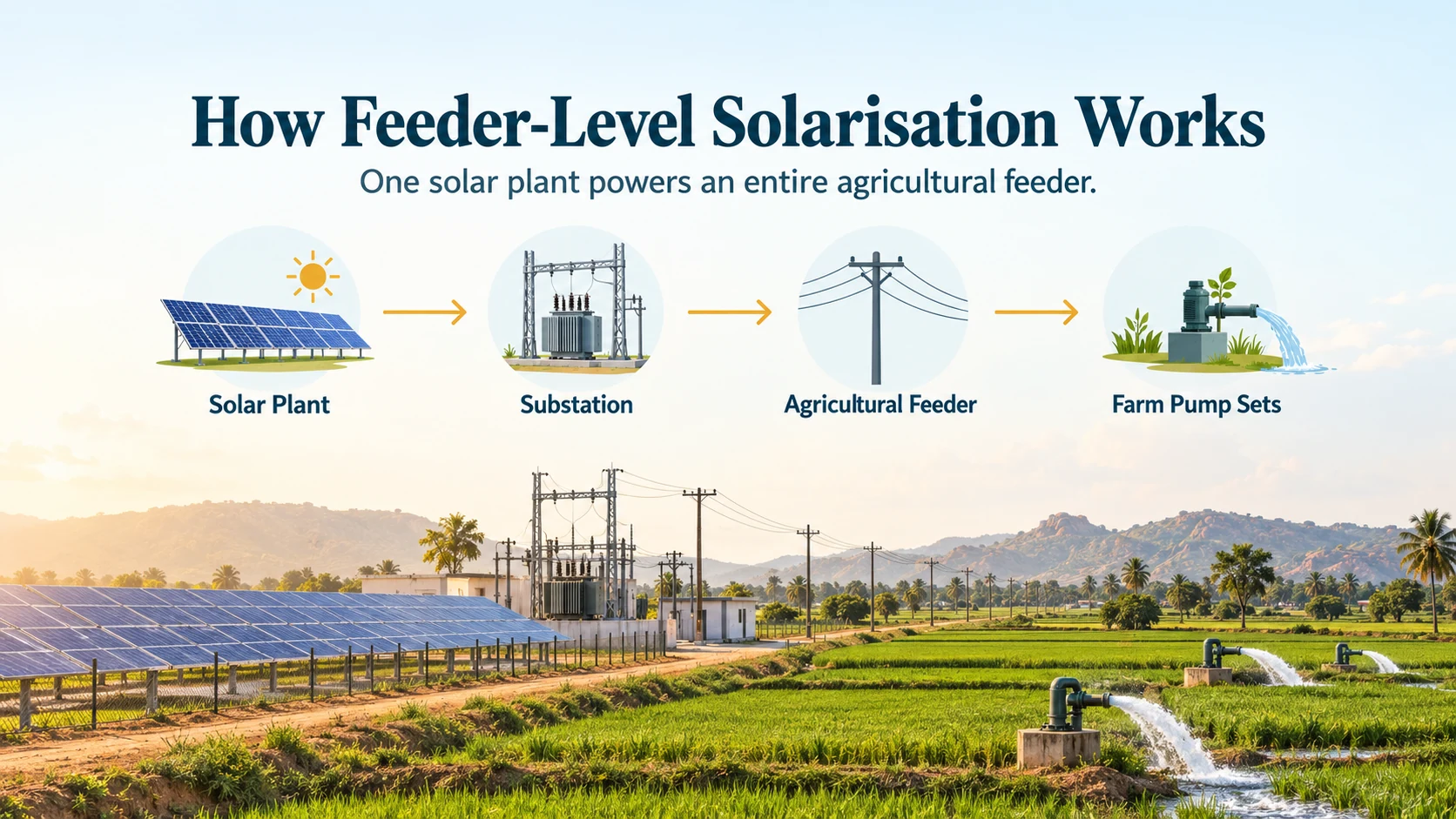
- A substation is picked. The ESCOM identifies substations whose feeders mainly serve irrigation pump sets.
- Land is arranged nearby. A developer leases land close to the substation. About 4 acres are needed for every 1 MW of solar (The Week (PTI), July 2025).
- The plant is built. The developer pays for, builds and runs the solar plant.
- Power flows to the farms. During daylight, the plant feeds the substation, and the agricultural feeders carry solar power to every pump set on the line.
- The ESCOM pays the developer. The ESCOM buys the solar power at a fixed tariff under a long-term agreement.
Farmers keep the same free power connection. The only change is that the power now comes from the sun, during the day. To see who builds and owns farm solar plants and how they earn, read our RESCO guide.
Feeder Level vs Individual Pump Solarisation
PM-KUSUM Component C allows two ways to solarise grid-connected pumps. Feeder-level solarisation powers a whole feeder from one plant, while individual pump solarisation puts panels on each farmer's pump. Karnataka has chosen the feeder route because it is faster to scale and needs nothing from the farmer.
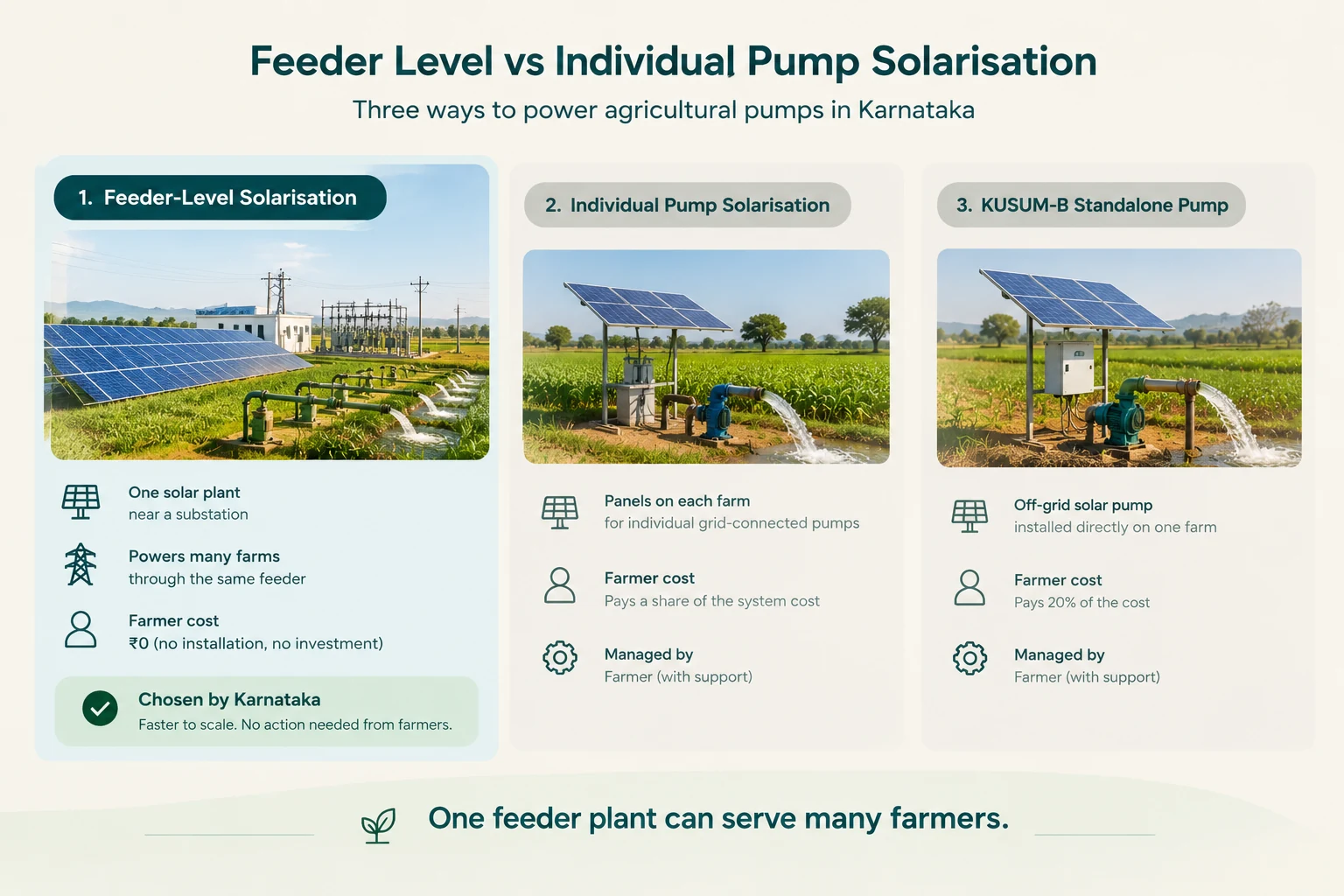
| <br> | Feeder-level solarisation | Individual pump solarisation | Standalone pump (KUSUM-B) |
|---|---|---|---|
| Where the panels go | One plant near the substation | On each farm, next to the pump | On each farm, off-grid |
| Grid connection | Yes | Yes | No |
| Farmer's cost | Nothing | A share of the system cost | 20% in Karnataka |
| Who runs it | Developer and ESCOM | Farmer | Farmer |
| Best for | Many pumps on one feeder | Farmers who want to sell surplus power | Farms far from the grid |
If your farm is far from any feeder, the solar water pump subsidy under KUSUM-B is the better fit.
KUSUM-C Feeder Level Solarisation in Karnataka: Progress
Karnataka had awarded 2,767 MW of KUSUM-C feeder solar projects by July 2026, with 540 MW complete and 2,227 MW under construction (Deccan Herald, July 2026). The programme has grown in stages since 2024.
| Date | Milestone | Source |
|---|---|---|
| July 2026 | 439 projects (2,767 MW) awarded; 540 MW complete; 2,227 MW in progress | Deccan Herald |
| March 2026 | State announces 3,000 MW more under Mukhya Mantri Saura Krishi Yojane | Energetica India |
| July 2025 | 200 MW built; 2,400 MW target set for feeder solarisation | The Week (PTI) |
| June 2025 | 389 substations being solarised to serve 6,32,794 pump sets | The Week (PTI) |
| February 2024 | Phase I: 1,320 MW for 3,37,000 farmers. Phase II: 1,192 MW for 4,30,000 pump sets | Renewable Watch |
The next wave is the state's own scheme announced in the Karnataka Budget 2026 solar scheme, which uses the same feeder model at KPTCL substations.
Daytime Power for Farmers in Karnataka: What Farmers Gain
The biggest gain for farmers is predictable power during the day. Under KUSUM-C, the state has committed to a dependable seven-hour daytime supply for agricultural pump sets (The Week (PTI), June 2025).
- No more night irrigation. Farmers no longer need to wake up at odd hours to run pumps in the dark, with all the safety risks that brings.
- Better quality power. Solar fed close to the farm means fewer voltage drops and less power wasted on the line.
- Zero cost and zero paperwork. Farmers on a solarised feeder do not apply, install or pay anything.
- Free power stays. The power is still supplied free under the state's farm power policy. Only the source and timing change.
"By solarising agricultural feeders, we are ensuring reliable daytime power for farmers." K J George, Energy Minister, Karnataka (Deccan Herald, July 2026)
What ESCOMs and the State Gain
Solarisation of agricultural feeders cuts the cost of supplying free farm power. Solar plants near substations produce power where it is used, which reduces line losses and lowers the ESCOMs' power purchase bills.
The savings matter because the farm power bill is huge. Karnataka has earmarked Rs 19,290 crore for free farm electricity in 2026-27 alone, after spending Rs 48,000 crore over the previous three years (Energetica India, March 2026).
The Energy Department has said KUSUM-C reduces the financial burden on the power sector while promoting clean energy (Deccan Herald, July 2026). The CM has also said it will reduce power wastage (The Week (PTI), June 2025).
For the bigger picture on IP set power supply and solar, see our analysis of free farm power.
Solar Power Plant at Substation: Role of Developers and Landowners
Every solar power plant at a substation needs two things: a developer to build it and land close to the substation. This makes feeder solarisation a business opportunity for both solar companies and landowners.
For developers. The centre supports 30% of the cost of feeder-level plants, up to Rs 1.05 crore per MW (MNRE). The ESCOM buys all the power under a long-term agreement. MNRE has set November 30, 2026 as the financial closure deadline for current KUSUM-C projects (Energetica India, October 2026).
For landowners. Developers need about 4 acres per MW, close to the substation. The state has said developers using private land under KUSUM-C must pay a minimum of Rs 25,000 per acre (The Week (PTI), July 2025). Barren or low-yield land near a substation is the most sought after.
If you are thinking of using farm land for solar, read our land lease guide before signing any agreement.
Challenges and the Role of Battery Storage
The main challenge is speed. Only about one in five awarded megawatts was running by July 2026: 540 MW of 2,767 MW (Deccan Herald, July 2026). Three issues slow things down.
- Land and connectivity. MNRE Secretary Santosh Kumar Sarangi has flagged delays in land acquisition and grid connections in Karnataka (Construction World, 2026).
- Financing. Banks were slow to lend for PM-KUSUM projects, which forced MNRE to extend deadlines (SolarQuarter, April 2026).
- Solar timing. Solar peaks at noon, but farm demand starts in the morning and runs past sunset.
Battery storage is the fix for the timing gap. Karnataka installed 1,000 MWh of battery storage across seven substations in 2025-26 and plans 2,000 MWh more at Huliyur, Pavagada and Kushtagi (Energetica India, March 2026). KREDL's tender for 450 MW / 900 MWh of this closed for bids on September 28, 2026 (Saur Energy, September 2026).
Nationally, PM-KUSUM 2.0 is expected to add two to four hours of storage to farm solar (Vision IAS, March 2026).
Frequently Asked Questions
What is feeder level solarisation?
Feeder level solarisation is when one solar power plant near a substation supplies an entire agricultural feeder, the line that serves many farm pump sets. Every pump on that feeder runs on solar during the day. Farmers do not install panels or pay anything.
How is feeder level solarisation different from a solar pump?
A solar pump under KUSUM-B is a standalone, off-grid system on one farm, and the farmer pays 20% of its cost in Karnataka. Feeder level solarisation uses one larger plant at a substation to power many grid-connected pumps, at no cost to farmers.
How many hours of daytime power will farmers get?
The Karnataka government has committed to a dependable seven-hour daytime power supply for agricultural pump sets under KUSUM-C. The actual hours depend on when your feeder is solarised and on local grid conditions.
How far has Karnataka progressed with KUSUM-C feeder solarisation?
By July 2026, Karnataka had awarded 439 projects totalling 2,767 MW. Of these, 540 MW was complete and 2,227 MW was under construction. The state also announced 3,000 MW more under Mukhya Mantri Saura Krishi Yojane in March 2026.
Do farmers need to apply for feeder solarisation?
No. Feeder solarisation is planned at the substation level by the ESCOM and KREDL, and built by developers. Farmers on a selected feeder benefit automatically. You can ask your ESCOM section office whether your feeder is in the plan.
Can landowners earn from feeder solarisation?
Yes. Developers need about 4 acres of land per MW near the substation. The state has said developers using private land under KUSUM-C must pay a minimum of Rs 25,000 per acre. Land close to a substation is the most in demand.
Disclaimer
This article is for general information only. It is based on government announcements and news reports available as of October 10, 2026, and is not legal, financial or investment advice.
Project numbers, supply hours, lease payments and deadlines can change without notice and may differ by district or ESCOM. Always confirm the latest details with KREDL, KPTCL or your local ESCOM before making any decision.
Planning a feeder-solar, farm-solar or land opportunity in Karnataka?
Panchami Global can help landowners, businesses, institutions and project partners understand site suitability, solar project models and execution options.