

A land lease for a solar plant in Karnataka lets farmers rent unused or low-yield land to a solar developer and earn steady income for many years. Under KUSUM-C, the state has set a minimum of Rs 25,000 per acre for private land, and a solar plant needs about 4 acres per MW. Land close to a power substation is in the highest demand.
Leasing is one of the simplest ways landowners can benefit from how Karnataka is bringing solar to farms. You do not invest, build or maintain anything.
This guide covers current lease rates, which land qualifies, the KUSUM-A option and what to check before you sign.
How You Can Lease Land for a Solar Farm in Karnataka
Karnataka landowners have three main ways to lease land for a solar farm. The right one depends mostly on where your land is and how much of it you have.
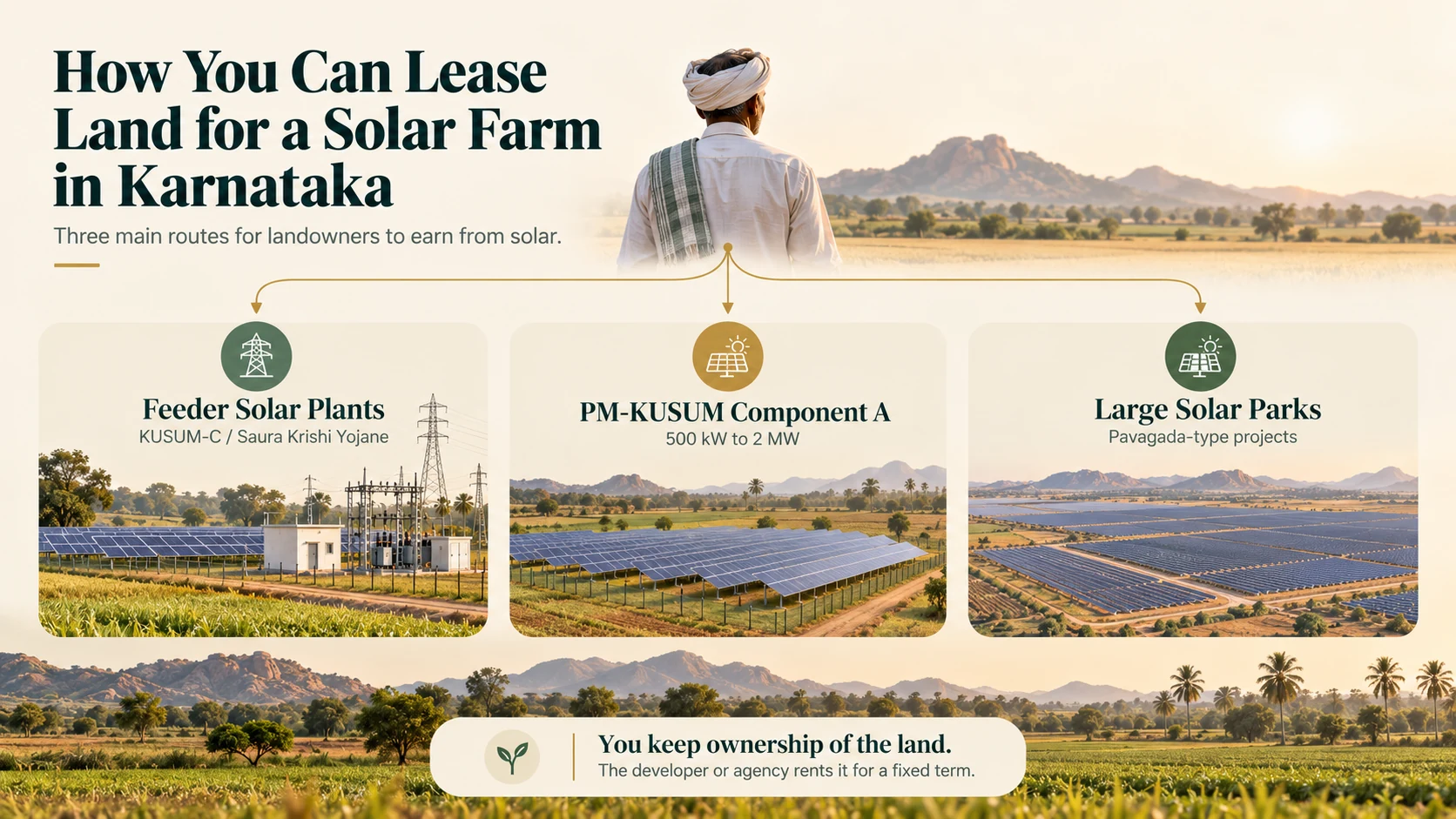
- Feeder solar plants near substations (KUSUM-C and Saura Krishi Yojane). Developers building plants for agricultural feeders need a few acres right next to a substation. This is the biggest source of demand today.
- PM-KUSUM Component A plants. A developer sets up a 500 kW to 2 MW plant on your land and sells the power to the ESCOM, paying you rent. You can also build the plant yourself under this component.
- Large solar parks. State agencies lease large blocks of land from many farmers for utility-scale parks. Pavagada in Tumakuru district is the best-known example: about 13,000 acres leased from roughly 2,300 farmers (Black Ridge Research).
You keep ownership of the land. In every route, the developer or agency only rents it for a fixed number of years.
Solar Land Lease Rates in Karnataka
Solar land lease rates in Karnataka start at about Rs 21,000 to Rs 25,000 per acre per year, usually with a 5% increase every two years. The figures below come from state-backed projects, so private offers should be at least this good.
| Project type | Lease rent | Increase | Source |
|---|---|---|---|
| KUSUM-C feeder plants on private land | Minimum Rs 25,000 per acre | Not stated | The Week (PTI), July 2025 |
| KUSUM-C plants on government land (HESCOM tender) | Rs 25,000 per acre | 5% every two years | SolarQuarter, December 2025 |
| Pavagada Solar Park | Rs 21,000 per acre per year | 5% every two years | Mercom India, 2023 |
Sample income from solar on farm land
A 2 MW plant needs about 8 acres, at roughly 4 acres per MW. If you lease 8 acres at Rs 25,000 per acre per year with a 5% rise every two years:
- Year 1 rent: Rs 2,00,000
- Year 25 rent: about Rs 3,59,000
- Total over 25 years: about Rs 67 lakh
This is an illustration only, based on the rates above. Your actual income depends on the rent, escalation and lease term written into your agreement.
Which Land Qualifies for a Solar Plant on Agricultural Land
The best land for a solar plant is flat, open and close to a power substation. Developers also want a clean title, so the lease cannot be challenged later. Land that gives poor crop returns is usually the best fit.
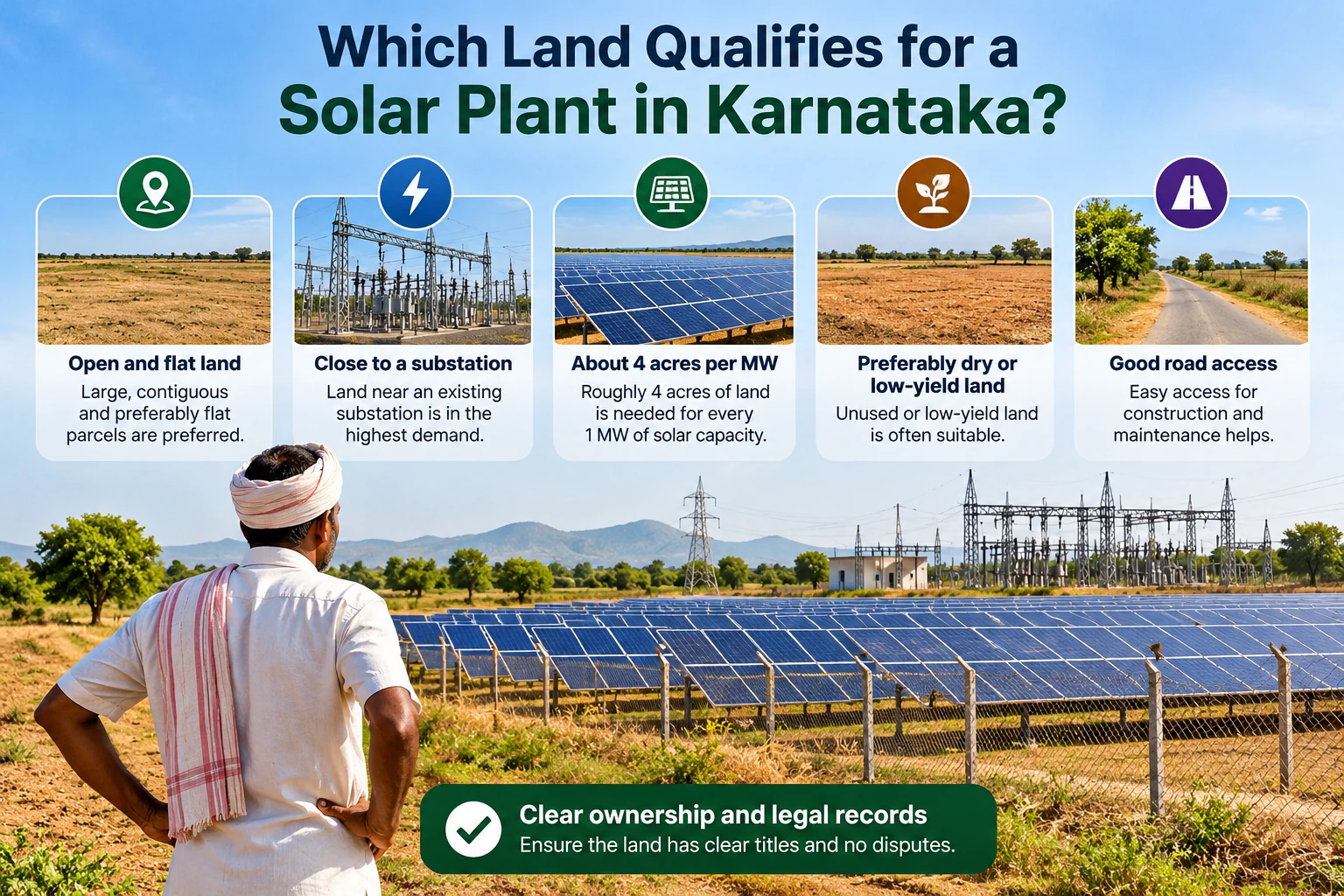
- Distance to a substation. Feeder plants connect at the substation, so land nearby saves the developer on transmission lines. This matters most for KUSUM-C and the new state scheme. Check Saura Krishi Yojane eligibility to see how substations are chosen.
- Size. Plan on about 4 acres per MW (The Week (PTI), July 2025). Smaller plots can be pooled with neighbours.
- Type of land. Dry, barren or low-yield land is ideal. Pavagada was chosen partly because the area is drought-prone and farming was not paying (Mercom India, 2023).
- Clear title. You will need ownership documents and details of any loans or encumbrances on the land. KSPDCL asked for exactly these when seeking land for the Pavagada expansion.
- Access. Road access helps with construction and maintenance.
Land-use rule: The supplied source does not confirm Karnataka's current land-conversion rule for solar on agricultural land. Confirm the applicable rule with the local revenue authority before signing or investing.
KUSUM A Land Lease: Rent It Out or Own the Plant?
Under PM-KUSUM Component A, a 500 kW to 2 MW solar plant can be set up on farm land, and the ESCOM buys the power at a tariff set by the state regulator. You can either lease the land to a developer for fixed rent, or set up the plant yourself and earn from power sales.
| Lease to a developer | Own the plant yourself | |
|---|---|---|
| Your investment | None | Full plant cost, usually with a bank loan |
| Your income | Fixed rent | Power sales to the ESCOM, minus loan and upkeep |
| Your risk | Low | High: performance, repairs, loan repayment |
| Work involved | Very little | Running and maintaining a power plant |
| Best for | Most farmers | Farmer groups, FPOs or cooperatives with capital |
MNRE's rules say the ESCOM buys Component A power at a feed-in tariff fixed by the state regulator, and SBI has separate lending guidelines for these plants (MNRE). Uptake has been slow: only 1,202 MW was installed nationally against a 10,000 MW target as of April 30, 2026 (IBEF).
For most landowners, leasing is the safer choice. To compare Component A with the other parts of the scheme, see the difference between KUSUM A, B and C.
Before You Rent Farm Land for Solar: Lease Agreement Checklist
A solar lease ties up your land for 25 years or more, so the agreement matters more than the first-year rent. Pavagada farmers, for example, signed 28-year leases (The News Minute). MNRE has issued a model lease agreement for PM-KUSUM, which is a useful reference (Odisha ERC order, 2024).
Check each of these before you sign:
- Lease period. How many years, and can it be extended without your consent?
- Rent and increase. The starting rent per acre and how often it rises. Rs 25,000 per acre with 5% every two years is the state benchmark.
- Payment timing. When rent is paid each year, and what happens if it is late.
- Advance or deposit. Whether you get any amount upfront.
- Taxes and charges. Who pays land revenue and any other dues.
- Exit and termination. What happens if the developer stops operating, sells the project or defaults.
- Land restoration. Who removes the panels and restores the land at the end of the lease.
- Registration. The lease should be a registered deed, not an informal agreement.
- Legal review. Have a lawyer read the full agreement before you sign.
Pros and Cons of Leasing Farm Land for Solar
Leasing land for solar gives steady, low-risk income, but it locks the land away for a generation. The Pavagada experience shows both sides clearly.
Pros
- Fixed yearly income that does not depend on rain or crop prices.
- No investment and no work. The developer builds, runs and maintains the plant.
- You keep ownership. The land is rented, not sold.
- Strong demand. Karnataka's push for solarising farm feeders and the state's 66 GW power target keep solar developer opportunities in Karnataka growing, and developers need land.
Cons
- Long lock-in. You cannot farm or sell freely for 25 years or more.
- Rent can lag land value. In Pavagada, the starting rent of Rs 21,000 per acre was set when land was valued at about Rs 35,000 per acre in 2016 (Pulitzer Center).
- Impact on farm labour. Studies of Pavagada found small farmers and labourers who depended on farm work felt left out (The News Minute).
If you would rather keep farming, a solar irrigation pump for your farm may suit you better. For the policy picture, see how solar changes Karnataka's farm power subsidy.
Frequently Asked Questions
What is the land lease rate for a solar plant in Karnataka?
State-backed projects pay about Rs 21,000 to Rs 25,000 per acre per year. Karnataka has set a minimum of Rs 25,000 per acre for private land under KUSUM-C, and HESCOM's tender priced government land at Rs 25,000 per acre with a 5% increase every two years.
How much land is needed for a 1 MW solar plant?
About 4 acres of land is needed for every 1 MW of solar in Karnataka, according to the state Energy Minister. A 2 MW plant under PM-KUSUM Component A would therefore need roughly 8 acres of flat, open land.
How much can I earn by leasing 8 acres for solar?
At Rs 25,000 per acre per year with a 5% rise every two years, 8 acres would earn about Rs 2 lakh in the first year and roughly Rs 67 lakh over 25 years. Actual income depends on the rent and terms in your agreement.
What is KUSUM A land lease?
Under PM-KUSUM Component A, a 500 kW to 2 MW solar plant is set up on farm land and the ESCOM buys the power. Landowners can lease their land to a developer for fixed rent, or set up the plant themselves and earn from power sales.
How long is a solar land lease?
Solar leases usually run for 25 years or more, matching the life of the plant. Farmers at Pavagada Solar Park signed 28-year leases. Always check the lease period, extension terms and land restoration clause before signing.
Do I lose ownership of my land if I lease it for solar?
No. You remain the owner. The developer or agency only rents the land for the lease period and pays you rent. The agreement should state clearly how the land will be returned and restored at the end.
Disclaimer
This article is for general information only. It is based on government announcements, tender notices and news reports available as of October 10, 2026, and is not legal, financial or investment advice.
Lease rates, land rules and agreement terms vary by project, district and developer, and can change without notice. Always have a lawyer review any lease agreement and confirm land-use rules with your local revenue office before signing.
Have land that could suit a solar project?
Panchami Global can help landowners understand site suitability, solar-farm project routes and the questions to ask before entering a long-term lease or project discussion.